Guides / Choosing a Factory
CNC and 5-Axis Wood Machining in Vietnamese Furniture Plants
October 12, 2026
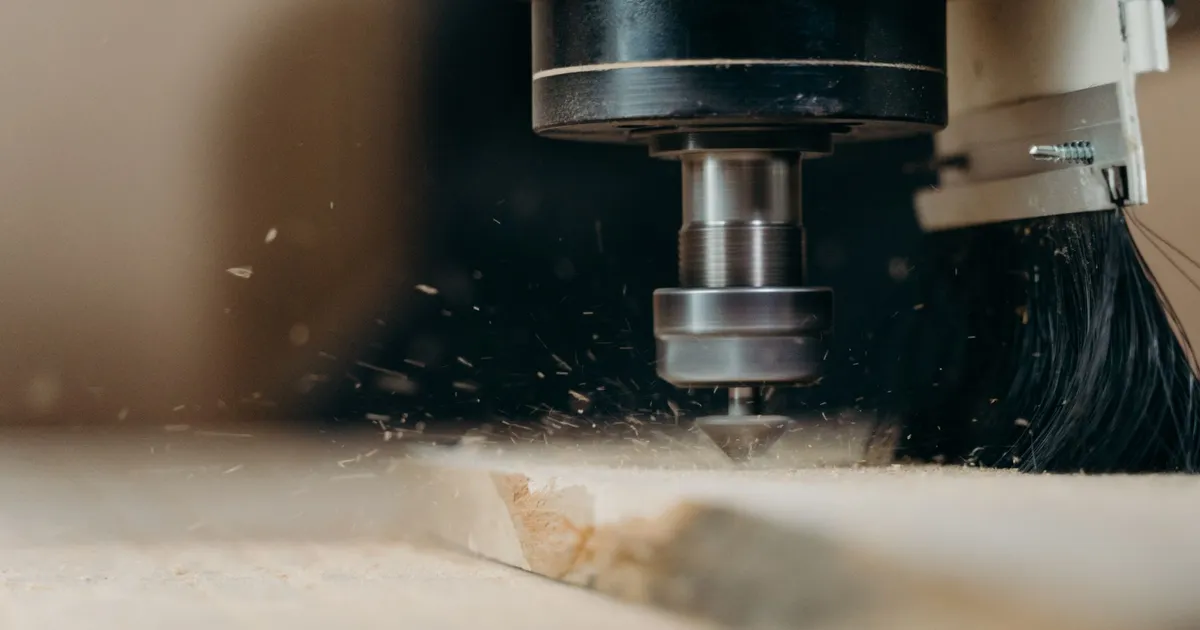
CNC machines sit in most mid size Vietnamese furniture plants now, and they do very different jobs. A nesting router cuts a full panel into dozens of cabinet parts. A point to point machine drills hundreds of holes in minutes. A 5-axis centre carves a curved chair back from a block. Knowing which machine your parts need helps you read quotes and avoid paying for capacity you do not use.
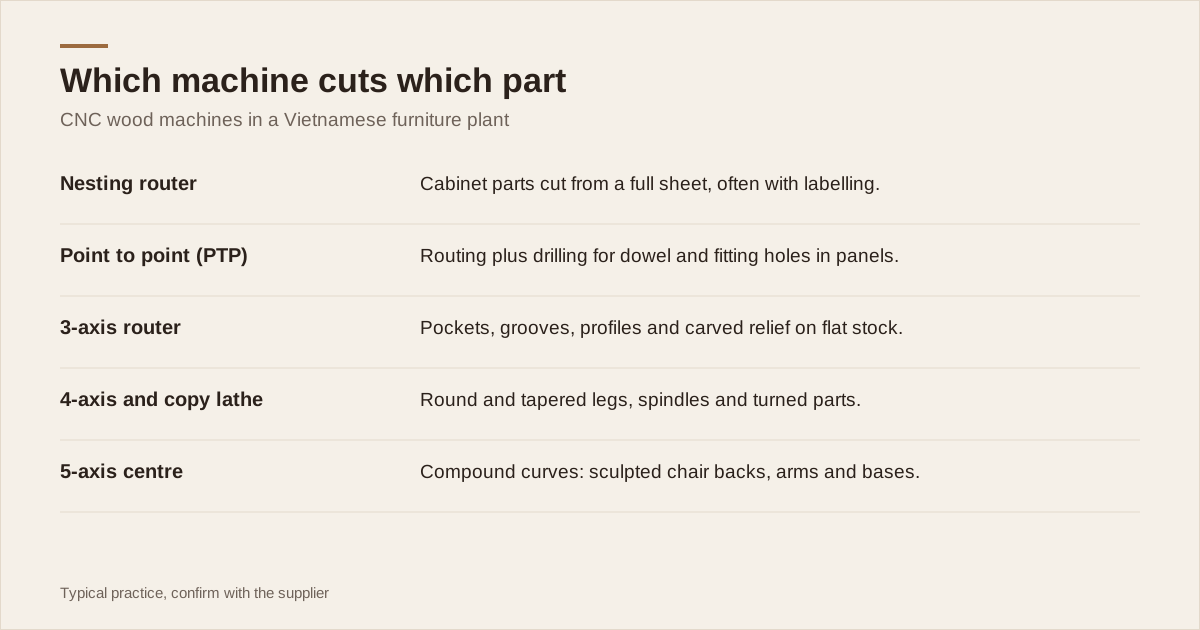
This guide describes the machines, matches them to part types and lists what to check before you send drawings.
The machines you will meet
3-axis CNC router. A spindle moves left, right, forward, back and up and down over a flat table. It cuts profiles, pockets, grooves and carved reliefs in flat stock. Many plants have routers with vacuum tables that hold sheets and boards. This is the workhorse for cabinet parts, decorative panels and flat carved details.
Nesting machine. A router with an automatic loader, a vacuum table and software that arranges parts on a full sheet to waste as little as possible. It is the standard tool for panel furniture, MDF and plywood carcass parts. It often connects to a labelling machine and an edge bander, so a sheet turns into labelled, sorted parts.
Point to point (PTP) machine. A flat bed machine with a spindle for routing and a drilling head for dowel and fitting holes. It is used for cabinet parts, desks and knock down furniture where hole position matters more than outline.
Boring machine. A dedicated machine with many vertical and horizontal drills that makes all holes for a part in one pass. It is fast for repetitive hole patterns in panels.
4-axis and rotary machines. A rotating axis lets the machine turn a part while cutting, which is how chair legs, spindles and table legs are made with round and tapered shapes. A copy lathe does similar work with a template.
5-axis machining centre. The spindle head tilts and rotates, so it reaches a part from many angles. It carves compound curves, undercuts and sculpted shapes in one setup. It is slower per part and more costly per hour than a router, so it is reserved for parts that really need it.
Which parts need which machine
| Part type | Typical machine | Why |
|---|---|---|
| Cabinet sides, shelves, doors in panel material | Nesting router, PTP | Many parts from a sheet, accurate holes |
| Solid wood table tops with simple edge | Panel saw, router for profile | Large flat parts |
| Chair legs, table legs, spindles | Copy lathe, 4-axis, CNC lathe | Round and tapered shapes |
| Chair seat with a shaped dish | 3-axis router with shaped cutter, or 5-axis | Contoured surface |
| Sculpted chair back or arm | 5-axis | Compound curves |
| Carved decorative panel | 3-axis router | Relief on a flat face |
| Tenons, mortises, dowel holes | Dedicated tenoner, boring machine, PTP | Repeatable joints |
Most pieces use several machines in sequence. A dining chair, for example, may use a saw for blanks, a copy lathe for legs, a 5-axis or router for the back, a boring machine for joints and a sander before assembly.
What CNC changes for a buyer
CNC reduces human variation. Once a program is proven, the thousandth part matches the first. This is a real gain for knock down furniture, where holes from two different parts must line up, and for sets where several pieces must share a profile.
CNC does not remove the need for sanding, fitting and finishing. A machined surface leaves tool marks, especially in curved areas, and a good plant allows time and labour to sand them before finishing. It also does not remove wood movement. A part machined to a tight dimension at one moisture level changes size when moisture changes, as covered in the moisture content guide.
CNC changes setup cost as well. A new part needs programming, test cuts and often a fixture, so one off pieces cost more per unit than a repeated run. That is one reason small samples carry sample prices, and why MOQ economics favour a design that uses the same part across several models.
Tooling and material limits
Cutting tools wear, and the type of wood and glue changes the wear rate. Plantation hardwood is moderate. Panels with abrasive glues and melamine faces wear tools faster. Ask how often the plant changes tools and whether it uses diamond coated cutters on panel material. A dull cutter chips veneer and melamine edges, so a poor tooling routine shows up as edge defects.
Dust extraction matters as well. A router without good extraction leaves dust on the part and in the machine, which affects glue joints and finish. Plants that care about quality keep clean extraction on every machine.
Cutter diameter limits the smallest inside radius. A 6 mm cutter cannot cut a 2 mm inside corner, so a drawing with sharp inside corners on a routed part needs either a larger radius or a corner clean up by hand. State your minimum inside radius or accept the factory’s.
Solid wood and panel behave differently
Solid wood and panel material need different cutting settings, and a plant that runs both well keeps separate programs for each. In solid wood, grain direction matters. Cutting against the grain tears fibres out of the surface, and cutting end grain on a curve burns easily. A good programmer chooses a climb or conventional cut and a feed speed to suit the species and the direction of cut, and leaves a small finishing allowance for sanding.
In panel material, the risk is chipping on the face and edge, particularly on veneer and melamine. Plants reduce it with compression cutters, with a scoring pass, or with a low feed rate on the final pass. MDF dust is fine and abrasive, so extraction and tool wear are higher than in solid wood. Plywood is somewhere between the two, and voids in the core can cause a cutter to grab.
Buyers can help by naming the material and the thickness on every drawing, and by telling the factory which faces are visible. A programmer who knows the visible face can put the climb cut and the best edge quality where it shows.
Cost and lead time
CNC time is charged by the machine hour in effect, even when the quote is a unit price. A router cutting a simple flat part may take under a minute. A 5-axis part with a deep carve can take 20 minutes or more. This is why a design with five sculpted parts costs much more than a design with five flat parts, even when the wood volume is the same.
Three decisions keep CNC cost under control. Reuse the same part across models where the design allows. Keep inside radii generous so a larger, faster cutter can be used. And avoid deep pockets and thin walls in solid wood, because they need slow passes and break in handling. A plant that offers a design review before pricing is trying to protect both sides from surprises.
Lead time depends on programming and on machine slots. A new part needs programming, a test cut and approval before a batch, which usually fits inside the sample stage. Repeat orders skip those steps. The lead time and production schedule guide shows where CNC sits in a normal calendar.
Files and programming
The plant programmer builds machine code from your drawing. Better inputs give faster, cleaner results.
- Send a dimensioned PDF drawing with tolerances and the critical datum edges marked.
- Send DXF or DWG files for flat profiles and hole patterns.
- For 3D parts, send STEP or IGES files, plus a reference photo or a physical sample if one exists.
- State the material, thickness and grain direction, since grain direction decides tear out and strength.
If you only have a photo or a sketch, say so. Many plants offer drawing help at a cost, and the OEM and ODM guide explains how design responsibility splits between buyer and factory.
Quality checks for machined parts
Four checks cover most CNC risk.
- First article. Measure the first part from a new program against the drawing, and record the result.
- Gauge or template. Use a go and no go gauge or a template for critical profiles and hole positions.
- Sampling during the run. Measure parts from the start, middle and end of a batch, because tools wear during a run.
- Fit test. Assemble a few full sets from random parts, not hand picked ones, to prove the parts fit.
The quality inspection guide shows how to write these checks into an inspection plan.
Questions to ask a plant
- Which machines will cut my parts, and how many of each do you have?
- Do you program in house or outsource?
- What tolerance can you hold on the critical dimensions of my part?
- How often do you change cutters, and how do you check wear?
- Can I see a video of the machine cutting a similar part?
- What do you need from me to start programming?
Treat a plant with a clear answer to each as a plant that runs its machines on purpose. Be careful with plants that mention a 5-axis machine in every conversation but cannot say which parts it cuts.
When you are ready to compare machining capability, the RFQ page matches your drawing with up to three Vietnamese wood factories and replies within 24 business hours.
Frequently asked questions
Do I need 5-axis machining for furniture parts?
Only for parts with compound curves, such as sculpted chair backs, carved arms or organic table bases. Flat parts, panels, tenons and drilled holes run on 3-axis routers, nesting machines and boring machines at lower cost. A 5-axis centre is the right tool for a small set of shaped parts, not for the whole product.
What file format should I send for CNC parts?
Send a 2D drawing in PDF with dimensions and tolerances, plus a DXF or DWG file for flat profiles. For 3D shaped parts, add a STEP file. The factory programmer builds the machine program from these, so a missing file means a delay while they redraw.
How accurate is CNC wood machining?
Machine positioning is much tighter than wood itself can hold. Wood moves with humidity by tenths of a millimetre across small parts and more across wide ones. For furniture, tolerances of around plus or minus 0.2 to 0.5 mm on machined features are typical, and wider on overall panel size. Confirm the figure the plant can hold on your part.
Need a quote for this product?
Send the specification. We match you with up to 3 Vietnamese wood factories and reply within 24 business hours.
Get matched with a Vietnam wood factory