Guides / Sourcing Guide
COM and COL in Furniture: What Customer's Own Material Means for Your Order
November 21, 2026
COM stands for customer’s own material and COL for customer’s own leather: the buyer supplies the fabric or leather, and the factory cuts it and upholsters it onto the frame. The factory approves the material first and states the yardage, and in the rules we read, production is scheduled only after the material arrives. This post explains the terms in a sofa or chair order, based on the published rules of three furniture makers, and it sits beside our guide to upholstered sofas and chairs from Vietnam.
What COM and COL mean
COM is fabric that you supply for the manufacturer to apply to the product. COL is the same idea with genuine leather. One reseller’s guide adds that both need the manufacturer’s pre-approval for yardage and sewing compatibility. The alternative is a fabric from the maker’s own range, which Thonet calls its stock fabrics: the factory buys and holds that material.
Both makers we read treat COM as an exception that needs approval, not a default. Indiana Furniture says it reserves the right to inspect, approve or reject any COM or COL upholstery. Thonet says it may refuse COM, or process it without responsibility, where the fabric is unsuitable because of pattern, weight, width or stretch.
How yardage is counted
Yardage is the quantity of fabric needed for one product, and the factory gives you the number. Do not estimate it yourself. Indiana Furniture bases its listed COM yardage on non-directional upholstery 54 inches (137 cm) wide for a quantity of one chair, and it does not accept upholstery narrower than 54 inches. Thonet also bases its estimates on 54 inches of usable width and says striped, patterned or distinctly textured fabrics need extra yardage that the customer must supply.
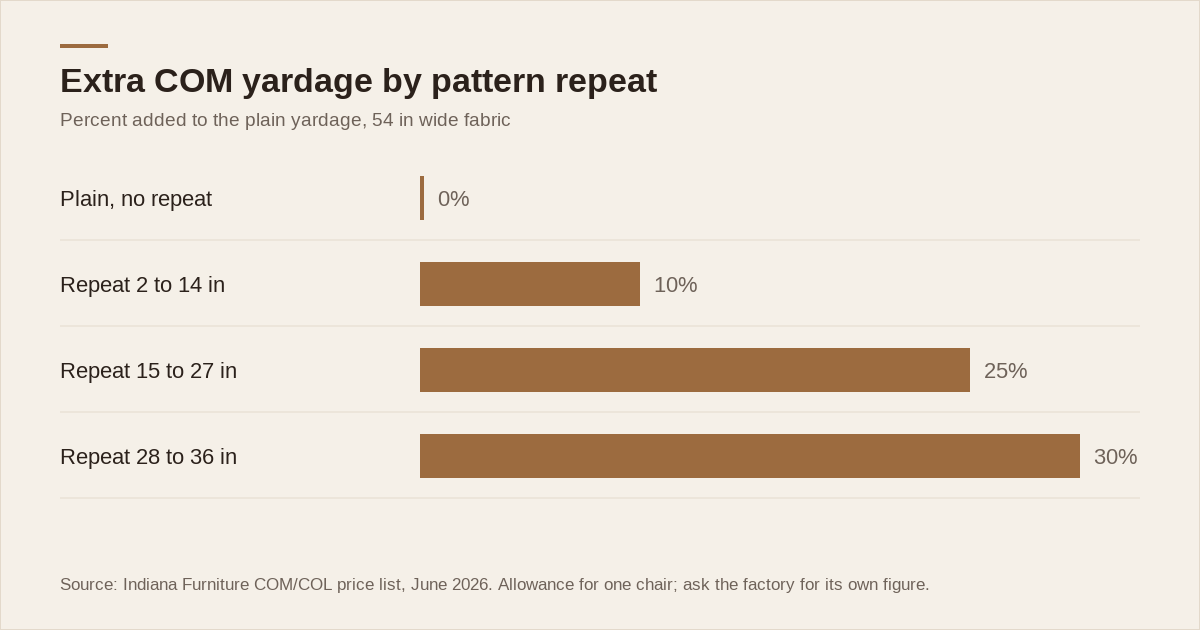
A pattern repeat is the distance before a printed or woven pattern starts again. A fabric with a repeat has to be matched across panels, which wastes material. Indiana Furniture gives the allowance in the table below.
| Pattern repeat | Added to plain yardage | Basis |
|---|---|---|
| None (plain) | 0% | 54 in wide fabric |
| 2 to 14 in | 10% | 54 in wide fabric |
| 15 to 27 in | 25% | 54 in wide fabric |
| 28 to 36 in | 30% | 54 in wide fabric |
Source: Indiana Furniture COM/COL price list, June 2026, opened 25 October 2026. Allowance for a single chair; for larger quantities the maker says to ask its customer service to optimise the yardage. Confirm the figure with your own factory.
For leather, Indiana Furniture multiplies the COM yardage by 18 to get square feet, counting 1 yard of upholstery as 18 sq ft of usable leather. Its figures assume an average hide of 45 to 50 sq ft and count usable footage only, so it may ask for more leather after the hides arrive. Thonet says it is hard to estimate leather until each hide has been checked for natural marks, and that the customer must supply enough good hides.
What the factory needs from you
Both manufacturers ask for the same paperwork before they accept an order.
- A sample. Indiana Furniture asks for a 6 inch sample stapled to the order, with the exposed side marked. Thonet asks for a 12 inch by 12 inch sample.
- The material description. Supplier name, pattern and colour. Thonet does not enter an order until these accompany the purchase order.
- Application instructions. For stripes, plaids and patterns, say which direction the pattern runs. Thonet applies the fabric as it sees fit if no instructions are given and will not be responsible afterwards. Indiana Furniture applies all stripes vertically unless told otherwise.
- Fire test information. Indiana Furniture requires written confirmation from the fabric supplier that the cover meets California TB 117-2013, and a statement of whether it contains added flame retardant. Thonet takes no responsibility for the flame retardancy of COM and says the customer must make sure it meets the codes where the furniture is installed.
For a destination market with its own upholstery fire rule, ask the factory what test paper it needs on your fabric before you buy the roll.
Need a quote for this product? Get matched with a Vietnam wood factory
Who ships the fabric and when production starts
You do, and the schedule waits for it. Thonet states that scheduling does not begin until COM is received, and that an order with COM or COL gets no shipping date until the material is received and recorded. Roweam, another maker, says production starts only after it receives and inspects the fabric, and gives a typical lead time of 16 to 18 weeks.
Thonet asks you to mark all cover materials with the purchaser’s name, the purchase order number, its order acknowledgement number, the style number, the quantity and the project name. It also says COM that arrives with no order placed can be disposed of, and surplus COM goes back only if the purchase order says so. A factory abroad will have its own version of these rules. Ask for it in writing, and add the fabric arrival date to the production schedule described in the lead time guide.
Where COM goes wrong
| Problem | Cause | What to settle first |
|---|---|---|
| Fabric runs short | Yardage guessed, repeat ignored, leather hides smaller than assumed | The factory’s yardage in writing, and the allowance for repeat |
| Order stalls | Fabric arrives late or unmarked | Arrival date, carrier tracking, labels on each roll |
| Fabric refused | Width under 54 in, stretch, weight or pattern unsuitable | Sample approval before you buy the roll |
| Cover fails a fire test | Fabric supplier gave no test confirmation | Supplier’s written test statement before cutting |
| Pattern looks off on the finished piece | Direction or match not stated | Application instructions on the purchase order |
Source: Indiana Furniture COM/COL price list (June 2026), Thonet fabric and C.O.M. information (January 2019) and Roweam COM page, all opened 25 October 2026. The Thonet document is dated 2019, so treat it as an example of how a maker writes these rules, not as current terms.
Using COM on a hotel or contract order
A hotel or contract package may use COM across many styles. The hospitality furniture guide covers how that package is coordinated. For the fabric itself, the points above hold across the package: one approved sample, one yardage figure from the factory and one arrival date for every style.
What to write on the RFQ
Name the product style and quantity, say whether the material is COM or COL, give the supplier, pattern, colour and width, and state the repeat if there is one. Ask the factory for its yardage per piece and the date by which the material must reach the plant. If you want the order matched with factories that work with customer material, send it through the quote form. For the rest of the build, from frame to foam, read the guide to upholstered sofas and chairs from Vietnam.
Sources
- Indiana Furniture, COM/COL and graded-in programs, price list pages (June 2026), PDF
- Thonet (CF Group), fabric and C.O.M. information, fabric cutting practices (v01/19), PDF
- Roweam, Customer Owned Material page
- Office Furniture 2 Go, difference between COM and COL in conference chair upholstery
Frequently asked questions
What does COM mean in furniture?
COM stands for customer's own material. You buy the fabric from a mill or supplier and ship it to the factory, which cuts and upholsters it onto your frame. COL is the same arrangement with leather. The factory still needs to approve the material and tell you the yardage before you buy it.
Who is responsible if the COM fabric fails or runs short?
The buyer, in the rules we read. Thonet states it takes no responsibility for the wearability or flame retardancy of COM, and Indiana Furniture may ask for more leather after it inspects the hides. Put the yardage, the sample and the approval in writing so a shortfall has an owner before production starts.
Does COM change the lead time?
It can. Thonet assigns no shipping date until the material is received, and Roweam starts production only after it receives and inspects the fabric. Roweam quotes a typical lead time of 16 to 18 weeks. Work out when the fabric must land at the factory, then count the production time from that date.
Need a quote for this product?
Send the specification. We match you with up to 3 Vietnamese wood factories and reply within 24 business hours.
Get matched with a Vietnam wood factory