Guides / Sourcing Guide
How Many Pieces of Furniture Fit in a 40HQ Container: CBM, Cartons and Weight
November 21, 2026
The number of furniture pieces in a 40HQ container comes down to the packed carton’s volume in cubic metres, written CBM, and how the cartons stack inside a box that DSV lists at 76.4 m3 nominal. A loaded container never reaches the nominal volume, so count by grid, check weight and ask the factory for a loading plan. This post is part of our guide to importing furniture from Vietnam, and it shows the arithmetic with worked examples that you can repeat for your own carton.
What you need first
- The outer dimensions of the packed carton in metres: length, width and height.
- The gross weight of one packed carton in kilograms.
- Whether cartons go floor-loaded or on pallets.
- The container type: 20 ft, 40 ft or 40 ft high cube.
- The destination’s road weight limits, which your forwarder knows. We found no single public figure that fits every route.
Step 1: measure the carton in metres
CBM is length times width times height, in metres. A carton of 1.20 by 0.45 by 0.80 m is 0.432 m3. The failure point is using the product’s size and not the packed size: the carton, the corner protectors and any strapping add to every dimension. Our packaging guide covers the carton specification that sets those numbers.
Step 2: read the container’s limits
DSV publishes representative figures for the usual boxes and notes that actual dimensions and capacities vary by manufacturer, container age and owner.
| Container | Internal L x W x H | Capacity | Maximum payload | Tare |
|---|---|---|---|---|
| 20 ft dry | 5.90 x 2.35 x 2.39 m | 33.2 m3 | 25,000 kg | 2,300 kg |
| 40 ft dry | 12.03 x 2.35 x 2.39 m | 67.7 m3 | 27,600 kg | 3,750 kg |
| 40 ft high cube (40HQ) | 12.03 x 2.35 x 2.70 m | 76.4 m3 | 28,560 kg | 3,940 kg |
DSV dry container and high cube dry container pages, checked October 2026.
The 40HQ is 0.31 m taller inside than the standard 40 ft dry box, which matters when cartons stack in layers. The high cube’s door opening is 2.58 m high.
Step 3: count by grid
The simplest count divides each container dimension by the carton dimension, rounds down and multiplies. The examples below use cartons chosen for the arithmetic, not real products, and they assume a 0.10 m allowance under the roof, cartons standing as labelled with only the floor orientation turned, no pallets and no gap at the doors. A real load leaves more space than this, and we found no public benchmark for how much.
For a side-table carton of 0.50 by 0.50 by 0.60 m in a 40HQ, with a stacking height of 2.60 m: 12.03 divided by 0.50 gives 24 along the length, 2.35 divided by 0.50 gives 4 across, so 96 per layer. 2.60 divided by 0.60 gives 4 layers. That is 384 cartons, or 57.6 m3, 75 per cent of the nominal volume.
| Example carton (m) | CBM each | In a 40HQ | Share of 76.4 m3 | In a 40 ft dry | Share of 67.7 m3 |
|---|---|---|---|---|---|
| Side table, 0.50 x 0.50 x 0.60 | 0.150 | 384 | 75% | 288 | 64% |
| Chair, knock-down, 0.55 x 0.50 x 0.90 | 0.248 | 192 | 62% | 192 | 70% |
| Cabinet, 1.20 x 0.45 x 0.80 | 0.432 | 150 | 85% | 100 | 64% |
| Sofa frame, 2.10 x 0.90 x 0.70 | 1.323 | 39 | 68% | 39 | 76% |
Illustrative grid counts with a 0.10 m allowance under the roof (stacking height 2.60 m in the 40HQ and 2.29 m in the 40 ft dry). Not a quote and not a loading plan.
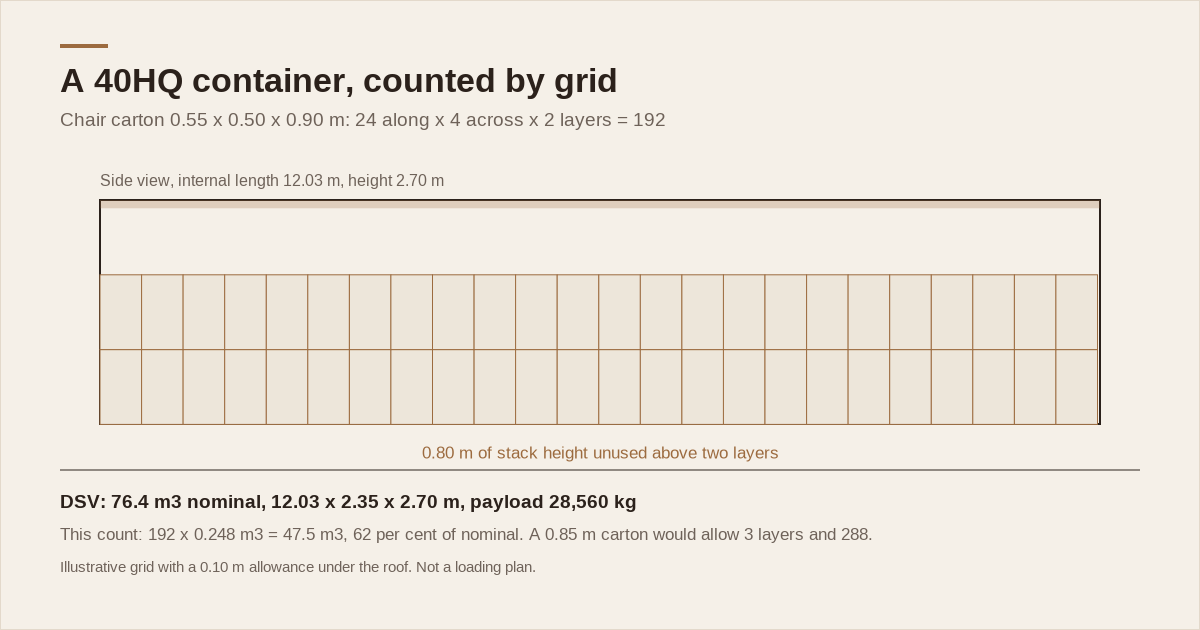
The chair row shows where the grid loses space. A 0.90 m carton fits only two layers in a 2.60 m stack, leaving 0.80 m of height unused. If the same carton were 0.85 m high, three layers would fit and the count would rise from 192 to 288. Whether a shorter carton still protects the chair is a packaging question, but it is the kind of change a loading plan reveals.
Step 4: check the weight
A full 40HQ reaches its payload when the cartons average more than 28,560 kg divided by 76.4 m3, about 374 kg per m3 of nominal volume. For the cabinet example, 150 cartons divided into 28,560 kg gives 190 kg per carton as the point at which weight, and not volume, ends the load. Which limit comes first depends on the product, and we found no public benchmark for furniture carton weights. A heavy product such as a stone-topped table is the case to check. Ask the factory for gross weight per carton and multiply by the carton count.
What changes the count
A grid count describes one carton type in a box. Real orders change it in four ways.
- Mixed loads. Models with different carton heights can share layers, so a plan for a mixed container is a puzzle that only the factory’s loading plan solves. Our grid examples do not apply to it.
- Pallets. A pallet takes height from the stack and keeps cartons off the floor. Subtract its height from the stacking height before you divide.
- Carton design. A few centimetres of carton height can decide how many layers fit, as the chair example shows. Ask for the carton dimensions at the quotation stage, when a change is still cheap.
- Assembled or knock-down. Compare the CBM of both versions of the product. Which one costs less to ship per piece is arithmetic, not opinion.
Need a quote for this product? Get matched with a Vietnam wood factory
From count to freight per piece
Freight is quoted per container, so the cost per piece is the container rate divided by the number of pieces in it. We found no public rate we could open, so take the rate from your forwarder. The effect of the count is still clear without one. If the chair carton is shortened so that 288 fit in place of 192, the freight per chair falls by one third, because 192 divided by 288 is two thirds. The same calculation shows why an unrealistic factory count is expensive: a count of 288 that turns out to be 192 raises your freight per piece by half.
Step 5: ask for the loading plan
A loading plan from the factory turns your arithmetic into a checkable document. It should show the carton dimensions, cartons per layer, layers, the total count, the total gross weight and whether the load is floor-loaded or on pallets. Compare it with your grid count. A plan that beats the grid by a wide margin deserves a question about how cartons are being stacked, and a plan far below it deserves a question about void space.
If the cartons travel on wooden pallets or with wooden dunnage, ISPM 15 applies to that wood packaging, and the standard excludes packaging made from wood processed to be pest-free, such as plywood, according to the International Plant Protection Convention. Ask what mark the pallets carry. Also ask who supervises the loading, because crushed cartons and a wet container are loading problems that an inspection report will not catch; see our guide to furniture quality inspection and container loading.
A line to copy into the order
Carton: 1,200 x 450 x 800 mm outer dimensions, gross weight stated per carton. Seller supplies a loading plan for one 40HQ showing cartons per layer, layers, total cartons and total gross weight, at least 10 days before the loading date.
The 10 days is an example, not a rule. Adjust it to your schedule.
What to put in the specification
State the carton outer dimensions and gross weight, the container type you intend to use, floor-loaded or palletised, the loading plan requirement and the named FOB port. If the product can ship knock-down, ask for the carton dimensions of both the assembled and the flat version and compare cubic metres per unit, as our guide to knock-down design describes. Then return to the guide to importing furniture from Vietnam and send your specification through the RFQ page. We reply within 24 business hours and match you with up to 3 Vietnamese wood factories that quote you directly.
Sources
- DSV: dry container dimensions
- DSV: high cube dry container dimensions
- IPPC: Regulation of wood packaging material in international trade (ISPM 15)
Frequently asked questions
How is CBM calculated for a furniture carton?
Multiply the outer length, width and height of the packed carton in metres. A carton of 1.20 by 0.45 by 0.80 metres is 0.432 cubic metres. Use the packed outer dimensions, not the product size, and add any strapping or corner protection that sits outside the carton.
How many cubic metres is a 40HQ container?
DSV lists the 40-foot high cube at 76.4 cubic metres nominal, with internal dimensions of 12.03 by 2.35 by 2.70 metres and a maximum payload of 28,560 kg. These are representative figures, and actual dimensions vary by manufacturer, age and owner. A loaded container is not full to the nominal volume.
Will furniture reach the weight limit before the volume limit?
It depends on the product, and a heavy one can. For a 40HQ, dividing 28,560 kg by 76.4 cubic metres gives about 374 kg per cubic metre. Cartons that average above that when the container is full hit the payload first. Ask the factory for gross weight per carton.
Can I trust the factory's container count?
Ask how it was made. A count from a loading plan with carton dimensions, cartons per layer and gross weights is checkable. A count from a rule of thumb is not. We found no public benchmark for furniture loading efficiency, so compare the factory's plan with a grid count of your own.
Need a quote for this product?
Send the specification. We match you with up to 3 Vietnamese wood factories and reply within 24 business hours.
Get matched with a Vietnam wood factory