Guides / Sourcing Guide
Upholstered Sofas and Chairs From Vietnamese Factories
November 21, 2026
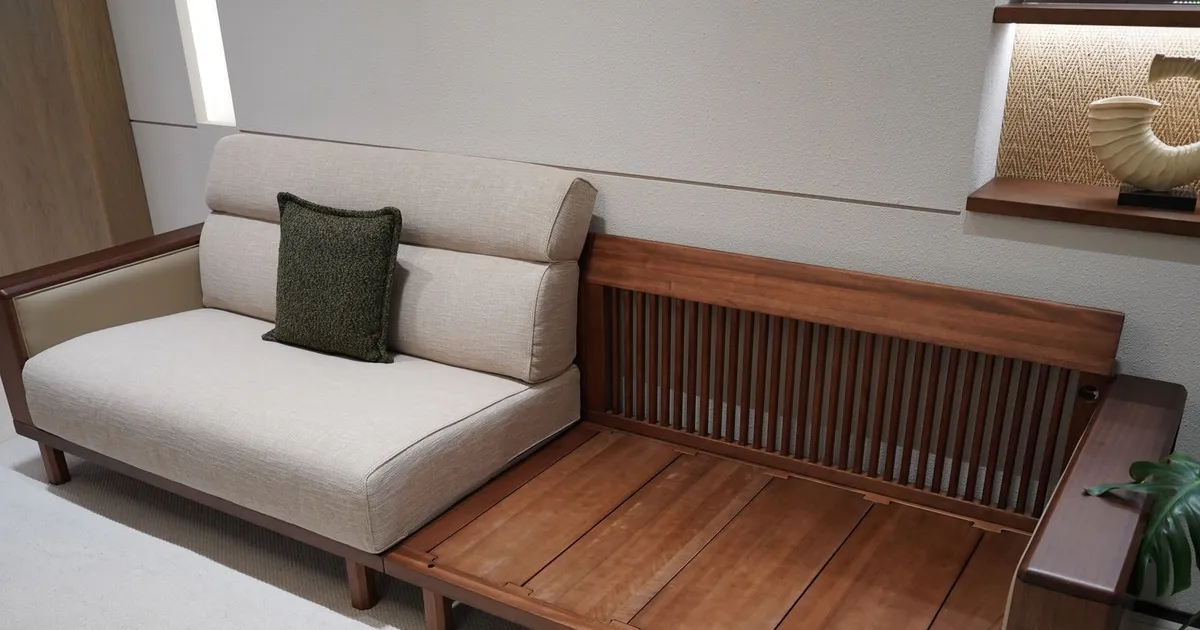
A sofa is more complex than it looks. Under the fabric sit a frame, joints, a suspension, several layers of foam and a cover cut and sewn to a pattern. Vietnamese plants have built upholstery capacity next to their wood furniture lines, and many make sofas, armchairs, dining chairs and benches for export. The factory that makes a good wood dining table does not automatically make a good sofa, so treat upholstery as a separate skill.
This guide covers the parts of a sofa, the specification points that decide quality and the tests that matter in the main markets.
The frame
The frame carries every load, and a weak frame fails no matter how good the fabric is.
Wood frame. Kiln dried hardwood, often plantation species, or a mix of solid wood and plywood. Joints are glued and fixed with dowels, screws or staples, and corner blocks reinforce stress points. Hardwood is preferred for load bearing rails, and softer wood is used for non critical bars. Ask for the species and the moisture content of the frame wood. Wet wood shrinks inside the upholstery and creates squeaks and loose joints, as the moisture content guide explains.
Plywood and panel parts. Used for arms, backs and platforms. Thickness and grade matter, and cheap panel can split at screw lines. The plywood and MDF guide explains how to specify it.
Metal frame parts. Brackets, recliner mechanisms and sofa bed frames are steel. Ask for the load rating and the finish, since rust spots on a hidden bracket cause stains.
For visible wood legs and trims, the dining chair guide covers leg joints and finishes.
Suspension
The suspension holds the seat up and decides how it feels.
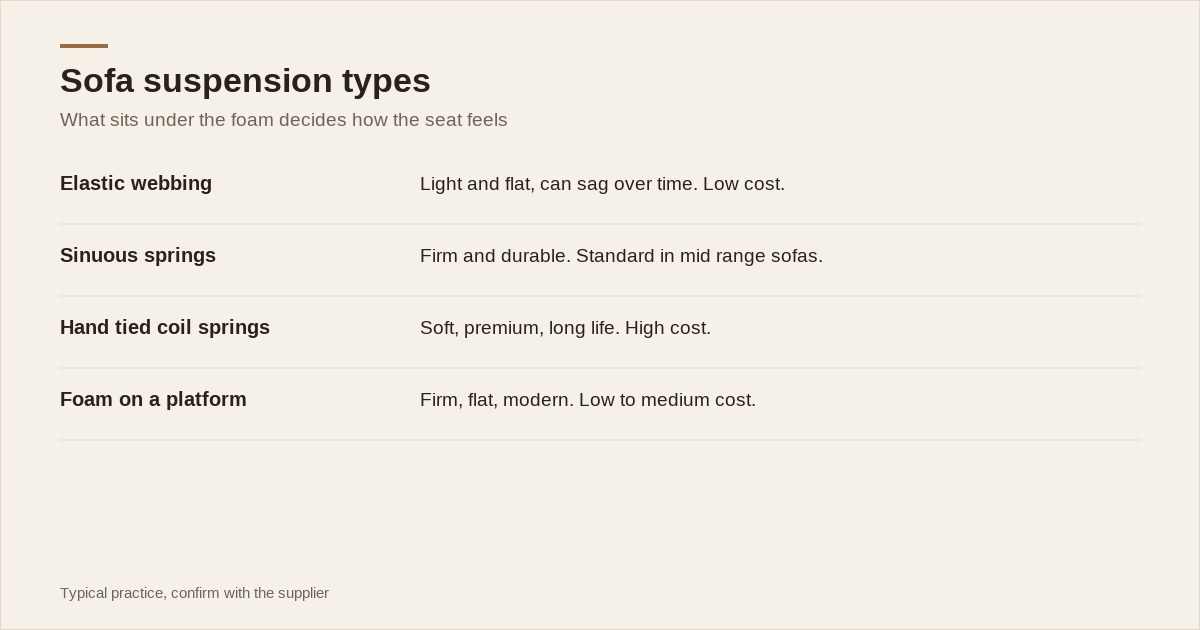
| Type | How it works | Feel | Cost |
|---|---|---|---|
| Elastic webbing | Strips of rubber or fabric webbing stretched across the frame | Light, flat, can sag over time | Low |
| Sinuous springs (zig zag) | S shaped steel wire clipped to the frame | Firm, durable, common | Medium |
| Coil springs, hand tied | Coil springs tied to each other and the frame | Soft, premium, long life | High |
| Foam only on a platform | Plywood or webbing base with thick foam | Firm, flat, modern | Low to medium |
Sinuous springs are the standard in mid range sofas. Check the wire gauge, the number of springs per seat and the way they are fixed. Springs clipped without reinforcing at the ends loosen and rattle.
Foam and cushioning
Foam is the layer your customer sits on. Three numbers describe it.
Density. Mass per volume, in kilograms per cubic metre. Higher density foam usually lasts longer and keeps its shape.
Firmness. Often described by the force needed to compress it by a set amount. Firmness is a feel choice and varies by market.
Resilience. How quickly the foam recovers after compression.
Seats use higher density foam than backs, and cheap sofas use low density foam everywhere to save cost. Ask for a data sheet that lists density and firmness for each foam layer, and for the foam supplier name. Foam can also carry chemical limits in some markets, so ask about the formulation as well.
Wrap layers matter. A layer of polyester fibre over foam softens the look and prevents the foam edge from showing through the cover. Feather and down fills are used in premium cushions, and they have their own supply, labelling and cleaning issues.
Covers: fabric and leather
Covers drive the look and the wear.
Woven and knitted fabrics. Cotton, linen, polyester, velvet and blends. Abrasion is measured by rub tests, and the number of cycles to wear indicates durability. A fabric intended for light domestic use will wear quickly in a family room or a café.
Leather. Top grain and full grain leather last and age well. Split leather and bonded or reconstituted leather cost less and wear differently. Ask which type is used and whether the leather is real or coated synthetic.
Performance fabrics. Treated for stain, water or pet claw resistance. Ask what the treatment is and whether it affects colour or feel.
Check colour fastness to light and to rubbing. A dark fabric that transfers dye onto light clothes is a problem for returns. Check pilling, seam strength and pattern matching as well. A stripe that does not line up across cushions looks cheap even when the fabric is expensive.
Safety and fire rules
Upholstered furniture faces flammability rules in several markets. The United States has a federal rule for upholstered furniture sold for home use, and California and other jurisdictions have added labelling and testing rules. The United Kingdom has strict regulations that require fabric, filling and sometimes an interliner to pass ignition tests and carry permanent labels. The European Union has no single rule for domestic upholstery, so national rules and buyer requirements apply.
Do not assume that a sofa that passes in one market passes in another. Name the target market in your order, ask the plant which tests the product has passed and request the reports on the combined construction, including fabric, foam and interliner. A change of fabric or foam can invalidate a report. The furniture test standards guide explains how to read reports, and chemical limits for foam and coatings follow the rules in the CARB and TSCA guide where composite wood is used.
Where Vietnam fits
Vietnamese plants buy fabric locally and from imports, and many source leather from outside the country. Foam is produced locally and imported. A plant with an in house sewing line, a foam cutting line and a wood frame workshop can control the whole product. A plant that outsources sewing or frames has more handoffs, so ask which steps are in house.
Upholstery also relies on skilled labour for cutting, sewing and stapling. Quality varies between workers, and a plant that trains and checks its sewers produces more consistent covers. Ask for photos of the sewing line and the QC points.
Patterns, samples and fit
A sofa cover is cut from a pattern, and the pattern decides how well the cover fits the frame and the cushions. A small error of a few millimetres shows as wrinkles at the arms or gaps at the seams. A good plant makes a pattern from your drawing, builds a prototype and adjusts the pattern after fitting. Allow at least one sample round for any new upholstered design, and expect two for a complex shape, as described in the sample development guide.
Fabric choice affects the pattern. A stretch knit fits differently from a stiff woven fabric, and a patterned fabric needs extra yardage for matching. When you change the fabric after sample approval, ask the plant whether the pattern needs to change, and expect a new sample. Fabric lots also vary in shade, so ask the plant to buy enough fabric for the whole order in one lot, and to keep a cutting from each roll.
Need a quote for this product? Get matched with a Vietnam wood factory
What drives the price
Four items drive most of the price of an upholstered piece.
- Cover. Fabric and leather prices range widely, and leather costs several times a common woven fabric per sofa.
- Frame and suspension. Hardwood and hand tied springs cost more than softwood and webbing.
- Foam and fill. High density foam and down blends cost more than basic foam.
- Labour. Tufting, piping, pattern matching and hand finishing add hours.
Ask the plant for a cost split on the quote. A low price with weak frame, low density foam and thin fabric looks identical to a good price with strong parts when you see only the photo. The MOQ and order economics guide shows how to compare quotes line by line.
Common complaints and their causes
| Complaint | Likely cause |
|---|---|
| Seat sags within months | Low density foam or webbing that stretched |
| Frame creaks | Wet wood, loose joints, missing corner blocks |
| Cover wrinkles | Pattern error or cover too loose for the cushion |
| Fabric pills or wears at arms | Low rub test rating for the use |
| Colour transfer | Poor colour fastness in dark fabric |
| Odour on arrival | Fresh foam or adhesive in a sealed carton |
| Cushion lumps | Fill shifts without baffles or wrap |
Odour deserves special care. Foam and adhesives can smell when sealed in a carton for weeks. Ask the plant to air cushions before packing, and to use low emission adhesives where your market asks for them.
Frame to cover: the checks that matter
| Check | What to look for |
|---|---|
| Frame joints | Glued and fixed, corner blocks present, no rocking |
| Wood moisture | Recorded value within the agreed range |
| Suspension | Springs fixed and spaced as specified |
| Foam | Density and firmness match the data sheet |
| Cover seams | Straight, strong, matching patterns |
| Cushion fit | Fills the cover without wrinkles or voids |
| Stability | Does not tip when loaded on one arm |
| Smell | No strong chemical odour |
Ask the plant to cut open one sample sofa for you. The inside tells you more than any photo.
Minimums and lead time
Upholstery minimums differ from wood furniture minimums. Fabric is bought by the roll, and a roll covers a set number of sofas, so a plant often asks for an order that uses whole rolls, or it charges extra for small lots. Ask for the minimum per fabric colour as well as the minimum per model. Plants may accept a lower minimum on a stock fabric than on a custom colour.
Lead time follows fabric arrival. A plant with stock fabric starts at once, and one that must import fabric or dye a custom colour adds weeks. Confirm the fabric lead time in writing before you set the delivery date, and add it to the calendar in the lead time guide.
Packing and freight
Sofas are bulky and costly to ship. Plants reduce volume by compressing foam and vacuum packing cushions, by shipping legs separately and by splitting sofas into modules. Compression has limits. Over compressed foam may not recover its shape, so ask for the compression ratio and the recovery time. The packaging guide covers cartons and drop tests, and the knock down guide explains how to design for flat shipping.
What to put in the specification
For each upholstered product, state the frame wood and moisture content, the joint method, the suspension type, the foam density and firmness for each layer, the fill, the cover fabric or leather with rub test result, the fire and chemical standard for your market, the packing method and the test reports required. Include a request for a cut away sample.
To compare factories that make upholstered furniture, send your specification through the RFQ page. The matching service finds up to three Vietnamese wood factories and replies within 24 business hours.
Frequently asked questions
What is inside a sofa?
A sofa has a frame of hardwood or plywood, a suspension of springs or webbing, foam or other cushioning layers on the seat and back, and a cover of fabric or leather. Quality sits mostly in the parts you cannot see, which is why the frame, joints, suspension and foam density belong in the specification.
How do I judge fabric durability?
Look at the rub test result and the fabric weight. Rub tests count cycles of abrasion before wear shows, and the number needed depends on use: light domestic, general domestic or contract. Ask for the test method and the result on the exact fabric in your colour, and check colour fastness to light and rubbing.
Do upholstered products need fire tests?
Many markets set flammability rules for upholstery. The United States has a federal rule covering upholstered furniture sold for home use, and the United Kingdom has its own regulations with strict labelling. Other markets differ. Ask for the rule that applies to your destination and ask the plant for test reports on the combined fabric, foam and interliner.
Need a quote for this product?
Send the specification. We match you with up to 3 Vietnamese wood factories and reply within 24 business hours.
Get matched with a Vietnam wood factory