Guides / Materials
Finger-Jointed and Laminated Panels in Vietnamese Furniture
October 28, 2026
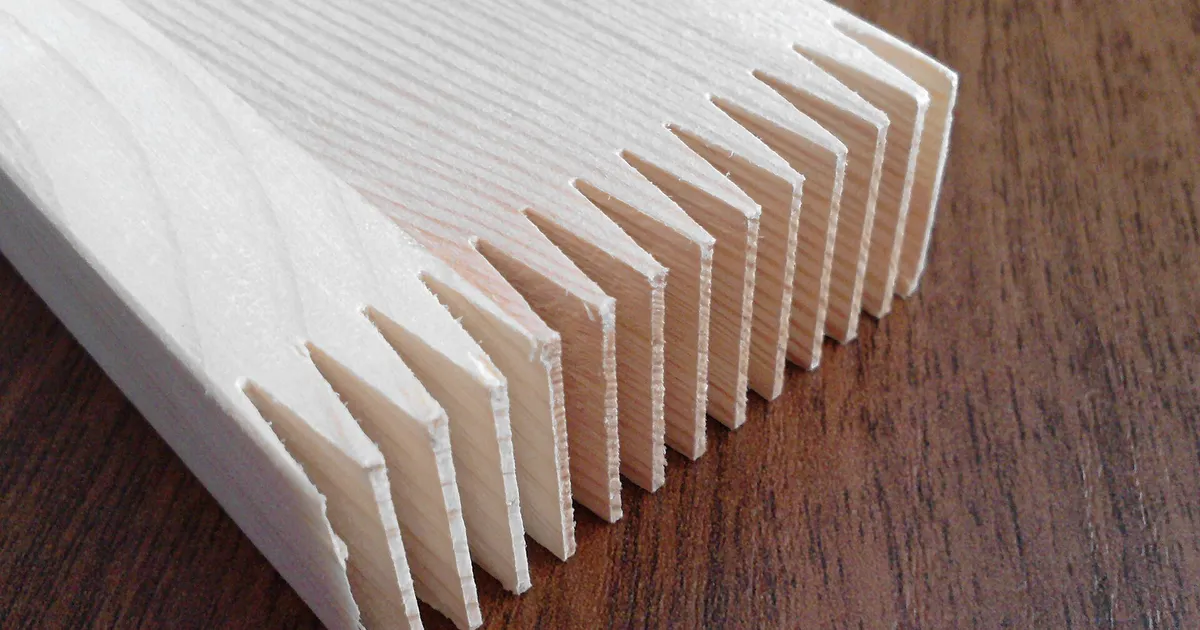
A finger joint panel is the most common wide board in a Vietnamese furniture plant, and the way it is made decides how it behaves in your customer’s living room. Short clear pieces of plantation wood are cut with interlocking fingers on the ends, glued into long strips, then glued edge to edge into a wide panel and sanded flat.
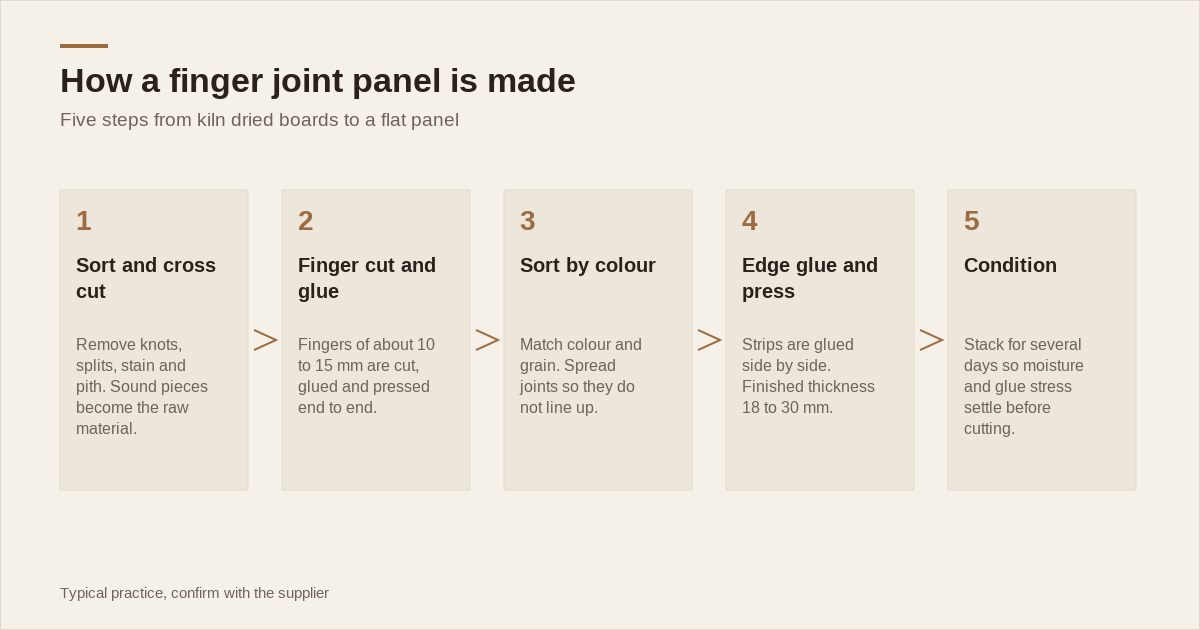
Buyers see the result as a table top, a shelf, a cabinet side or a bed slat. The decision they face is whether to accept visible joints, how much to pay for grade and which glue and moisture limits to write into the order. This guide covers the process, the specification and the failure points.
How the panel is made
The process is the same in most plants, with differences in machine age and in how closely each step is controlled.
Sorting and cross cutting. Kiln dried boards are cut to length and the defects are removed: knots beyond the grade, splits, blue stain, pith and wane. The sound pieces, often 100 to 600 mm long, are the raw material for the fingers. This step is why the construction is efficient. A long board with a defect in the middle is waste. The same board cut around the defect yields two usable pieces.
Finger cutting and gluing. A shaper with a finger cutter head profiles both ends. Glue goes onto the profile and the pieces are pushed together under end pressure, then the strip is cut to length. Typical finger length in furniture grade work is 10 to 15 mm. Longer fingers give a larger glue area and a stronger joint, while shorter fingers waste less wood and look neater.
Sorting by colour and grain. Strips are sorted before the next step. This is where a factory earns or loses a good panel. A plant that sorts well matches colour and grain direction across a panel and spreads the joints, so no two joints line up in neighbouring strips. A plant that does not sort gives a patchwork.
Edge gluing and pressing. Strips are glued side by side and pressed in a clamp carrier or a frame press until the glue sets. Panels are then planed or sanded to thickness. Common finished thicknesses are 18, 20, 25 and 30 mm for table tops and cabinet parts.
Conditioning. Good plants stack panels for several days after pressing so that moisture and glue stress settle before cutting parts. This step is often rushed when orders are late, and rushed panels are the ones that bow in a container.
What “laminated” means here
The word is used loosely. In a Vietnamese quote, “laminated panel” can mean three different things, and you need to ask which.
| Quote wording | What it usually is | Visible joints | Typical use |
|---|---|---|---|
| Finger joint panel | Strips with finger joints, edge glued | Yes, both end and edge joints | Shelves, cabinet sides, bed parts |
| Edge glued panel | Full length boards glued edge to edge, no finger joints | Edge joints only | Table tops, desk tops |
| Laminated panel | Often a finger joint panel, sometimes a veneered or foiled panel | Depends on face | Mixed |
| Glulam beam or leg blank | Layers glued face to face | Face joints on edge | Table legs, thick posts |
If the quote says only “laminated”, ask for a photograph of a finished and sanded sample. The photograph settles the question in one message.
Grades that matter
Panel grade is described by the factory, not by an international standard, so the words differ from plant to plant. Ask for a grade written against what you can see.
A or clear grade. Few knots, close colour match, joints spread and tight. Price is highest because the cross cutting waste is highest.
B or select grade. Small sound knots allowed, some colour variation, joints visible. This is the usual grade for painted furniture and for the inside of cabinets.
C or rustic grade. Larger knots, strong colour change, filled splits allowed. Cheapest, and an acceptable look for rustic designs when the customer wants it.
Write the grade into the specification with a limit you can measure, for example “no open knots wider than 8 mm on the visible face, filled knots allowed on the back”. A grade word alone invites argument at inspection.
Glue, moisture and the paperwork
Most furniture panels use a water based PVAc adhesive for interior products. For kitchens, bathrooms or outdoor furniture, buyers specify a water resistant adhesive class and the factory switches the glue system. The glue is a cost and a compliance line, so name it.
Moisture content at pressing time should sit near the moisture content the product will reach in service. The moisture content guide gives typical target ranges for export furniture. A panel pressed from wood at 14 percent and shipped to a heated home at 7 percent will shrink, and the joints will open or the panel will cup.
Paperwork follows the wood and the glue. Plantation wood needs the legal origin documents described in the legality documents guide. If the panel carries a composite core or a formaldehyde releasing adhesive, the United States rules in the CARB and TSCA Title VI guide apply to the finished product. Solid finger joint panel on its own does not carry formaldehyde limits, but the factory may blend it with parts that do.
Need a quote for this product? Get matched with a Vietnam wood factory
Where the construction works and where it does not
Finger joint and edge glued panels are the right choice for flat parts that are supported on several edges or by an apron: cabinet sides, shelves, desk tops, headboards, bed slats and drawer boxes. They cost less than single piece wide boards and move less, because the many narrow strips spread seasonal movement across the panel instead of letting it build in one board.
They work poorly in three cases. In thin panels under about 12 mm, joints telegraph through any finish. In free standing structural parts with high bending loads, such as chair legs and arms, a single piece or a laminated blank with continuous grain is safer. And in clear coated designs that need an even look, joints show and sorting costs more than the saving.
Panel construction also interacts with the species. Plantation woods that are soft and pale, such as rubberwood, take finger joints well. Strongly figured woods with big colour swings are harder to sort into a quiet panel. The comparison in the acacia versus rubberwood guide covers how each species behaves.
What moves the price
Four things move the price of a finger joint panel, in this order.
Grade comes first. The share of cross cut waste rises quickly as the grade gets cleaner, because every knot or stain that is rejected becomes a short offcut that may not be long enough for a finger. A plant that sells A grade panel at a high price is often selling the cost of sorting, not the cost of the wood.
Thickness comes second and scales almost in proportion. A 30 mm panel uses about two thirds more wood than an 18 mm panel, and presses and sanders take longer on it. If the design only needs visual weight at the edge, a thinner panel with a built up edge profile gives the same look for less money.
Panel size is third. Large panels need larger press frames and more careful handling, and sanding losses rise. Many plants cap their standard panel width at 600 to 1,200 mm and quote a premium above that.
Finish preparation is fourth. A panel for paint can be sanded to a lower standard than a panel for clear lacquer, and the plant will price it that way. State the finish when you ask for the quote, so the factory prices the right sanding level.
Treat the ordering of these four as reliable and the size of each step as variable, because it depends on species, season and how busy the plant is. The MOQ and order economics guide shows how panel cost sits inside the full price of a furniture order.
Inspection points before shipment
Four checks catch most panel problems before they reach a container.
- Cut one sample panel across the joints and look at the glue line. It should be thin, continuous and wood failure should show next to it, not clean glue.
- Measure moisture content in five places on three panels from the lot, and write down the readings.
- Check flatness by laying a straight edge across the panel on a flat table and measuring any gap.
- Count joints that line up across neighbouring strips and compare against the approved sample.
The quality inspection guide explains how to run these checks through a third party if you cannot visit.
What to put in the specification
Give the factory seven lines for each panel part: species, construction (finger joint, edge glued or single piece), thickness and tolerance, grade with measurable limits, glue family, target moisture content and finish. Add a photograph of the look you want and a note on whether joints may show on the visible face.
With those lines, two or three factories quote the same product and the price differences mean something. Without them you compare one plant’s A grade against another plant’s C grade.
If you want matching with up to three Vietnamese wood factories that already run panel lines, send the specification through the RFQ page. Replies arrive within 24 business hours, and you can compare quotes on the same seven lines.
Frequently asked questions
Is a finger joint panel weaker than a solid board?
A well glued finger joint is not the weak point of a panel. In a bending test the break usually runs through the wood beside the joint, not along the glue line. The real risks are poor glue coverage, wood that was too wet when it was pressed and fingers that were cut with a dull tool. Ask for a cut-open sample from the same production run.
Can finger joint panels be stained or oiled?
Yes, but the joints show. Stain and clear oil follow the grain and the changes in grain direction at each joint, so the pattern becomes a design feature. If you want an even surface, specify paint, a solid opaque stain or a veneer face over the panel.
What glue should I specify for panels that go to the United States or the EU?
Name the glue family and the emission or bond standard you need, for example PVAc for interior use or a water resistant D3 or D4 class adhesive for damp areas. Ask for the glue supplier's data sheet and for formaldehyde documentation if any composite part is in the product. The wood itself needs no formaldehyde paperwork, the adhesive and any panel core do.
Need a quote for this product?
Send the specification. We match you with up to 3 Vietnamese wood factories and reply within 24 business hours.
Get matched with a Vietnam wood factory