Guides / Materials
Teak Furniture Made in Vietnam: Plantation vs Reclaimed
November 21, 2026
Teak has a reputation that few woods can match: weather resistance, a warm golden brown colour and a long life outdoors. Buyers ask for teak in dining tables, garden furniture, benches and bedroom pieces, and many Vietnamese plants offer it. The word teak on a quote covers a wide range, from young plantation boards to beams taken from old buildings, and the price, the look and the legal risk differ along that range.
This guide explains the two main teak supplies used in Vietnam, how they differ in the finished product and the legal checks to make before you order.
Where teak for Vietnamese furniture comes from
Teak is a tropical hardwood native to South and Southeast Asia and now planted in many countries. Vietnamese furniture plants rarely rely on domestic teak, since the country has limited plantation supply. Most teak is imported as sawn lumber, as logs for sawing in country, or as reclaimed timber from older structures in producing countries.
Two supplies dominate in practice. Plantation teak comes from managed stands planted for timber and cut after a set number of years. Reclaimed teak comes from old buildings, bridges, boats and railway sleepers, and is dismantled, de nailed, cleaned and re sawn. Both are called teak, and both produce attractive furniture, but they are different products with different risks.
A third supply, wood from natural forests, is the most tightly controlled. Buyers in many markets avoid it, or accept it only with strong documentation. Treat any quote for natural forest teak with caution and ask for the full legal file.
Plantation teak
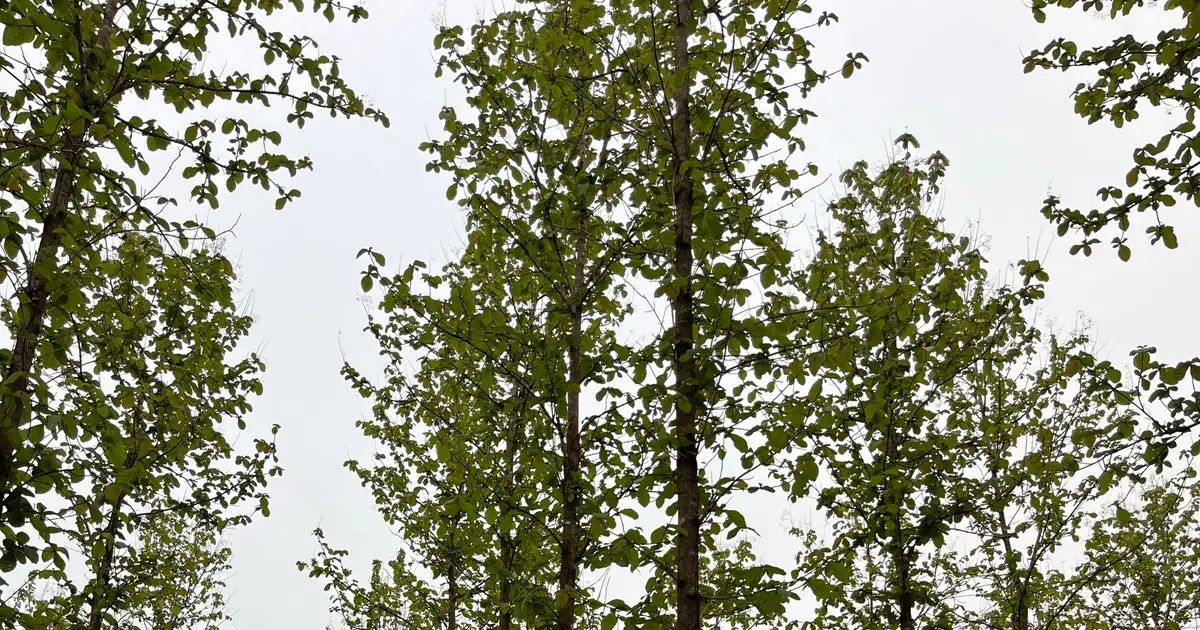
Plantation teak is harvested younger than old growth, often in a rotation of 15 to 30 years depending on the owner and the region. The trees grow faster, so growth rings are wider and the share of heartwood is lower.
The effects show in the wood. Heartwood colour ranges from golden brown to darker brown, often with a wider colour spread between boards. Oil content tends to be lower than in old growth wood, so natural resistance to rot and insects is lower, although still good among commercial timbers. The grain is straight to wavy, with a fine to medium texture and a slightly oily feel.
Practical consequences for furniture:
- Colour matching takes more sorting, since boards differ in tone.
- Sapwood, which is pale and less durable, appears more often, and the specification should say whether it is allowed.
- Dimensional stability is good once the wood is properly dried.
- Outdoor performance is good with maintenance, and a plantation teak table can last many years outdoors when oiled or allowed to weather to grey.
Plantation teak is usually the right choice when you want teak at a controlled cost and a legal record that is easy to document.
Reclaimed teak
Reclaimed teak has a distinct appeal. The wood has aged for decades, often in a roof or a floor, and it has dried slowly and settled. Many buyers like the colour, the saw marks and the old nail holes.
The wood also carries risks.
- Hidden metal. Old nails, bolts and screws can remain deep in the wood and damage blades. Good plants scan boards and remove metal before cutting.
- Cracks and old joints. Beams have drying cracks, notches and mortises, and these limit the size and the grade of usable parts.
- Variation. Boards from different structures differ in colour, density and condition. A matched set needs careful sorting.
- Contamination. Wood from boats or buildings may carry paint, preservatives or residues. Ask about cleaning and testing.
- Documentation. There is no harvest record, so the plant must prove the origin differently.
Reclaimed teak is the right choice when the look is the reason to buy, and when the buyer accepts variation and a higher price per usable part.
Side by side
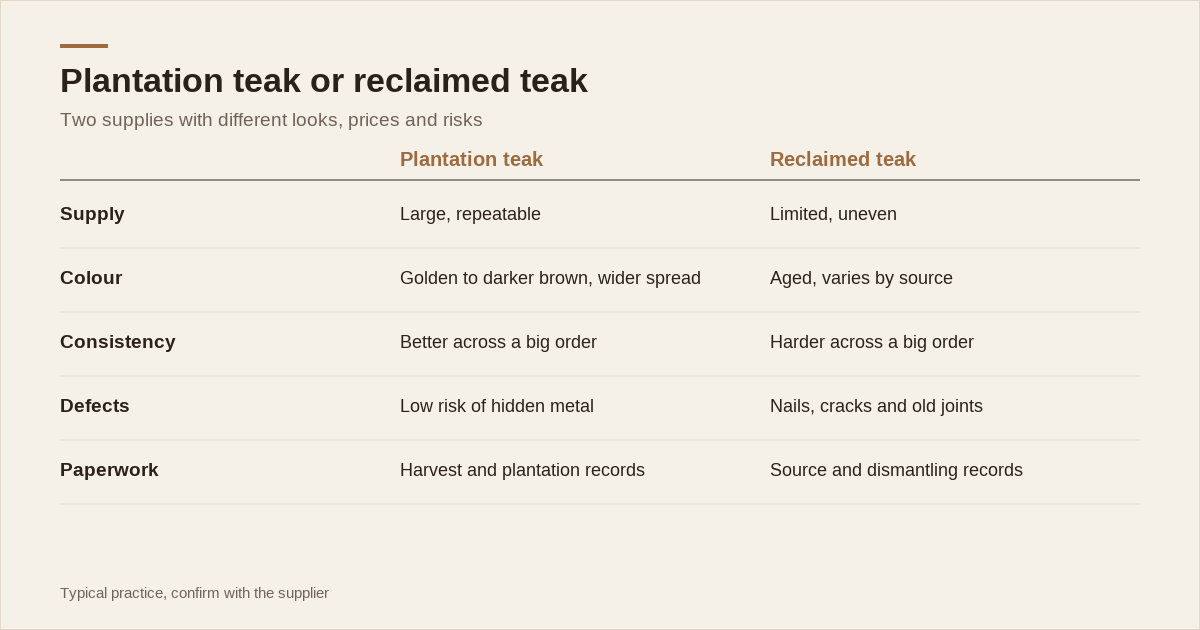
| Factor | Plantation teak | Reclaimed teak |
|---|---|---|
| Price per cubic metre | Moderate to high | High, and yield is lower |
| Colour | Golden to darker brown, wider spread | Aged, richer, varies by source |
| Natural oil and durability | Good, lower than old growth | Often higher in heartwood from old growth beams |
| Supply volume | Large and repeatable | Limited and uneven |
| Consistency across a big order | Better | Harder |
| Legal documentation | Harvest and plantation records | Source and dismantling records |
| Risk of metal and defects | Low | Higher |
For large programs with repeat orders, plantation teak is the safer supply. For limited editions and statement pieces, reclaimed teak can justify its price.
Legal and compliance checks
Teak is not an ordinary commodity from a compliance view. Some producing countries restrict exports, and some markets apply sanctions or enhanced checks to timber from specific origins. Teak from Myanmar, for example, faces sanctions and heightened due diligence in several markets. Rules change, so check the current position with your customs broker and your legal adviser before ordering.
For plantation teak, ask the plant for the country of origin, the supplier name, the harvest and sawing records, the export documents and the Vietnamese import records. The legality documents guide explains the paper trail, and the EUDR guide explains the due diligence data that buyers in the European Union need.
For reclaimed teak, ask for photos and records of the source structure, the dismantling contract, the transport documents and the export papers. Some rules treat wood that has completed a life cycle differently, and others do not, so do not assume an exemption. The FSC guide explains how chain of custody certification works if your market asks for it, although reclaimed wood often has no certificate.
Need a quote for this product? Get matched with a Vietnam wood factory
Finishing and use
Teak contains natural oils that can interfere with some glues and coatings. Plants wipe the surface with solvent before gluing or finishing and use adhesives suited to oily woods. For outdoor furniture, teak is often left unfinished or finished with teak oil, which keeps the colour warm but needs reapplication. Without oil, teak weathers to a silver grey, which many customers like and some do not.
For indoor furniture, plants use lacquer, oil or wax, and the colour range of the wood can be evened with stain or bleach. The finishes guide compares the options, and the outdoor wood guide shows how teak ranks against other choices for outdoor use.
Hardware matters outdoors. Use stainless steel or other corrosion resistant fittings, since teak oils and moisture corrode ordinary steel and leave dark stains.
Claims to check in a teak quote
Teak quotes often carry words that sound precise and mean little. Check these five.
Burmese or Myanmar teak. The name is used as a quality label for golden, oily wood, and it may refer to the origin or only to the look. Ask for documents that prove origin and check current sanctions rules for your market.
Old growth. Ask for the evidence. Few lots of genuinely old growth wood are available, and plantation wood sold under that name is a common problem.
Grade A. Teak grading terms are set by sellers and not by one standard. Ask for the rule: sapwood allowed or not, knot size and colour range.
Kiln dried. Ask for the moisture reading at the plant, with a date and the meter type.
Solid teak. Check whether the piece is solid, a veneer over a core or a thin teak face glued over other wood. Each is legitimate when named, and each has a different price.
Spend one email on these five points before sending a deposit. Plants that deal in honest teak answer quickly and with documents.
Inspection and care
At inspection, check colour consistency across a set, the amount of sapwood on visible faces, the glue joints for oily wood failures and the hardware for corrosion resistance. Moisture content should be recorded for each lot, since teak moves less than many woods but still reacts to a large humidity change.
Include a care sheet with the product. Tell the end customer whether to oil, how often and what to expect if they do not. A customer who wanted a golden table and receives a grey one after a year will blame the product, and a one page sheet avoids many complaints. The quality inspection guide explains how to set inspection points for natural wood variation.
Cost and lead time
Teak costs more than plantation acacia or rubberwood, and the premium comes from the log price and the lower yield after sorting. The gap can be large on wide parts such as table tops, so ask the plant for the cost of wood per unit and compare it with the same part in another species.
Lead time depends on stock. Plants that hold dried teak can start production within days. Plants that must import lumber add shipping time, and plants that must source reclaimed beams add more, since the beams must be collected, cleaned and sawn. The lead time guide shows how to plan.
What to put in the quote request
For each teak part, state plantation or reclaimed, the country of origin, the grade or the rule on sapwood, the thickness, the moisture content target, the finish, the hardware and the documents required. Ask for a written statement that no natural forest teak is used unless you agree.
To compare factories that offer teak, send your specification through the RFQ page. The matching service finds up to three Vietnamese wood factories and replies within 24 business hours.
Frequently asked questions
Is teak grown in Vietnam?
Some teak is planted in Vietnam, but most teak used by Vietnamese furniture plants is imported as sawn lumber, boards or reclaimed beams from other producing countries. Ask for the country of origin and for the shipping and import documents of the specific lot.
Is plantation teak as durable as old teak?
Usually not to the same degree. Plantation teak is harvested younger and contains less of the natural oil that gives old growth teak its weather resistance. It still performs well in furniture when it is dried and finished properly, and it is often sold at a lower price. Ask for the age of the trees and the heartwood share.
Is reclaimed teak legal to import?
It can be, but the paperwork is harder. Reclaimed wood has no harvest record, so the factory needs evidence of the source building, boat or structure and of the dismantling and export. Some rules treat truly reclaimed material differently, and others do not. Ask your customs broker and ask the factory for photos and records of the source.
Need a quote for this product?
Send the specification. We match you with up to 3 Vietnamese wood factories and reply within 24 business hours.
Get matched with a Vietnam wood factory