Guides / Sourcing Guide
What Sets the Cost of Furniture Made in Vietnam: Wood, Labour, Hardware, Finish and Packing
November 21, 2026
Furniture manufacturing cost in Vietnam is the sum of timber, drying, panels, hardware, finish, labour, packing and one-off setup, plus the factory’s margin, and the line that moves most is usually the construction you specify. We found no public cost survey for Vietnamese furniture, so this post shows how the lines work and how to make quotes comparable, not what a table should cost. It is part of our guide to importing furniture from Vietnam, and it goes one level deeper on price.
The cost drivers at a glance
| Driver | Direction | Who controls it | What we found publicly |
|---|---|---|---|
| Timber and construction | Solid, finger-jointed, edge-glued, veneered and plywood are different materials at different prices | You, through the specification | No public price by construction |
| Drying | Careful drying costs kiln time; rushed drying saves cost and risks the goods | Factory, under your moisture target | USDA Wood Handbook: furniture hardwood usually dried to 6 to 8 per cent (our moisture guide gives 8 to 10 per cent at production; the ranges overlap at 8) |
| Panels | Certified low-emission panels usually cost more than uncertified ones in our reading, and we found no public price gap | Factory, under your panel requirement | US limits: 0.05 ppm hardwood plywood, 0.09 ppm particleboard, 0.11 ppm MDF, 0.13 ppm thin MDF |
| Hardware | Stainless and branded fittings usually cost more than plated ones in our reading | You, through the hardware list | No public figure |
| Finish | More coats and tougher systems cost more | You, through the finish standard | No public figure |
| Labour and yield | A wider grade yields more usable wood per cubic metre | You, through the grade limits | No public figure |
| Packing | Heavier board, foam and a drop test cost more | You, through the packing spec | No public figure |
| Setup and tooling | One-off per model and finish; spread over quantity | Shared | No public figure |
| Getting to the ship | Trucking to the named port and loading are inside an FOB price | Factory, under the Incoterm | No public figure |
Wood Handbook: USDA Forest Products Laboratory, FPL-GTR-190 (2010), chapter 13. Emission limits: 40 CFR 770.10, checked October 2026. Direction of difference only.
Timber and construction
Construction is the largest lever and the least visible one. Two factories quoting the same chair may be pricing solid acacia and a plywood seat on one side and a finger-jointed frame on the other. The result is two prices for two objects. Name the construction per component in the specification: solid, finger-jointed, edge-glued, veneered or plywood. Our construction guide on solid wood versus engineered panel explains why choosing by part and not by product is usually cheaper and safer.
Species works the same way. A quote that says “wood” or “hardwood” leaves the factory free to choose, and it will choose by its own cost. Name the species or write “open to factory recommendation, must hold flat” so the choice is visible.
Drying, panels and compliance
Drying is a cost the buyer rarely sees. The Wood Handbook says hardwood lumber for furniture, cabinets and millwork is usually dried to 6 to 8 per cent moisture content, and that air drying lumber to 20 to 25 per cent before kiln drying saves energy cost and reduces the kiln capacity needed. It also says slower drying can be uneconomical and can introduce the risk of stain. In our reading, a factory under schedule pressure has a reason to pull a charge early, which is why a moisture range and a kiln record belong in the order. The same handbook lists a recommended interior furniture moisture content of 8 per cent on average in most areas of the United States and 11 per cent in damp, warm coastal areas, so the target depends on where the furniture will live. Our moisture guide gives 8 to 10 per cent at production, while the Wood Handbook gives 6 to 8 per cent for furniture lumber and 8 per cent on average (6 to 10 per cent for individual pieces) at installation in most US areas; the ranges overlap at 8, so ask the factory for the range that suits your destination.
Panels bring a compliance cost. US federal rules limit formaldehyde emissions from composite wood at 0.05 ppm for hardwood plywood, 0.09 ppm for particleboard, 0.11 ppm for MDF and 0.13 ppm for thin MDF, as of the page we checked in October 2026. A panel from a certified producer usually costs more than one with no paperwork in our reading, and we found no public price gap. Ask the factory to name the panel supplier and the certificate in the quote. We hold no certificate ourselves, and the certificate belongs to the panel producer.
Finish, hardware and packing
Finish cost follows the system and the coat count, and a coat count alone does not fix film thickness. Ask for the system, the coat count and a signed colour and sheen sample. Sheen is a measured quantity: ASTM D523 is the test method for specular gloss and uses 20, 60 and 85 degree geometries, so a specification that says “satin, 60 degrees” can be checked.
Hardware is a line a quote may not spell out. A set with stainless fittings costs more than one with plated fittings, and the quote may not say which it priced. Ask for a hardware list with material and supplier.
Packing is the last line. Heavier board, corner protection, inner partitions and a drop test each add cost, and a thinner pack saves money on the quote but gives up protection. Our packaging guide covers the specification.
Need a quote for this product? Get matched with a Vietnam wood factory
Setup cost and quantity: a worked example
Setup is the cost that explains MOQ. It is paid once per model and per finish: jigs, programming, sample time, colour matching and changeover. The figures below are hypothetical and chosen only to show the shape. They are not a price from any factory.
Assume one model in one finish carries a setup cost of 900 currency units. Spread over the quantity:
| Pieces ordered | Setup share per piece |
|---|---|
| 50 | 18.00 |
| 100 | 9.00 |
| 200 | 4.50 |
| 300 | 3.00 |
| 500 | 1.80 |
Hypothetical example: 900 divided by quantity. Real setup costs vary by model, and we found no public figure.
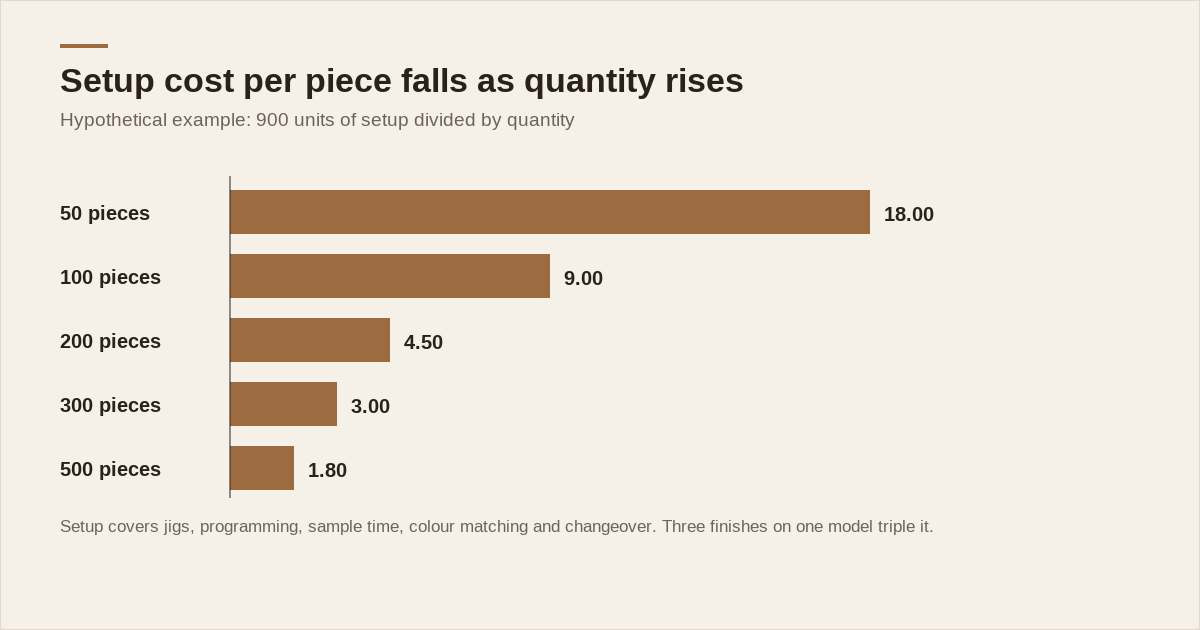
The curve is steep at the bottom, which is why the price gap between 50 and 100 pieces is larger than the gap between 300 and 500. Three finishes on the same model triple the setup in this example, so cutting variants is the cheapest way to improve a small order. The guide to furniture MOQ and order economics lists the levers that move a factory.
A second example: a timber price rise
A timber price change reaches the quote in proportion to timber’s share of the factory’s cost, and that share depends on the product. Assume a 10 per cent rise in the price of the timber and three different shares:
| Timber share of factory cost | Effect of a 10 per cent timber rise on cost |
|---|---|
| 30 per cent | 3.0 per cent |
| 40 per cent | 4.0 per cent |
| 50 per cent | 5.0 per cent |
Hypothetical shares, multiplied through. We found no public breakdown of cost shares for Vietnamese furniture.
A solid-wood table sits toward the top of that range and a mostly upholstered piece toward the bottom. The point for a buyer is to ask what share of a price is timber, and to agree whether a timber surcharge clause is in the contract. Our guide on payment terms and Incoterms covers where the price terms live.
Lines to ask for in the quote
An itemised quote makes comparison possible. Ask each factory to show:
- Timber or panel material, with species, grade and target moisture range.
- The panel supplier and certificate, where panels are used.
- Hardware, with material and supplier.
- Finish system, coat count and sheen reference.
- Packing: carton board, inner pack, labelling and drop test.
- Setup or tooling charge, who pays and who owns jigs and moulds.
- The named FOB port and what the price includes up to loading.
- Sample cost and whether part of it is credited against an order.
- Payment terms and the Incoterm version.
What to put in the specification
State the construction per component, the species or grade, the finish with a reference sample, the hardware list, the packing method, the quantity per model and per finish, the Incoterm and port and the date you need the goods. Then compare the cost lines, not only the totals. With that in hand, go back to the guide to importing furniture from Vietnam for the order of the steps and send your specification through the RFQ page. We reply within 24 business hours and match you with up to 3 Vietnamese wood factories that quote you directly.
Sources
- USDA Forest Products Laboratory: Wood Handbook, FPL-GTR-190 (2010), copy hosted on Wikimedia Commons
- Cornell Law School LII: 40 CFR 770.10, formaldehyde emission standards for composite wood products
- ASTM International: D523 Standard Test Method for Specular Gloss (D523-25 catalogue page, listed as active; the standard text was not read)
- ICC Academy: Incoterms 2020, FAS or FOB
Frequently asked questions
How much does it cost to manufacture furniture in Vietnam?
We found no public price list or cost survey for Vietnamese furniture, and any single figure would mislead because cost follows construction, species, finish, hardware and packing. Ask three factories for FOB quotes on one tech pack and compare the cost lines, not only the total.
Which cost line moves the price most?
Usually construction, because solid wood, finger-jointed wood, veneered panel and plywood are different materials at different prices. We found no public figure for the gap, so quote the same construction at every factory before you compare totals, and ask each factory to name the construction per component.
Why does a quote change after the sample?
Because the sample shows what the product really needs. A hardware change, an extra coat or a heavier carton adds a cost line that the first quote did not include. Write the approved sample into the price so a later change is visible as a change.
Does a lower price mean a cheaper factory?
Not necessarily. A lower number can come from a cheaper construction, a thinner finish, a lower moisture standard or a lighter carton. Compare assumptions line by line before you decide which factory is lower, and ask each factory to itemise its quote so the lines sit side by side.
Need a quote for this product?
Send the specification. We match you with up to 3 Vietnamese wood factories and reply within 24 business hours.
Get matched with a Vietnam wood factory