Guides / Sourcing Guide
Importing Furniture From Vietnam: What an Order Costs, How It Is Paid and How It Ships
November 21, 2026
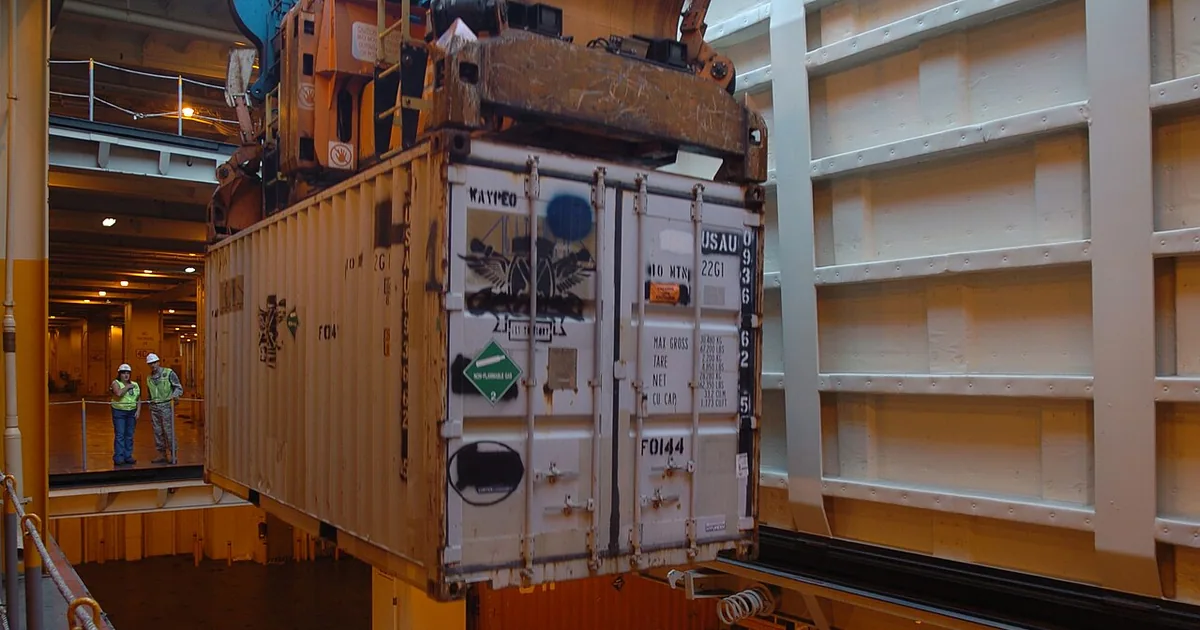
To import furniture from Vietnam, you write one specification, collect comparable FOB quotes, approve a signed sample, pay a deposit, follow production milestones, inspect at about 80 per cent packed and supervise the loading. Price follows construction, finish and packing more than the factory’s name, MOQ follows setup cost per model and per finish, and a container fills by volume before it fills by weight. This guide is for importers, brands and retailers placing a first or second order, and it leads to one decision: what first order to place and on what terms. For the wider picture of what Vietnam makes, see our guide to Vietnam wood products.
We are a matching service. We own no kiln, no machines and no finishing line, and we name no factory on this site. You send one specification and we match it with up to 3 Vietnamese wood factories that quote you directly.
Last reviewed: October 2026. Figures carry the date they were checked; confirm tariffs and regulations with your broker before you rely on them.
- The order in one view
- What sets the factory price
- MOQ and why it is what it is
- Tech pack and sample
- When the factory proposes a swap
- Payment terms and Incoterms
- Lead time
- Knock-down design and packing
- How much fits in a container
- Inspection and loading supervision
- Mould and moisture in the box
- A first-order plan
- Next step
The order in one view
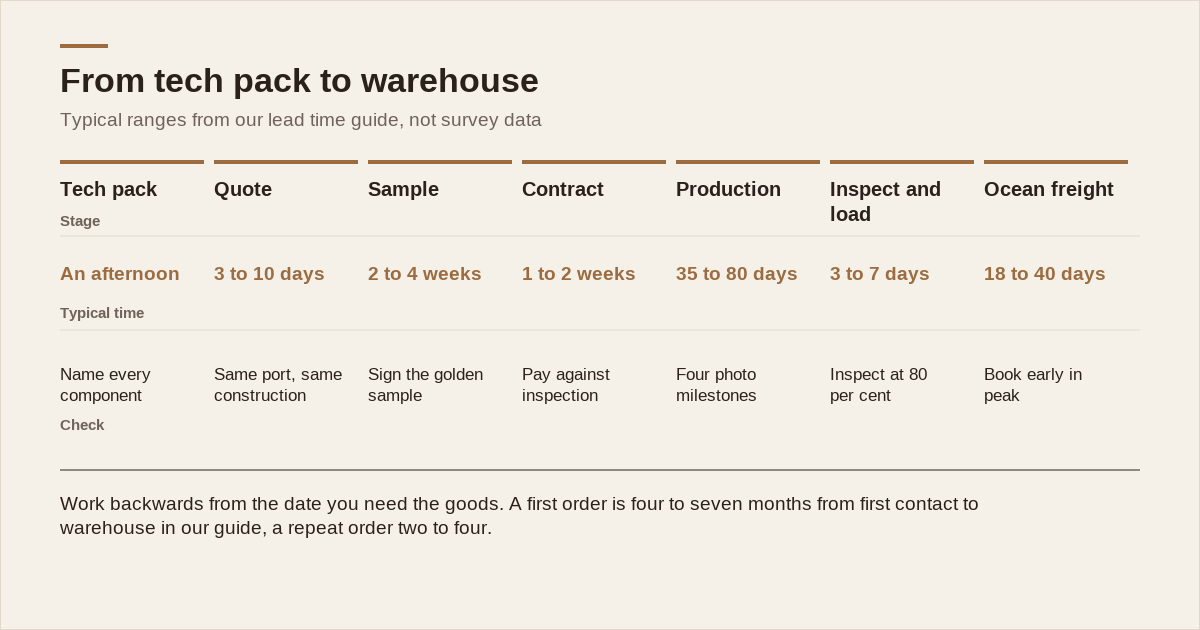
Vietnam is a large furniture exporter, which is why the process is well worn. Viet Nam News, citing Vietnam Customs, reported $17.2 billion of wood and wood product exports in 2025, nearly 6 per cent above 2024. Citing the Import-Export Department of the Ministry of Industry and Trade, it reported that wooden furniture made up nearly 61 per cent of export value in the first 11 months. In its own voice, without naming a source, it reported that timber and wood product exports to the United States totalled $9.46 billion for the year, approximately 55 per cent of the total. A buyer is therefore not asking a factory to do something unusual. The risk lies in the order of the steps, and in skipping the dull ones.
| Stage | What happens | Typical time | Where it usually goes wrong |
|---|---|---|---|
| Specification | You write the tech pack: drawing, construction, species, finish, hardware, packing | An afternoon to a few days | Blank lines produce quotes that cannot be compared |
| Quote | Factories price the pack; you normalise the quotes | 3 to 10 days | One factory priced plywood and another priced solid wood |
| Sample | Development sample, then a signed pre-production sample | 2 to 4 weeks, then 1 to 3 weeks per revision | Colour takes two rounds; approval is never written down |
| Contract and deposit | Payment terms, inspection standard, substitution notice | 1 to 2 weeks to production start | An undefined inspection clause |
| Production | Material, machining, finish, packing, with milestones | 35 to 80 days | Kiln drying, finish cure and subcontractors cannot be rushed |
| Inspection and loading | Inspect at about 80 per cent packed; supervise loading | 3 to 7 days | Crushed cartons or a wet container |
| Ocean freight | On your booking under FOB | About 18 to 40 days by destination | A rolled vessel or a peak-season booking |
Typical ranges taken from our own sourcing and lead time guides, not survey data. We found no public lead-time survey for Vietnamese furniture.
Added up, our lead time guide puts a first order at four to seven months from first contact to warehouse, and a repeat order on an approved product at two to four months, because the sample stages fall away. Plan from the arrival date backwards.
Read more: How to Source Furniture From Vietnam: A Step by Step. Before step one, you need factories worth quoting, which is covered in our guide to wood furniture manufacturers in Vietnam.
What sets the factory price
Two quotes on the same chair can differ widely without either factory being cheap or dear. The usual cause is that they priced different objects: a different construction, a different grade, a different finish system, a different carton or a different Incoterm. Before you compare numbers, compare assumptions.
| Cost line | Direction | What to ask for | What we found publicly |
|---|---|---|---|
| Timber and construction | Solid, finger-jointed, edge-glued, veneered and plywood are different prices | Construction named per component | We found no public price by construction |
| Drying | Kiln drying adds cost; rushing it saves cost and risks the order | Target moisture range and kiln record | USDA Wood Handbook: hardwood lumber for furniture is usually dried to 6 to 8 per cent (our moisture guide gives 8 to 10 per cent at production; the ranges overlap at 8) |
| Panels | Certified low-emission panels usually cost more than uncertified ones in our reading, and we found no public price gap | The panel supplier and certificate named in the quote | US federal limits: 0.05 ppm hardwood plywood, 0.09 ppm particleboard, 0.11 ppm MDF |
| Hardware | Stainless and branded fittings usually cost more than plated ones in our reading | A hardware list with material and supplier | We found no public figure |
| Finish | More coats and a tougher system cost more | System, coat count and sheen reference | We found no public figure |
| Labour and yield | A wider grade yields more usable wood per cubic metre | The grade written out, with knot and colour limits | We found no public figure |
| Packing | Heavier board, foam and a drop test cost more | Carton board grade, inner pack and test | We found no public figure |
| Setup and tooling | One-off per model; spread over quantity | Who pays and who owns jigs and moulds | We found no public figure |
Wood Handbook: USDA Forest Products Laboratory, FPL-GTR-190 (2010), chapter 13. Emission limits: 40 CFR 770.10, checked October 2026, as chamber-test limits for composite wood products sold in the United States. Direction of difference only; we found no public cost breakdown for Vietnamese furniture.
The Wood Handbook also notes that air drying lumber to 20 to 25 per cent before the kiln saves energy cost and reduces the kiln capacity needed. A factory that dries slowly and carefully carries that cost, and a factory that rushes may be able to quote lower, though we found no public figure for the size of that saving. That is one reason to ask for kiln records and moisture readings.
Read more: Furniture Manufacturing Cost in Vietnam: Wood, Labour, Hardware, Finish and Packing
MOQ and why it is what it is
Four costs are paid once per order whatever the quantity: setup and jigs, sampling and approval, material buying and line changeover. Divide them by the number of pieces and you have the shape of the MOQ curve, which is steep at the bottom. A factory quoting an MOQ is naming the point below which the order stops covering its setup.
Our MOQ guide gives typical working ranges, not survey data, of about 100 to 300 pieces per model for indoor furniture at a mid-size plant and more for outdoor furniture. We found no public MOQ survey, so treat any single number you read, including ours, as a starting question for the factory.
The levers that move a factory are different from the ones buyers usually pull:
- Cut variants. One model in one finish on a first order gets a better answer than the same quantity split across three finishes.
- Use the factory’s standard panel thickness, leg section and carton.
- Offer a quiet month, which the lead time section below describes.
- Put a written forecast for the second and third order beside the first.
- Combine models so the material buying and the container both fill.
- Accept a wider grade where the product allows it.
Asking for a discount without changing the specification does not move the arithmetic.
Read more: Furniture MOQ in Vietnam and the Economics Behind It
Tech pack and sample
A factory can only quote what it understands. The tech pack is the package that makes a quote comparable: a dimensioned drawing, a bill of materials, the construction per component, the finish standard with a reference sample, the hardware list, the packing specification, the tests the product must pass and the paperwork the market needs. Our RFQ form asks for the same things in short form and accepts drawings in PDF, DWG, DXF and STEP.
The sample round then turns the pack into a product, in steps that are easy to mix up. A development sample checks the design. A colour and finish sample approves the look. A pre-production sample, built with production materials and methods, becomes the golden sample once both sides sign it. A production sample from the first run checks that the line matches the golden sample before the rest ships. Approving one of these does not approve the next.
Three habits save most of the rework. Write the approval down with the date and drawing version. Photograph the golden sample from every side and keep the physical piece. State who owns drawings, jigs and moulds before the first sample, and sign an NDA first if the design matters. The RFQ form has a tick box for that.
Read more: Furniture Tech Pack: Drawings, BOM and Finish Callouts a Factory Can Quote From and Furniture Sample Vietnam: Prototype Steps, Cost and Time
When the factory proposes a swap
Sooner or later a factory writes that it wants to change the wood, the panel or the hardware. The reasons are ordinary: a shortage, a price rise, a high reject rate in drying or a date that cannot be met with the quoted material. A request is not a bad sign. A swap made without asking is.
Treat every proposal the same way. Ask for the reason, the price effect, a sample of the new material and the effect on the legal documents that go with the species. Decide by part and not by product. A hidden frame part inside an upholstered piece is a low-risk swap. A visible part with a clear finish, a structural leg or anything sold under a species name is high risk, because colour, strength or the label changes.
Put one sentence in the contract: any change of species, panel supplier or hardware needs written approval before it is made. Then check at inspection, because the cheapest time to find a swap is before the container seals.
Read more: Wood Species Substitution: When a Factory Proposes a Swap
Payment terms and Incoterms
Our payment guide describes a structure that many Vietnamese factories accept on a first order: a 30 per cent deposit with the purchase order and 70 per cent against a passed final inspection plus a copy of the bill of lading. We found no public survey of terms, so read that as a workable opening position, not a norm. The deposit buys timber and panels. The clause that gives you leverage is the one tying the balance to a defined inspection result, with the inspection standard written into the contract.
The Incoterm decides who controls the freight and where risk passes. The International Chamber of Commerce’s pages describe the two sea rules buyers meet most often.
| Rule | Modes of transport | Seller delivers | Risk passes to buyer | Who contracts the main carriage |
|---|---|---|---|---|
| FOB | Sea and inland waterway only | On board the vessel the buyer nominates, at the named port of shipment | When the goods are on board | Buyer |
| CIF | Sea and inland waterway only | On board the vessel, or procures goods already so delivered | When the goods are on board, even if they never arrive | Seller, who must also buy cargo insurance |
ICC Academy and ICC Incoterms 2020 rules pages; modes per the US International Trade Administration, all checked October 2026. Under CIF the minimum insurance is Institute Cargo Clauses (C) cover of at least 110 per cent of the contract price.
Two points deserve attention. First, the ICC pages themselves say that when goods are handed to a carrier in a container, the parties should consider FCA instead of FOB and CIP instead of CIF. Our payment guide treats FOB as the usual choice for furniture, which matches common trade practice, but ask your forwarder which rule fits your route. Second, whatever the rule, name the port. A factory in the centre or north that quotes FOB from a southern port has trucking inside the number.
Read more: Payment Terms and Incoterms for Vietnam Furniture Orders
Lead time
Most late deliveries are planning errors. The buyer counted from first contact, or assumed a stage could overlap with another when it cannot. Inside the production window three stages resist compression: kiln drying, finish curing and subcontracted parts such as metal frames, glass and stone, which the factory does not control.
The year has a shape as well. Our lead time guide describes Tet, the lunar new year, as removing one to three weeks of production with reduced output around it, factories running retail programmes in a tight window from about March to August and an easier period from September to December. We found no public capacity survey behind that pattern, so ask each factory what is booked for your window. A buyer who can run in the quiet months tends to get a better MOQ and more attention.
For a date that cannot move, set four milestones with a photo against each: material bought, first parts machined, first pieces in finish, packing started. A slip seen in week three can be recovered. The same slip seen in week nine cannot. Book the vessel early in peak season, because the booking can become the constraint, and agree what happens on a slip before it happens.
Read more: Furniture Lead Time From Vietnam: A Realistic Schedule
Need a quote for this product? Get matched with a Vietnam wood factory
Knock-down design and packing
Knock-down, or KD, furniture ships in parts that the end user assembles, and it exists mainly to cut freight volume. The saving depends on the product: a bulky chair or cabinet can need much more container space assembled than flat, while a dining table with a separate base and top saves less. Ask the factory for the carton dimensions of both versions and compare cubic metres per unit. Knock-down also moves risk into the details: hole positions that must line up between two parts, fittings that survive repeated assembly and an instruction sheet that matches the product.
The carton is then the only thing between the finished surface and four or more handling points. Specify the board by test rating and not by the number of layers, protect the corners separately from the surface, label to the market’s rules and ask for a drop test on a packed unit if the product will meet courier handling. If cartons travel on wooden pallets or with wooden dunnage, the International Plant Protection Convention’s ISPM 15 applies to that wood packaging, and the standard excludes packaging made from wood processed to be pest-free, such as plywood. Ask the factory what its pallets carry as a mark.
Read more: Knock Down Furniture Vietnam: Design and Hardware Guide and Furniture Packaging Export: Carton Specs and Drop Tests
How much fits in a container
Freight is charged per container, so what matters is how many cartons fill one. The unit is the cubic metre, written CBM: carton length times width times height, in metres. DSV lists representative figures for the usual boxes. Actual dimensions vary by manufacturer, age and owner.
| Container | Internal L x W x H | Capacity | Maximum payload |
|---|---|---|---|
| 20 ft dry | 5.90 x 2.35 x 2.39 m | 33.2 m3 | 25,000 kg |
| 40 ft dry | 12.03 x 2.35 x 2.39 m | 67.7 m3 | 27,600 kg |
| 40 ft high cube (40HQ) | 12.03 x 2.35 x 2.70 m | 76.4 m3 | 28,560 kg |
DSV container dimension pages (dry and high cube), checked October 2026.
A loaded container is rarely full to the nominal volume, because cartons do not tile perfectly, a margin is left under the roof and at the doors, and pallets and dunnage take space. We found no public benchmark for furniture loading efficiency. As an illustration only, a simple grid of the example cartons in our container loading post, with a 0.10 m allowance under the roof, gives 384 side-table cartons, 192 knock-down chair cartons, 150 cabinet cartons or 39 sofa-frame cartons in a 40HQ. Weight rarely limits furniture, but a heavy product such as stone-topped tables can reach the payload before the volume.
Read more: Furniture Container Loading: How Many Pieces Fit in a 40HQ
Inspection and loading supervision
An inspection report is worth the standard it was checked against. Give the inspector a pack: the approved sample photos, the specification, the colour limit samples, the packing and labelling specification and the AQL levels you have agreed. AQL, the acceptable quality limit, is a sampling rule that sets how many pieces are pulled and how many defects of each severity the lot may carry. It is not a guarantee, and arguing the levels after a failure is a negotiation, not a standard.
Book the inspection at about 80 per cent packed. Earlier, there is too little finished stock to judge. Later, the factory is loading and a failure means unloading. On a wood product check dimensions, moisture content on several pieces, finish against both limit samples, joints, hardware, one flat-pack unit assembled from the instructions and the packing.
Loading supervision is a separate job. It describes what happened between the warehouse and the sealed container: whether the container floor and roof were sound and dry, whether the carton count matched and how the stack was built. A photograph of the sealed doors with the seal number visible settles many later arguments. Write the failure remedy into the contract in advance: who pays for the re-inspection, whether the answer is rework, sorting or a discount and how the date moves.
Read more: Furniture Quality Inspection and Container Loading
Mould and moisture in the box
Mould is the quiet failure of a wood shipment, because the cargo looks fine at the factory. The mechanism has three parts. First, moisture can enter with the goods. Second, humid air at sea pushes dry wood toward a higher equilibrium moisture content: the USDA Wood Handbook table gives about 15.7 per cent at 80 per cent relative humidity and 20.2 per cent at 90 per cent, at 26.7 degrees Celsius. West P&I Club notes that sea air at main deck level will normally exceed 80 per cent relative humidity. Third, liquid water from condensation can take wood far above that. The Handbook says humid air alone will not wet wood enough to support significant decay but will permit some mould fungi, and that wood kept air dry, at 20 per cent or less, has a reasonable margin of safety.
The Container Handbook lists the causes of container sweat as moisture sources inside the box, a temperature difference between the air and the cargo or walls and cooling that takes the surface below the dew point. The preventives it names are low-moisture packaging and dunnage, no packing in rain and care with wet pallets. The EPA’s mould guide adds a plain rule: mould will not grow without water, and wet items should be dried within 24 to 48 hours.
For a buyer this becomes three requests: a moisture range at packing for the destination, a dry and sound container checked at loading, and kiln records. Our moisture guide covers the range. Our moisture guide gives 8 to 10 per cent at production, while the Wood Handbook gives 6 to 8 per cent for furniture lumber and 8 per cent on average (6 to 10 per cent for individual pieces) at installation in most US areas; the ranges overlap at 8, so ask the factory for the range that suits your destination. We found no public mould threshold for finished, coated furniture specifically, so use the 20 per cent figure for lumber as a warning level and not as a pass mark.
Read more: Mould in Furniture Shipping Containers: Causes, Prevention and Claims and, for the moisture targets, Wood Moisture Content for Export Furniture Explained
A first-order plan
Use this order for a first container. It keeps your leverage where the risk is.
- Write the tech pack: drawing, construction per component, species or grade, finish with a reference sample, hardware list, packing and test list.
- Decide the category and region, then shortlist three factories that already build your category.
- Ask each for a quote on one FOB basis with a named port, and normalise construction, grade, finish, packing and Incoterm before you compare.
- Cut variants to one or two models in one finish, using the factory’s standard sizes.
- Run one sample round, approve it in writing and keep the golden sample.
- Sign a contract that covers payment against a passed inspection, the AQL levels, substitution notice, documents and the failure remedy.
- Set four production milestones with a photo against each.
- Book a third-party inspection at about 80 per cent packed and separate loading supervision.
- On arrival, take moisture readings on several pieces, assemble one flat-pack unit and photograph anything out of specification.
- Ask your customs broker for duty and documents before you commit, because we do not give legal or tax advice.
Next step
You do not need to answer every question above before you start. Send one specification through the RFQ page. We reply within 24 business hours and match you with up to 3 Vietnamese wood factories, which quote you directly and deal with you directly. Buyers pay nothing to be matched. Attach what you have: a drawing, a photo, a spec sheet, and say plainly what you do not know yet. A line such as “open to factory recommendation on construction” is more useful to a factory than a blank.
Sources
- Viet Nam News: Việt Nam’s wood exports reach record $17 billion in value (19 January 2026)
- ICC Academy: Incoterms 2020, FAS or FOB
- ICC Incoterms 2020: rules for sea and inland waterway transport (library page)
- US International Trade Administration: Know Your Incoterms
- DSV: dry container dimensions
- DSV: high cube dry container dimensions
- USDA Forest Products Laboratory: Wood Handbook, FPL-GTR-190 (2010), copy hosted on Wikimedia Commons
- US EPA: A Brief Guide to Mold, Moisture and Your Home
- West P&I Club: Cargo ventilation and precautions to minimise sweat
- Container Handbook: container sweat (condensation)
- IPPC: Regulation of wood packaging material in international trade (ISPM 15)
- Cornell Law School LII: 40 CFR 770.10, formaldehyde emission standards for composite wood products
See also: the market pages for the United States, the European Union and Japan, and the certificate of origin reference.
Frequently asked questions
How much does it cost to import furniture from Vietnam?
We found no public price list for Vietnamese furniture, and the cost depends on construction, species, finish, packing and the Incoterm. Collect FOB quotes from up to three factories on one specification, then add ocean freight, insurance, duty and inland transport from a forwarder and a customs broker.
What is a normal MOQ for furniture from Vietnam?
We found no public MOQ survey. Our MOQ guide gives typical working ranges of about 100 to 300 pieces per model for indoor furniture at a mid-size plant. The number moves with variants, finishes and timing, so cut variants on a first order before you argue about quantity.
How long does a first order take from first contact to warehouse?
Our lead time guide puts a first order at about four to seven months, and a repeat order on an approved product at two to four months. These are typical ranges, not survey data. Count backwards from the date you need the goods, not forwards from today.
What payment terms do Vietnamese furniture factories ask for?
A deposit with the purchase order and the balance before the goods ship is the usual shape. Our payment guide lists 30 per cent with the order and 70 per cent against a passed inspection and a copy of the bill of lading as a workable first-order structure. We found no public survey of terms.
Should I buy FOB or CIF?
Many buyers choose FOB because they then book the carrier and see the freight cost. The International Chamber of Commerce recommends considering FCA instead of FOB, and CIP instead of CIF, when goods go to a carrier in a container. Ask your forwarder which rule fits your route and write the named port into the contract.
How many pieces fit in a 40HQ container?
It depends on carton volume. A 40-foot high cube container is listed at about 76.4 cubic metres, and a simple grid of cartons in our worked examples fills roughly 62 to 85 per cent of that. Ask the factory for a loading plan with carton dimensions and gross weights before you rely on a count.
Need a quote for this product?
Send the specification. We match you with up to 3 Vietnamese wood factories and reply within 24 business hours.
Get matched with a Vietnam wood factory