Guides / Compliance
BSCI, SMETA and Sedex Audits for Furniture Factories: What Buyers Ask For
November 21, 2026
When an importer writes “send us your BSCI audit” or “are you SMETA audited”, the request is about a report on your site, not a certificate you hang on the wall. A BSCI audit at a furniture factory and a SMETA audit work differently, and the buyer usually has a preference you cannot change. This guide is for the owner or export sales engineer of a wood furniture factory: what each programme is, who orders the audit, how the result and follow-up work, and how to answer the buyer in the first week.
Two programmes, two operators
amfori BSCI is run by amfori, a trade association that TUV Rheinland describes as bringing together more than 2,000 mostly European retailers, importers and brands. SMETA is run by Sedex, and Sedex calls it the most widely used social audit. A factory may meet both in the same year, from different customers.
| amfori BSCI | SMETA | |
|---|---|---|
| Run by | amfori | Sedex |
| What it covers | The amfori code of conduct, which one audit company translates into thirteen performance areas | Labour standards and health and safety in every audit; the 4-pillar version adds environment and business ethics |
| Result | A rating from A to E, calculated by the amfori system | An audit report with a corrective action plan, no pass or fail |
| Certificate | None issued | None issued |
| Who requests the audit | A member of amfori, on the amfori platform | A Sedex member, who also picks the scheduling type |
| Who sees the report | You and the amfori members linked to you on the platform | The customers you share it with on the Sedex platform, which requires Sedex membership |
| Scheduling | Announced, semi-announced or unannounced; semi-announced is the most common, inside a window of one month | Announced, semi-announced (a window of at least three weeks) or unannounced |
| Illustrative duration | Not stated in the sources we read | Two days for 2-pillar, three days for 4-pillar |
The practical point is in the “who requests” row. TUV Rheinland’s FAQ says only companies actively supplying amfori BSCI members can be audited, and that the audit is applied for on the amfori platform and approved by the member responsible for the supplier. A factory cannot buy a BSCI audit speculatively and then use it to win a customer. The route runs from a buyer that is a member.
How a BSCI audit runs
The audit companies describe the same sequence.
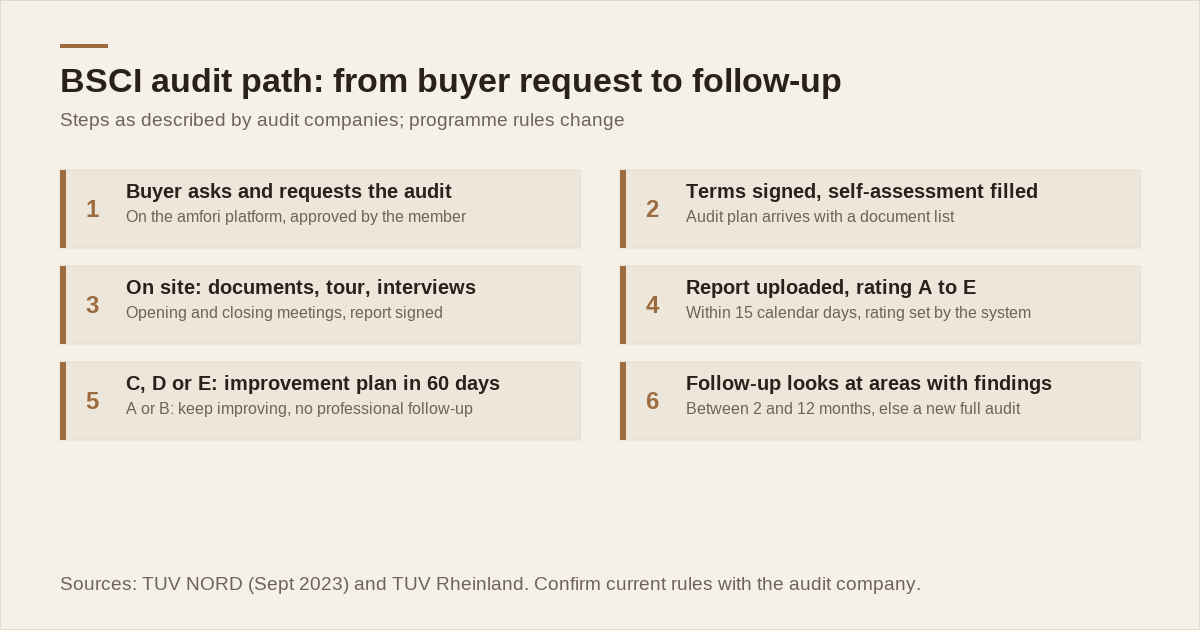
- Terms and questionnaire. Before the first audit the factory signs the programme’s terms of implementation and fills in a self-assessment questionnaire. It then receives an audit plan with a list of documents.
- Opening meeting. The auditor explains purpose and scope. TUV NORD says at least a management representative and a worker representative attend.
- Evidence. The auditor collects evidence three ways: documents, observation of the site and interviews. Interviews with managers and workers are confidential.
- Closing meeting and findings report. The lead auditor explains positive and negative findings. The report is signed by the factory and the auditor. TUV NORD notes that a signature does not mean the factory accepts the content, only that the audit took place without irregularities.
- Upload and rating. The report goes to the amfori platform within 15 calendar days of the last audit day. The rating is calculated automatically by the amfori system and is outside the auditor’s control.
- Improvement plan and follow-up. The factory defines a plan in response to the findings. Linked members can see it but not edit it.
Ratings run from A (outstanding) to E (unacceptable) in TUV Rheinland’s description. TUV NORD, in a procedure description dated September 2023, says that with an A or B the factory keeps improving without a professional follow-up. With a C, D or E the factory has 60 days to write an improvement plan, the audit stays valid for 12 months, and a follow-up between two and twelve months later extends validity to the end of the audit cycle. Without that follow-up a new full audit is needed. The follow-up looks only at the performance areas that had findings.
TUV NORD also says that, depending on the result, either a follow-up audit comes within a year or a full audit comes after two years. TUV Rheinland’s older FAQ describes a full audit as valid for two years. Programme rules change, so ask the audit company for the version in force on your audit date.
What is different in SMETA
SMETA has no letter rating. Sedex states that it encourages using findings to drive continuous improvement instead of a pass or fail model, and that the same standard applies to every site so a supplier can share one audit with several customers. That last point matters for a factory with many importers: one report can serve all of them if each is a Sedex member you share it with.
Version 7, released in 2024, changed two things worth knowing. LRQA describes a Management Systems Assessment that replaces the old “observations” category, and a new finding type called Collaborative Action Required for issues the site cannot fix alone, which has no fixed closure date. Auditors also had to complete new training before running version 7 audits. The 2-pillar and 4-pillar choice is the buyer’s. Sedex says most buyers now choose the 4-pillar audit, and DNV says major global buyers often require it.
Questions to put to the buyer
Do not answer “yes we have it” or “no” before you ask these.
- Which programme, and for SMETA which pillars?
- Do you need a new audit, or will you accept an existing report? How old can it be?
- Who requests the audit, you or the buyer? Which audit companies do you accept?
- Will the audit be announced, semi-announced or unannounced?
- Which platform record will hold the report, and which of your staff can see it?
- How do you treat a C rating or a major finding when you place an order, and how long do we have to close it?
- Does your own code of conduct add rules beyond the programme’s?
Write the answers down. A buyer’s sourcing team and its compliance team are often different people, and the second set of answers usually decides whether the first order ships.
Need a quote for this product? Get matched with a Vietnam wood factory
What auditors look at in a furniture plant
TUV Rheinland’s FAQ lists the code requirements. They include legal compliance, no discrimination, legal minimum wages, a maximum of 48 working hours a week with overtime limited, health and safety rules and no child or forced labour. They also set minimum requirements for waste, emissions and wastewater, and for handling chemicals. Suppliers must make sure subcontractors follow the code too.
In our judgement, based on how a wood furniture plant is laid out and not on audit statistics, the places where a furniture factory has the most to show are:
- sanding and sawing areas: dust extraction, guarding on saws and spindles, emergency stops, operator training records
- the finishing area: ventilation, chemical storage and safety data sheets, protective equipment
- offcut and sawdust storage and disposal
- timesheets that match payroll, and overtime records that match both
- outsourced steps such as finishing, veneering or upholstery, which count as subcontractors
For a document-by-document checklist in Vietnamese, see hồ sơ audit BSCI và SMETA cho xưởng gỗ. For how a buyer reads the finished report, see how to verify a Vietnam wood factory’s certificates.
A sequence for the first week after the request
- Reply within a day and say you are reading the requirements. Do not promise a date.
- Send the questions above and ask for the buyer’s code of conduct and the programme version.
- Run the programme’s self-assessment against your own site before any audit is booked. Note each gap with an owner and a date.
- Fix what can be fixed cheaply first: guards, signage, records that do not match.
- Agree who commissions the audit and which audit company the buyer accepts.
- After the audit, answer every finding in writing with an action and a date, and keep the evidence.
Mistakes that cost an order
- Saying “we have BSCI” when the factory holds no report. The programmes produce reports about one site on one date, and a buyer that is a member can check on the platform.
- Offering the report of a sister factory for goods that will be made in another building.
- Letting records drift between audits. Semi-announced audits give a window, not a date, so the files must always be current.
- Leaving subcontractors off the list.
- Reading a C rating as a refusal. In the procedure above it is a plan, a deadline and a follow-up. Buyers differ, so ask.
A report also does not prove what the site looks like today. Buyers who care add an unannounced visit of their own to the contract, as we describe in how to vet a Vietnamese wood factory.
Talk to us
We are a matching service, not an auditor. We do not run BSCI or SMETA audits, hold a report for any factory or review the reports you hold. If your factory builds wood furniture in Vietnam and a buyer’s audit requirement is part of why you want export customers that fit what you already make, talk to us through the for suppliers page. We reply within 24 business hours.
Sources
- Sedex: SMETA, Sedex Members Ethical Trade Audit
- Sedex: SMETA 7.0 one-pager (pillars, audit types, illustrative duration)
- TUV NORD: description of the amfori BSCI verification procedure, September 2023
- TUV Rheinland: questions and answers on amfori BSCI audits
- LRQA: SMETA 7 changes (MSA, CAR, auditor training)
- DNV: SMETA audits, a structured assessment and not a certification
Audit company descriptions are not the programme owners’ own rules, and the programmes change. Confirm the current rules with your buyer and the audit company. This guide is general information, not legal advice.
Frequently asked questions
Is a BSCI audit a certificate for a furniture factory?
No. A certification body that audits for amfori BSCI states that no certificate is issued. The audit produces a report and a rating on the amfori platform. SMETA is the same in this respect: DNV states plainly that SMETA is not a certification, and the output is a report with a corrective action plan.
Can a furniture factory order a BSCI audit on its own?
Not as a first step. One audit company states that only companies actively supplying amfori BSCI members can be audited, and the audit is requested on the amfori platform and approved by the member responsible for that supplier. Ask your buyer whether it is a member and whether it will request the audit.
What happens if the factory gets a C, D or E rating?
Under one audit company's description of the procedure, the factory writes an improvement plan within 60 days. The audit stays valid for 12 months, and a follow-up audit between 2 and 12 months later looks only at the areas that had findings. Without a follow-up, a new full audit is needed. Confirm the current rules with the audit company.
Is SMETA pass or fail?
No. Sedex says it encourages using audit findings for continuous improvement instead of a pass or fail model. The factory receives findings and a corrective action plan, and the buyer decides what it accepts. Ask each buyer which findings it treats as blocking for an order.
Need a quote for this product?
Send the specification. We match you with up to 3 Vietnamese wood factories and reply within 24 business hours.
Get matched with a Vietnam wood factory