Guides / Compliance
Furniture Tests a Factory Should Book Before Selling to the US or EU
November 21, 2026
A furniture factory should book tests in three groups: the ones a law names for the product, the ones the customer’s standard names and the ones you run to protect yourself. Put the sample into the lab as soon as the construction is frozen, before the price is final, because a failure usually changes the design. This guide is for the owner or export sales engineer of a wood furniture factory in Vietnam, and it covers what applies to US and EU orders as of October 2026. Our guide for importers, furniture test standards for export, covers the same ground from the buyer’s side.
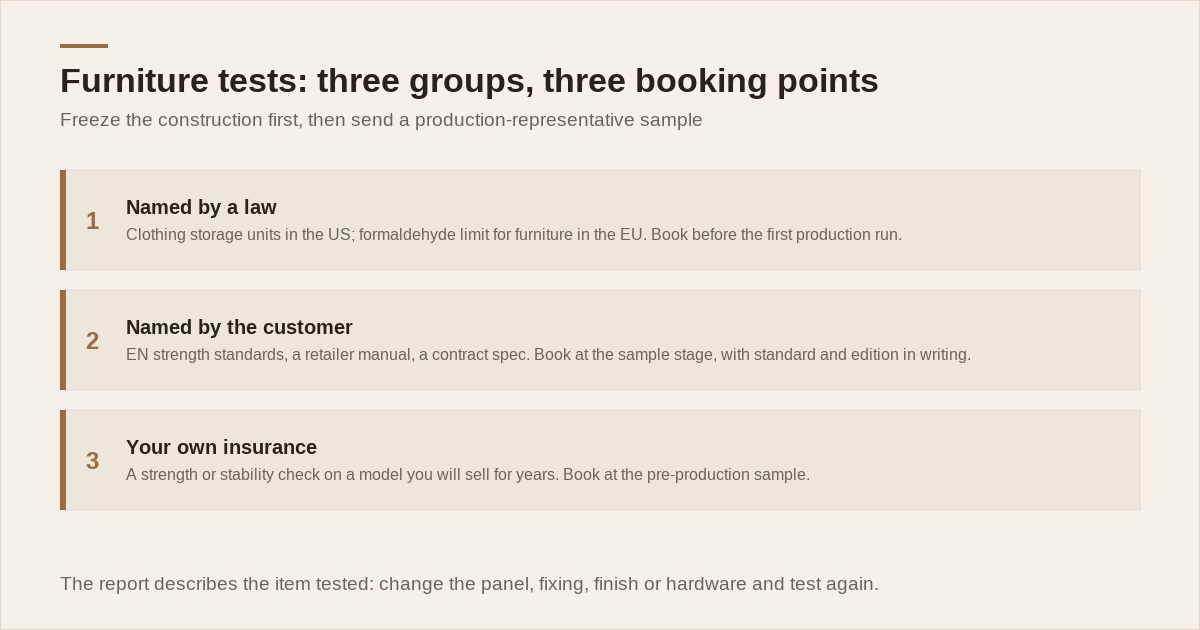
Three groups of tests
| Group | Example | Who decides | When to book |
|---|---|---|---|
| Named by a law | US clothing storage unit stability; EU formaldehyde limit for furniture | The regulation | Before the first production run |
| Named by the customer | EN strength standards for chairs, tables and beds; a retailer’s manual | The importer or retailer | At the sample stage, once the standard and edition are agreed |
| Your own insurance | A strength or stability check on a model you will sell for years | You | At the pre-production sample |
The first group is not negotiable and the second is a contract term. The third is the cheapest and most often skipped.
US: clothing storage units come first
If you make dressers, chests or similar bedroom storage, read the clothing storage unit rule first. CPSC’s business guidance says the rule is codified at 16 CFR part 1261 and requires the version of ASTM F2057 the Commission accepts, which it names as ASTM F2057-23. A unit is covered when it is free-standing, at least 27 inches tall, at least 30 pounds and has at least 3.2 cubic feet of enclosed storage volume, and the rule applies to units manufactured after 1 September 2023.
CPSC lists three stability tests: a clothing load test, a horizontal force test with 10 pounds applied at the highest hand-hold and a carpet test with a 60 pound child-weight apparatus. An anti-tip device that meets ASTM F3096 must be packaged with the product, and warning labels are required. We did not read the ASTM texts, which are sold by ASTM. Get the current edition and the clause list from your lab or your importer.
Two points sit on the factory’s side of the line:
- The certificate is not yours to issue. CPSC’s clothing storage unit page says manufacturers and importers must issue a certificate of compliance, and its testing page names the domestic manufacturer or the importer as the issuer. For a product made in Vietnam that is normally the importer. For this product the certificate should cite 16 CFR part 1261, clothing storage units. Your job is to supply test results and records the importer can rely on.
- The importer now files it electronically. CPSC states that from 8 July 2026 importers of most regulated consumer products must file certificates of compliance electronically with CBP. Expect your importer to ask for the report details early, so keep them on file.
Children’s furniture is a different case. CPSC says nearly all children’s products must be third-party tested by a CPSC-accepted laboratory, and accreditation is rule-specific, so one product can need several tests from different labs. If any of your range is for children, ask the importer before you sample.
For panel-based pieces sold in the US, the formaldehyde rule for composite wood is a separate compliance track, and our CARB and TSCA Title VI guide covers it.
EU: a product safety duty and one chemical limit
The EU has no single rule that says every chair needs a lab report. Two things matter for a factory.
The General Product Safety Regulation. The Commission’s trade portal says it has applied since 13 December 2024, covers consumer products including those sold online, and requires economic operators to conduct more rigorous risk assessments across the product’s life. It lists an authorised representative among the EU-based operators with safety tasks. We could not open the regulation text on EUR-Lex, so we do not state its article numbers or file retention period here. Ask your importer what technical file it needs from you for each model and how long it expects you to keep it.
The formaldehyde limit for furniture. Regulation (EU) 2023/1464 added entry 77 to REACH Annex XVII. Two laboratory summaries (SATRA and Intertek) give the same figures: a limit of 0.062 mg/m3 for furniture and wood-based articles and 0.080 mg/m3 for other articles, applying from 6 August 2026. The Commission’s own announcement gives the same two limits and says producers had 36 months to comply. Articles used only outdoors are exempt. Intertek’s summary adds the test conditions: a chamber at 23 degrees C and 45 percent relative humidity, an air exchange rate of 1 per hour and a duration of no more than 28 days.
That means a desk or wardrobe made from MDF, particleboard or plywood can now be tested for what it releases into the air. We read these through lab summaries, not the Official Journal, so treat the details as directional and confirm the text and the test method with your importer. The practical step is the same either way: ask each panel supplier for chamber-test data on the panel you buy, keep it with the model file and tell the importer which panel is in which model.
Which EN standard goes with which product
Importers usually name the EN standard for the product type. These are the ones we checked, with the status we found:
| Product | Standard | Status we found |
|---|---|---|
| Domestic seating | EN 12520 | The 2015 edition is withdrawn (BSI lists 15 November 2024); the Finnish SFS store lists a 2024 edition |
| Domestic tables | EN 12521 | The 2015 edition is withdrawn; DIN lists it as replaced by the 2024-02 edition |
| Beds | EN 1725 | Austrian Standards lists a current 2024 edition; tests assume users up to 110 kg |
| Domestic and kitchen storage units | EN 14749 | Austrian Standards lists a current 2022 edition; it excludes office and other non-domestic storage |
Two traps follow from the table. First, an importer’s template may still cite an old edition. Ask which edition it wants and tell the lab in writing. Second, the scope matters: EN 12520 covers domestic seating for adults and excludes office, school and outdoor seating, so a desk chair or an outdoor chair needs a different standard. Name the product type and the clause in the order, not only “EN standards”.
Our guide to reading a lab’s ISO 17025 scope shows how to check that the lab is accredited for the method you need.
Need a quote for this product? Get matched with a Vietnam wood factory
Build a test calendar for each model family
Treat testing like tooling: plan it once for each product family and reuse the plan.
- Write the test list from the order. List each model with its market, the standard, the edition and the clause, as the importer confirms them in writing.
- Freeze the construction first. Panel thickness, fixings, feet, glue and hardware should not change between the tested sample and production.
- Run an in-house check. A simple load or stability check on the pre-production sample finds weak joints before the lab does. It does not replace a report the importer will accept.
- Send a production-representative sample. Ask the lab for its turnaround on the method and put it in the schedule next to the sample round, because the queue is the part you cannot control.
- Keep the report with the drawing. Write the report number, lab and date on the model’s master sheet.
- Set retest triggers. Any change to panel, fixing, finish system or hardware supplier goes to the importer before you make it.
A failed test usually costs a design change, not a retest of the same piece. Typical fixes are a thicker rail, a different fixing, an extra stretcher or a wider foot, and each changes cost. Doing this before the price is final avoids a price argument later.
What to ask the importer before you sample
- Which standard, which edition and which clauses apply to each model?
- Does the importer accept any accredited lab for the method, or only a named one?
- Who receives the report and in what format?
- Does a test on one model cover its size and finish variants, or must each be tested?
- What do you need to supply for the certificate or technical file, and in what format?
Do not guess the answer to the fourth question. Importers and labs differ, and the answer decides how many samples you build.
Talk to us
We are a matching service. We do not test furniture, issue certificates or choose standards for your buyers. If your factory builds furniture in Vietnam and wants export requests that fit what you already make, talk to us through the for suppliers page. We reply within 24 business hours.
Sources
- CPSC: Clothing Storage Units business guidance
- CPSC: Third Party Testing
- European Commission, Access2Markets: the General Product Safety Regulation
- European Commission: the EU restricts exposure to formaldehyde in consumer products (14 July 2023)
- SATRA: REACH entry 77, formaldehyde in articles (laboratory summary)
- Intertek: Regulation (EU) 2023/1464 formaldehyde restriction (laboratory summary)
- BSI: EN 12520 domestic seating, edition status
- DIN Media: EN 12521 domestic tables, edition status
- Austrian Standards: EN 1725 beds and EN 14749 storage units
The SATRA and Intertek pages are test laboratories’ summaries of the regulation, and the standards pages are shop listings, so none of them replaces the official text. We did not read the ASTM or EN standards themselves. Rules, editions and dates change, so confirm each point with your importer and a test laboratory. This guide is general information, not legal advice.
Frequently asked questions
Which furniture must a factory test before it ships to the US?
The clearest legal case is the clothing storage unit rule. CPSC describes a covered unit as free-standing, at least 27 inches tall, at least 30 pounds and with at least 3.2 cubic feet of enclosed storage, made after 1 September 2023, and it must meet ASTM F2057-23. Other furniture is tested when the importer, retailer or contract asks.
Does the EU require a test report for every piece of furniture?
Not as one blanket rule that we could confirm. The General Product Safety Regulation applies from 13 December 2024 and expects risk assessment for consumer products, and the formaldehyde limit for furniture applies from 6 August 2026. How you prove compliance, and with which EN standard, is usually set by your importer.
Who issues the US certificate, the factory or the importer?
CPSC says manufacturers and importers must issue a certificate of compliance, and its testing page names the domestic manufacturer or the importer as the issuer. For a product made in Vietnam that is normally the importer, so the factory's job is to supply the test results, the drawing and the production records the importer needs. Ask what it wants to receive.
When should a factory send the first sample to a lab?
Send a production-representative sample as soon as the construction is frozen and before the price is final. A failed test usually means a thicker part, a different fixing or an extra stretcher, and each of those changes the cost. The report describes the item tested, so change the construction and the report no longer describes it.
Need a quote for this product?
Send the specification. We match you with up to 3 Vietnamese wood factories and reply within 24 business hours.
Get matched with a Vietnam wood factory