Guides / Compliance
The 2027 Compliance Calendar for Importers of Furniture Made in Vietnam
November 21, 2026
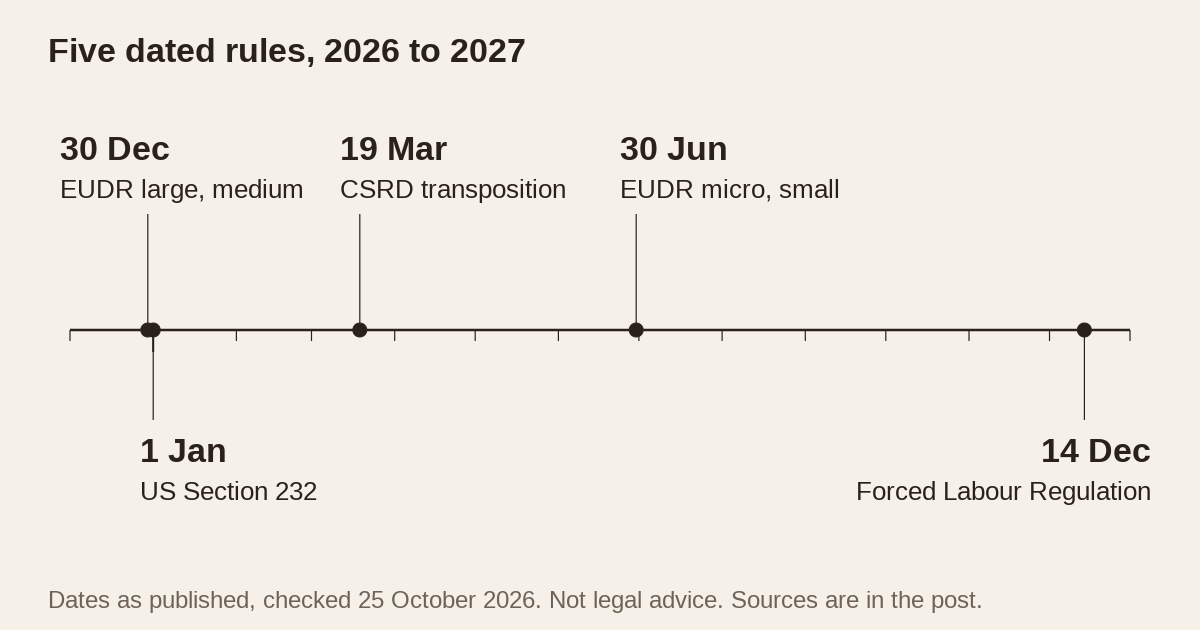
Five dated rules matter to an importer of Vietnamese furniture around 2027: the EU Deforestation Regulation (EUDR) for large and medium operators on 30 December 2026, the US Section 232 duty step on 1 January 2027, the CSRD transposition deadline on 19 March 2027, EUDR for micro and small operators on 30 June 2027 and the EU Forced Labour Regulation on 14 December 2027. The table below gives each date, what changes, what to ask the factory and the source. It is a reference as of 25 October 2026 and not legal advice. The single-rule details sit in our posts on EUDR for Vietnam wood imports and furniture to the United States.
The calendar
| Applies from | Rule | What changes | What to ask the factory | Source |
|---|---|---|---|---|
| 30 December 2026 | EUDR, Regulation (EU) 2023/1115 as amended | Large and medium operators need due diligence and a statement before wood products reach the EU market. Micro and small operators already covered by the EU Timber Regulation start the same day | Species, country of production and plot location for every timber input, and a complete data pack from a shipment that already went to Europe | European Commission EUDR page |
| 1 January 2027 | US Section 232 timber duty step | Upholstered furniture 25% to 30%. Kitchen cabinets and vanities 25% to 50%. The text excepts countries that reach an agreement with the US | A precise description of the product, materials and construction so your broker can pick the tariff line | Proclamation 11000 of 31 December 2025 |
| 19 March 2027 | CSRD changes (Omnibus I), transposition deadline | Member states write the new scope into national law. EU reporting companies must exceed 1,000 employees and EUR 450 million turnover | Whether a customer’s sustainability questionnaire is mandatory or a request, and which standard it follows | Latham & Watkins summary of Directive (EU) 2026/470 |
| 30 June 2027 | EUDR for micro and small operators | Small EU importers join the system | The same data pack as for large operators | European Commission EUDR page |
| 14 December 2027 | EU Forced Labour Regulation, (EU) 2024/3015 | Products made with forced labour may not be placed or made available on the EU market. It reaches stock already in warehouses | Policies, worker lists, grievance channel, the supplier list for key inputs and subcontractors | Law-firm summaries of the regulation and the Commission guidelines |
Dates are as published on the sources named; confirm each with your broker or lawyer. The official EUR-Lex pages did not open from our tools, so the Forced Labour Regulation and Omnibus entries rest on named law-firm summaries, and the EUDR entries on the Commission’s own pages.
Rule by rule
EUDR: 30 December 2026 and 30 June 2027
The Commission page lists 30 December 2026 for large and medium operators and 30 June 2027 for micro and small operators, with micro and small operators already covered by the EU Timber Regulation starting on 30 December 2026. The Commission’s country list places Vietnam in the low risk category. High risk is Belarus, North Korea, Myanmar and Russia, and countries not on the list are standard risk. Low risk allows simplified due diligence only when all of the product comes from low-risk countries, so a Vietnamese table made with imported oak is a mixed-origin case.
The importer files the statement, not the factory. The factory’s job is data. Our EUDR data pack page lists what a factory should be able to send, and the country risk page explains what low risk changes in practice.
Section 232: 1 January 2027
Proclamation 11000, signed on 31 December 2025, delayed for an additional year the increase in duty rates on upholstered furniture and on kitchen cabinets and vanities. The text raises the first from 25 to 30 percent and the second from 25 to 50 percent from 1 January 2027, “except for countries with which the United States reaches an agreement”. We opened the text on GovInfo. The step applies to those two product groups. Furniture outside them is not part of the step; ask your broker which other duties apply, including the Section 301 duty described below. Our US trade remedies page walks through the order of checks.
CSRD and the Omnibus: 19 March 2027
Directive (EU) 2026/470, the Omnibus I directive, was published in the Official Journal on 26 February 2026 and entered into force on 18 March 2026, according to Latham & Watkins. Member states have until 19 March 2027 to transpose the CSRD changes. The reporting scope is now companies with more than 1,000 employees and more than EUR 450 million net turnover. The due diligence directive (CSDDD) scope is above 5,000 employees and EUR 1.5 billion turnover, with compliance from 26 July 2029.
For a Vietnamese factory the practical point is the value chain cap. Latham & Watkins reports that companies in a value chain with 1,000 or fewer average employees can refuse sustainability information requests that go beyond the voluntary standards. Fewer buyers are in scope, yet those that remain may still send questionnaires, so ask which standard the request follows before the factory spends a week answering it.
Forced Labour Regulation: 14 December 2027
Regulation (EU) 2024/3015 applies from 14 December 2027. The Commission adopted guidelines on 26 June 2026 (document C(2026) 4386 final), and they appeared in the Official Journal notice C/2026/4637 on 3 September 2026. Summaries of the guidelines from Baker McKenzie, Covington and Hogan Lovells Cadwalader give these main points:
- Scope: the ban covers products made with forced labour and reaches stock already in warehouses, not only new shipments.
- Due diligence: the regulation does not require a due diligence system, but the guidelines use the OECD six-step framework as the benchmark, and a documented system helps as evidence. It is not a safe harbour.
- Timing: an authority decides within 30 working days whether there is a substantiated concern, and operators typically have 30 to 60 working days to answer information requests in a formal investigation.
- Who leads: the Commission acts as the lead authority where the suspected forced labour is outside the EU, so a Vietnamese factory may receive questions through its importer.
- Evidence the guidelines list: policies and codes of conduct, grievance mechanism documents, worker lists, social audits, remediation records, traceability documents, supply chain maps and purchase orders and invoices.
- Risk database: the EU forced labour risk database was still under development in the summaries we read.
Importers are likely to be the main target for forced labour outside the EU, so the supplier files matter. We hold no certificate and audit no factory.
Rules already in force that sit beside the calendar
| Rule | Date | What it does | Source |
|---|---|---|---|
| US Section 301 forced labor action | In force since 24 July 2026 | Additional 12.5% on listed economies including Vietnam. Goods already under Section 232 are excluded, so the two do not stack | Alston & Bird and EY summaries of the USTR action |
| US antidumping and countervailing duties on hardwood and decorative plywood from Vietnam | Final Commerce determinations on 16 July 2026 | Vietnam-wide antidumping cash deposit rate of 84.95% and countervailing rate of 47.68% for all others, per the Commerce page. The International Trade Commission injury stage ran in parallel | Trade.gov |
Re-check any quote written before 24 July 2026 for furniture outside the Section 232 lists, because it may not include the Section 301 duty. The plywood case matters to buyers who import plywood panels.
Need a quote for this product? Get matched with a Vietnam wood factory
How to use the calendar
- Before 30 December 2026. If you ship to the EU, collect the EUDR data pack for each live model and name the person at the factory who owns it.
- First quarter of 2027. Re-price any upholstered, cabinet or vanity model at the rate that applies on your entry date. Ask the broker for the tariff line.
- Second quarter of 2027. Check which sustainability questionnaires reach your factory and who sends them. Use the transposition date to ask whether the request is mandatory.
- Second half of 2027. Build a supplier file for the forced labour rules: the policy, the worker list, the key input suppliers and the subcontractors. Our factory vetting guide and certificate checking page show what to ask for and how to read what comes back.
- Every quarter. Re-read the dates in the table. Duties and deadlines in this field have moved before.
If you need the market data behind these dates, see our 2027 sourcing data and buyer plan. When your specification is ready, send it through the RFQ page. We reply within 24 business hours and match you with up to 3 Vietnamese wood factories that quote you directly.
Sources
- European Commission: Regulation on deforestation-free products
- European Commission: EUDR country classification list
- GovInfo: Proclamation 11000 of 31 December 2025, amendments to the timber, lumber and derivative products action
- Linklaters: EU Omnibus I directive published in the Official Journal (Directive (EU) 2026/470)
- Latham & Watkins: EU Sustainability Omnibus published in the Official Journal
- Baker McKenzie: EU publishes guidelines on the application of the EU Forced Labour Regulation (24 August 2026)
- Covington: European Commission publishes Forced Labour Regulation guidelines, key takeaways (July 2026)
- Hogan Lovells Cadwalader: EU Forced Labour Regulation, key takeaways from the Commission’s June 2026 guidelines
- Alston & Bird: USTR finalizes 10 to 12.5 percent Section 301 forced labor duties
- EY: USTR finalizes Section 301 forced labor tariffs on 60 economies
- Trade.gov: Final affirmative determinations, antidumping and countervailing duty investigations, hardwood and decorative plywood
Figures checked on 25 October 2026. The Federal Register and EUR-Lex pages did not open from our tools, so the Forced Labour Regulation date and the Omnibus entries come from named law-firm summaries that agree with each other. This post is a reference, not legal or customs advice.
Frequently asked questions
Which rules for furniture from Vietnam start in 2027?
The dates we found are the Section 232 duty step on 1 January 2027, the deadline for EU member states to transpose the CSRD changes on 19 March 2027, EUDR for micro and small operators on 30 June 2027 and the EU Forced Labour Regulation on 14 December 2027. EUDR for large and medium operators begins one day earlier, on 30 December 2026.
Does Vietnam's low-risk EUDR classification remove the paperwork?
No. The Commission lists Vietnam in the low risk category, which allows simplified due diligence only when all of the product comes from low-risk countries. The operator still collects the information and files the statement. Check the origin of every timber input, because imported oak or ash is not Vietnamese.
Does the EU Forced Labour Regulation require a due diligence system?
The regulation does not impose a mandatory due diligence obligation, according to law-firm summaries of the Commission's June 2026 guidelines. The guidelines use the OECD six-step framework as the benchmark, and documented due diligence is useful evidence if an authority asks questions. Operators are likely to ask suppliers for the records.
What happens to the Section 232 increase if a trade deal is signed?
Proclamation 11000 states that the increase applies except for countries with which the United States reaches an agreement. A search on 25 October 2026 did not find an announced agreement that exempts Vietnamese wood furniture, but we cannot rule one out. Plan for the scheduled rates and confirm the position on your entry date.
Need a quote for this product?
Send the specification. We match you with up to 3 Vietnamese wood factories and reply within 24 business hours.
Get matched with a Vietnam wood factory