Guides / Materials
Veneer Pressing and Edge Banding in Vietnam Furniture Plants
November 21, 2026
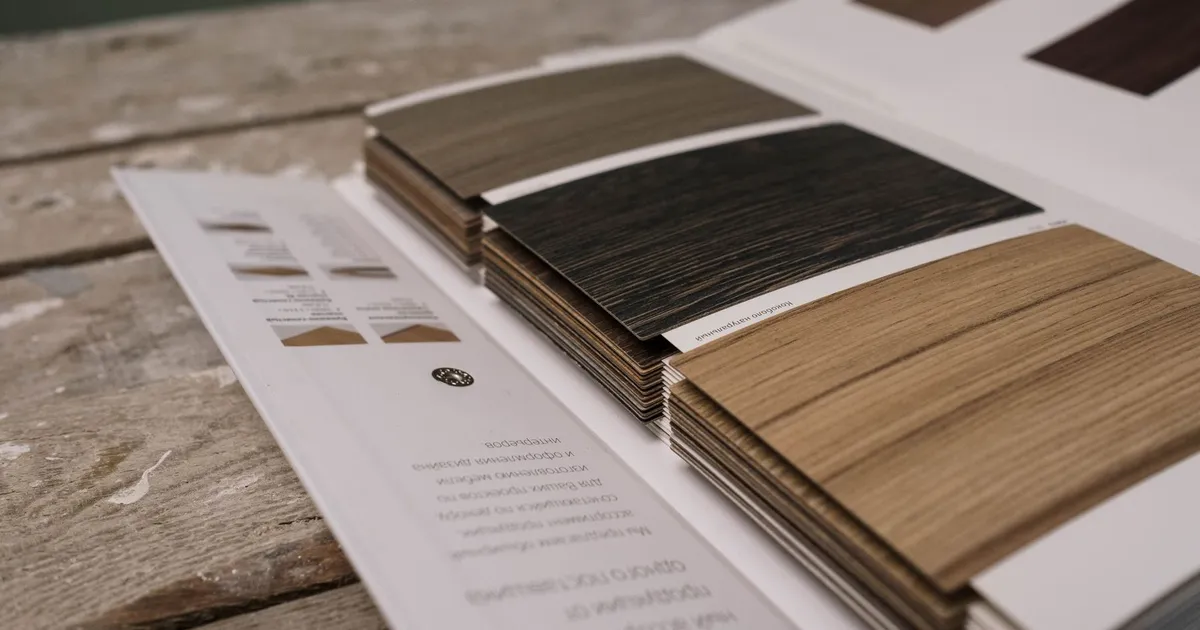
Veneer is a thin slice of real wood glued to a stable core, and Vietnamese furniture plants use it on a large share of cabinets, tables, desks and bedroom casegoods. The core is usually MDF, particleboard or plywood. The wood on the surface looks like solid timber, and the panel stays flatter than solid timber does.
Two steps decide whether a veneered product survives shipping and ten years of use: how the veneer is pressed and how the edges are closed. This guide explains both, then shows the checks that separate a good plant from a weak one.
What veneer is and where it comes from
Decorative veneer is made by slicing or peeling a log or flitch into sheets between 0.3 and 1 mm thick. Slicing keeps the grain pattern of the log and gives the familiar cathedral and straight grain looks. Rotary peeling gives wider sheets with a more irregular pattern, and it is used mostly for plywood layers.
Vietnamese plants buy veneer from three sources. Some veneer is cut in Vietnam from local plantation wood such as rubberwood and acacia. A large share is imported from other producing countries in species such as oak, ash, walnut and maple. A third category is reconstituted veneer, which is made by gluing and re-slicing fast growing logs to imitate a more expensive species with a uniform pattern.
The practical consequence for a buyer is that the species name on a quote needs a second line saying where the veneer comes from and whether it is natural or reconstituted. Both are acceptable when they are named. Neither is acceptable when a quote simply says “walnut”.
How veneer is pressed
The press step bonds the veneer to the core under heat and pressure. Most plants use one of two systems.
Hot press. The glue is a urea formaldehyde, melamine urea or PVAc system. The panel stack is pressed between heated platens at roughly 80 to 120 degrees Celsius for a few minutes. Output is high and the bond is strong. This is the standard for flat panels in volume programs.
Cold press or membrane press. PVAc glue is applied and the panel is pressed at room temperature for a longer time, or the veneer is pulled over a shaped core with a vacuum membrane. This is used for curved parts, profiled doors and small runs. Output is lower, and the plant needs more clamping time and more working space.
Whatever the method, the quality depends on five controls that you can ask about.
- Core flatness and sanding. The core must be sanded to a calibrated thickness. Any bump in the core shows through the veneer after finishing.
- Glue spread. Too little glue gives dry patches and blisters. Too much glue bleeds through thin veneer and stains the face.
- Veneer moisture. Veneer that is too wet shrinks and splits after pressing. Veneer that is too dry cracks when handled.
- Press temperature and time. These must match the glue system. A rushed press at the end of a shift leaves a weak bond.
- Stacking after pressing. Panels need to cool flat under weight, otherwise they warp.
Balancing the panel
A single face veneer on one side of a core makes an unbalanced panel that bows over time. The standard answer is a balancing layer on the back, either a veneer of a cheaper species or a paper or melamine sheet of similar thickness. If a quote prices a veneered panel very low, ask whether the back is balanced. A one sided panel looks identical at the factory and bends in a customer’s home.
Edge banding
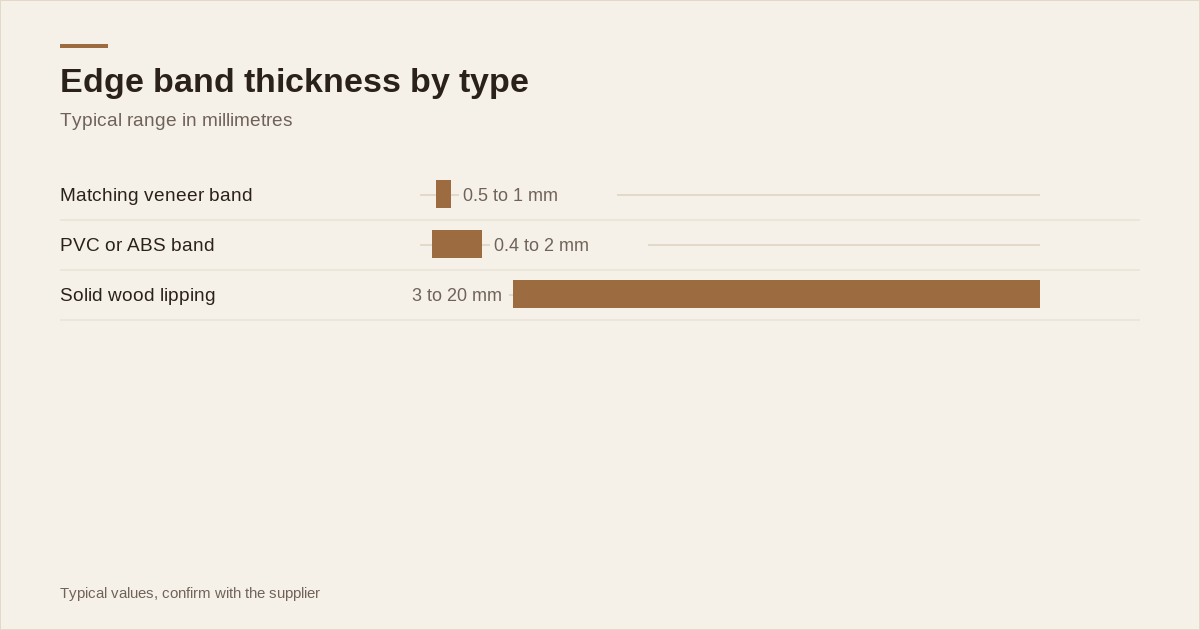
A veneered panel has raw core on every edge. Edge banding closes the core, protects it from moisture and gives the piece a finished look. Three kinds of band are common.
| Band type | Thickness (typical) | Look | Typical use |
|---|---|---|---|
| Matching veneer band | 0.5 to 1 mm | Same wood as face, grain runs along the edge | Cabinet and table edges on veneer furniture |
| PVC or ABS band | 0.4 to 2 mm | Printed or solid colour, uniform | Interior edges, budget lines, melamine panels |
| Solid wood lipping | 3 to 20 mm | Real timber, can be profiled | Table tops, desk tops, visible edges that need a radius |
Veneer band matches the face best and costs less than solid lipping, but it chips more easily at corners. Solid wood lipping resists impacts and can be rounded or chamfered, so it is the safer choice for tops that people lean on or bump with chairs.
Industrial edge banders apply hot melt glue to the edge, press the band on, trim the overhang, then round the corner and scrape or buff the edge. Good plants use PUR hot melt for edges that face water, such as kitchen cabinets, and standard EVA hot melt for dry areas. Ask which one is used.
Typical defects and what causes them
| Defect | What you see | Likely cause |
|---|---|---|
| Blister | Raised bubble on the face | Low glue spread, trapped air or wet veneer |
| Telegraphing | Core flaws visible through the face | Rough or uneven core sanding |
| Glue bleed | Dark patches on light veneer | Too much glue or too thin veneer |
| Edge peel | Band lifts at the end or corner | Cold glue, cold panel, low spread |
| Sand through | Core visible on the face after sanding | Veneer too thin for the sanding sequence |
| Bowing | Panel curves along its length | Unbalanced construction or wrong moisture |
Each of these can be spotted at an inspection, and the quality inspection guide explains how to set acceptance limits for them.
Need a quote for this product? Get matched with a Vietnam wood factory
Veneer and finishing
Veneer limits how hard a finishing line can sand. A 0.5 mm face can be scuff sanded between coats but not machine sanded aggressively, and the plant should use fine grits and a light touch. The guide to wood finishes for export furniture covers the finish options. Whatever finish you choose, approve a finished sample of the veneer species and band together, not the veneer alone, because the band absorbs stain at a different rate from the face and can look darker or lighter after finishing.
Matching grain across parts
A veneered cabinet or bed looks expensive when the grain runs continuously across the doors, drawer fronts and top. That effect needs book matching or slip matching of veneer leaves, and it needs the plant to cut all visible parts from the same flitch in the right order. It costs more than random matching, because the veneer is cut and laid out part by part, and the offcuts cannot always be used elsewhere.
Ask the factory which matching it will use and whether the whole order comes from one flitch lot. A second lot arrives with a slightly different colour and grain, and the mismatch shows on a bedroom set where the bed was made in the first batch and the nightstands in the second. For large programs, ask the plant to reserve enough veneer for the full quantity before production starts, and to keep sample leaves from each lot for later comparison.
Cost and lead time
Veneered furniture usually sits between solid wood and printed foil or melamine on price. Three items decide where it lands: veneer species, matching method and the number of finish coats. A reconstituted veneer costs a fraction of a premium natural walnut, and the difference grows in large panels.
On lead time, veneer adds a few steps compared with solid wood panel work: cutting and jointing veneer leaves, gluing, pressing, cooling, sanding, edge banding and then finishing. Plants that run these steps in line often add around one week to a comparable solid wood order, and plants that outsource pressing to a panel shop add more. The lead time and production schedule guide shows how to plan the full calendar from sample approval to loading.
Sample approval routine
A short routine avoids most disputes. Request a sample with the real veneer, the real core, the real edge band and the real finish. Check it against the drawing, keep it signed and sealed, and ask the plant to keep an identical reference piece. At inspection, compare production pieces against that reference under daylight and under the lighting your customers use, because veneer colour shifts between a factory floor and a showroom.
Photograph the sample on its edge, its corner and its back as well as its face. Corners and backs are where veneer plants cut corners, and a photo record lets you point to the approved standard when a shipment drifts from it.
Compliance on veneered panels
The core is where compliance questions arise. MDF and particleboard contain formaldehyde releasing resins, and furniture sold in the United States must comply with composite wood rules. Veneer on top does not change this. If you plan to ship veneered furniture to the United States, read the CARB and TSCA Title VI guide and ask for panel supplier documents before you place an order.
What to put in the specification
For each veneered part, write the following: species and whether natural or reconstituted, cut (flat sliced, quarter sliced or rotary), veneer thickness, core material and thickness, back balancing layer, edge band type and thickness, glue system for edges, and the finish. Add a photograph or a physical sample of the face you expect.
Two practical points keep surprises down. First, ask for a sample of a pressed and banded panel, not just a veneer swatch. Second, ask for a cross section photo of the edge, which shows the band, the glue line and the core in one view.
If you are weighing veneer against solid wood or other constructions, the comparison of solid wood and engineered panel lays out the trade offs. If you are ready to request quotes on a veneered product, the RFQ page matches your specification with up to three Vietnamese wood factories and replies within 24 business hours.
Frequently asked questions
How thick is the veneer on Vietnamese furniture panels?
Sliced decorative veneer for furniture is commonly 0.5 to 0.6 mm thick, with thinner and thicker options. Thicker veneer of 0.8 mm or more can be sanded back once or twice, while a 0.3 mm face cannot take a hard sanding. Ask the factory for the actual veneer thickness in writing.
Is veneered furniture real wood?
The face is real wood, the core is not. Most veneered panels use MDF, particleboard or plywood as the core. Describe the product as veneered, not solid, in your listings, and name the core in the specification.
Why do edge bands peel in transit or after a few months?
The usual causes are low glue spread, a cold panel or cold glue at the edge bander, a worn trimming cutter that leaves a rough edge, and humidity swings in the container. A good plant checks glue temperature and panel temperature at every shift. Ask to see the edge banding station during a video call.
Need a quote for this product?
Send the specification. We match you with up to 3 Vietnamese wood factories and reply within 24 business hours.
Get matched with a Vietnam wood factory