Guides / Sourcing Guide
Knock-Down Furniture Design and Hardware for Export
November 7, 2026
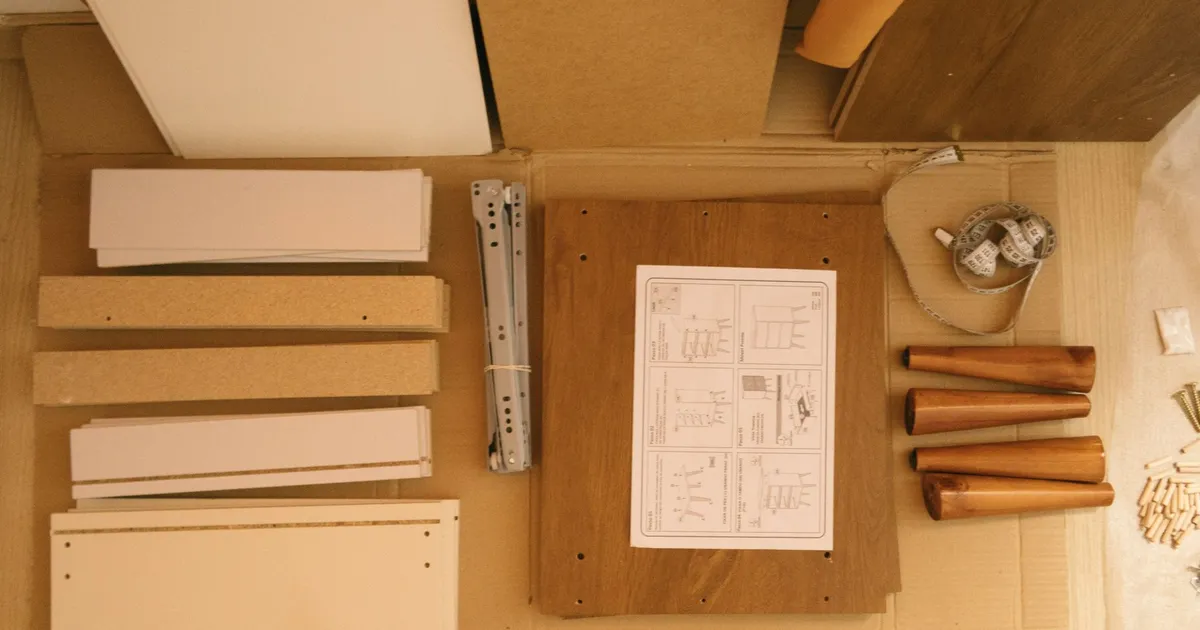
Knock down furniture ships flat and is assembled by the customer or an installer. It cuts freight, reduces damage in transit and lets a factory stack more units in a container. It also puts the quality of every joint, hole and fitting in the hands of someone who is not a woodworker. A knock down design that works in a factory test can fail in a living room if one tolerance or one instruction is off.
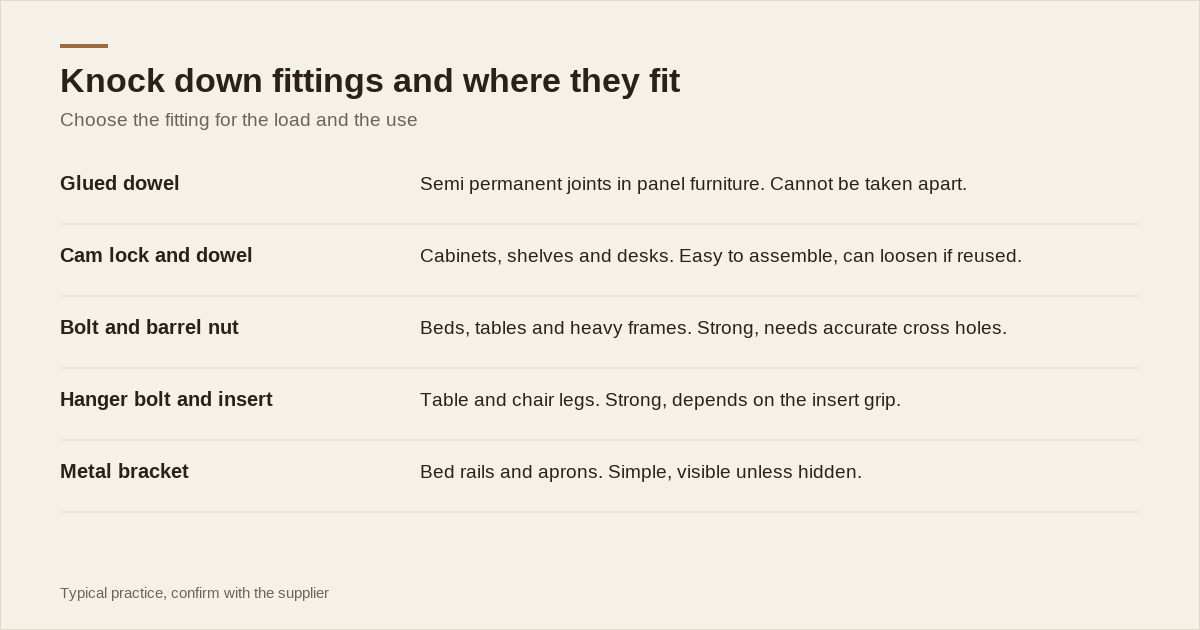
This guide covers the joints and fittings used in Vietnamese knock down programs, the tolerances that matter, the instruction sheet and the checks that keep returns low.
Why buyers choose knock down
Freight is the first reason. A dining chair assembled takes up a lot of air. The same chair as four legs, a seat and a back packs into a fraction of the space. For large orders, lower cubic metres per unit reduces the landed cost, and often that saving exceeds the extra labour or hardware cost.
Damage is the second reason. Flat parts in a carton with corner protection are less likely to scratch or crack than assembled pieces that touch each other. The third reason is storage and last mile delivery. A flat carton goes through a door and up a staircase more easily than a finished wardrobe.
The trade off is the customer experience. Every product that arrives flat needs clear assembly, hardware that fits and holes that line up. Poor assembly experience shows up in reviews and returns, and that cost can erase the freight saving.
Joint and fitting types
| Fitting | How it works | Typical use | Strength and risk |
|---|---|---|---|
| Wooden dowel with glue | Glued dowel pins and screws | Semi permanent joints in panel furniture | Strong once glued, cannot be taken apart again |
| Cam lock and dowel | Cam turns a bolt head and pulls panels together | Cabinets, shelves, desks | Easy to assemble, can loosen with repeated assembly |
| Bolt and barrel nut | Bolt passes through a cross barrel set in the part | Beds, tables, heavy frames | Strong and re-usable, needs accurate cross holes |
| Hanger bolt and insert | Threaded insert in the part, bolt in the mating part | Table legs, chair legs | Strong, depends on the insert grip in the wood |
| Metal bracket and screws | L bracket or plate screwed to both parts | Bed rails, table aprons | Simple, visible unless hidden |
| Slide in or keyed joint | Parts slide together and lock by shape | Flat pack designs without tools | Neat, needs tight tolerance |
Pick the fitting for the load and the use, not only for price. A bed frame carries body weight and movement for years, so it needs bolts and barrel nuts or equivalent. A small side table may use dowels or hanger bolts.
Tolerances that decide whether it assembles
Knock down fails at holes. If two holes that should line up are off by 1 mm, a cam lock may still close. If they are off by 2 mm, it will bind, strip or split the panel. Hole position, diameter and depth need a stated tolerance on the drawing, and the plant needs a way to hold it, usually a boring machine or a CNC point to point router, as described in the CNC guide.
Wood movement adds to the problem. A solid wood part machined at 12 percent moisture and shipped to a home at 7 percent shrinks. Across a 600 mm width, the change can be a millimetre or more in some species. Designs that use solid wood in a knock down structure leave slotted holes or a small clearance in the direction of expected movement. The moisture content guide lists target ranges.
Hardware tolerance matters as well. A cam lock fitting made by one maker may not fit holes drilled for another maker’s fitting. State the fitting brand or the dimensions and make sure the drilled hole matches the fitting that ships.
Hardware sourcing and substitution
Hardware is a common cause of dispute. A factory may substitute a cheaper or locally available fitting when the original runs short, and the substitute may differ by a few tenths of a millimetre. To avoid this:
- Write the fitting model or full dimensions into the specification.
- Say who orders the hardware, the plant or the buyer.
- Ask for a hardware sample set with the product sample, and keep it as the standard.
- Ask the plant to inform you in writing before any change in supplier.
For safety critical parts, such as bed bolts and chair joints, ask for a test report or a load test on the assembled product. The furniture test standards guide explains which standards apply in the main markets.
The instruction sheet
An instruction sheet is part of the product. It needs clear numbered steps, a parts list with quantities, a drawing of each fitting and a note about which tools are needed. Pictures work better than words, because the buyer’s customers speak many languages.
Write the sheet before production, and have someone who has never seen the product follow it. If they get stuck at a step, the drawing needs another view. The plant often drafts a first version, and you should review it against your own sample. A missing screw type on the parts list is the most common error, and it generates the most customer service calls.
Carton design and parts protection
KD cartons hold many small parts, and the hardware bag needs its own place. Put hardware in a labelled bag taped inside the carton in a fixed location, and print a parts check list on the outside or on a sheet inside. Protect finished faces with foam or paper, and use corner protectors on panel edges. The packaging guide covers carton strength and drop test requirements.
Count the cartons per unit. A bed may ship in three cartons, and if one goes missing, the unit is unusable. Label cartons “1 of 3” and so on, and add the model code and a barcode if your system uses one.
Need a quote for this product? Get matched with a Vietnam wood factory
Counting the freight saving
Do the arithmetic before you commit to KD. Ask the factory for the carton size of the flat version and the assembled version, then calculate cubic metres per unit for each. A standard 40 foot container holds roughly 65 to 70 cubic metres of usable cargo in practice, so a flat carton of 0.05 cubic metres lets you load far more units than an assembled piece of 0.4 cubic metres.
Then add the costs that KD brings: hardware, drilling, extra cartons and inner packing, instruction sheets and the customer service load. For a small, cheap product the hardware and packing can take back much of the freight saving. For a large product the saving usually dominates. Run the numbers per model, not per programme, because a bed and a bedside table behave differently.
A short example of the method: if an assembled chair takes 0.30 cubic metres and the flat version takes 0.09, the container holds more than three times as many flat chairs. If freight per container is a fixed amount, the freight per chair falls by about two thirds, which you compare against the extra hardware cost per chair. The payment terms and Incoterms guide explains how freight terms change who carries the saving.
This section pairs with furniture container loading by CBM.
Quality checks for knock down products
- Pilot assembly. Assemble the first production unit from a random carton, following only the instruction sheet.
- Fit test across a batch. Assemble units from three different cartons to prove that parts interchange.
- Hole check. Measure hole positions on a sample of parts with a template.
- Hardware count. Check that each carton contains the right number of each fitting plus the spares you specified.
- Re-assembly. Take one unit apart and assemble it again to see whether the joints survive a second time.
The quality inspection guide shows how to place these checks inside a standard inspection.
When knock down is the wrong choice
Some products do not suit KD. Upholstered pieces with fixed frames, glued chairs with complex joinery and heavy cabinets with doors fitted to frames lose quality or strength when taken apart. A solid wood dining chair with mortise and tenon joints is usually shipped assembled, because the glue and the fit are part of its strength. Forcing KD on such a design can cost more in failures than it saves in freight.
A good compromise is partial knock down: a chair ships with the back and seat assembled and the legs attached by bolts, or a table ships with the legs removed and the top and aprons assembled. Ask the factory to suggest a split that keeps the strong joints permanent and puts only the safe joints in the customer’s hands.
Think about the person who assembles the product as well. A professional installer in a hotel works with a drill and a bit set and tolerates a hard joint. A retail customer works with a screwdriver and an Allen key, and one stripped screw ends the project. If your end users are consumers, favour fittings that tighten by hand, limit the number of steps and avoid any joint that needs a hammer.
What to put in the specification
For each knock down product, state: the fitting list with models or dimensions, hole positions with tolerance, the moisture content at machining, who supplies hardware, the carton layout, the instruction sheet sign off and the pilot assembly check. Add a request for a full assembled sample with a flat packed version, so you can see both.
When you are ready to request quotes on a knock down design, send the drawing and fitting list through the RFQ page. The matching service finds up to three Vietnamese wood factories and replies within 24 business hours.
Frequently asked questions
What does knock down mean in furniture?
Knock down, often shortened to KD, means the product ships in separate parts that the end user or an installer assembles. Flat pack and ready to assemble describe the same idea. The alternative is a fully assembled product, which ships built and takes much more container space. KD is the usual way to cut freight cost.
How much freight does knock down save?
It depends on the product. A bulky chair or a cabinet can fill several times more container space assembled than flat. A dining table with a separate base and top saves less. Ask the factory for the carton dimensions of both the assembled and flat versions and compare cubic metres per unit.
Who supplies the hardware, the factory or the buyer?
Either, and it must be stated in the order. Many Vietnamese plants source common fittings locally or import them from large hardware makers. If your design needs a branded fitting or a specific load rating, name it in the specification and say who orders it, so a substitute does not arrive at the line.
Need a quote for this product?
Send the specification. We match you with up to 3 Vietnamese wood factories and reply within 24 business hours.
Get matched with a Vietnam wood factory