Guides / Choosing a Factory
Large Exporter, Mid-Size Plant or Small Workshop: Which Vietnamese Furniture Factory Fits Your Order
November 21, 2026
The size of a Vietnamese furniture factory decides how it treats your order more than its brochure does. A large exporter plans around repeating programmes, a mid-size plant fits most first containers and a small workshop fits samples and short runs. This post is part of our guide to wood furniture manufacturers in Vietnam, and it goes one level deeper on the size question: what each type offers, where it breaks and how to match it to an order.
The matching rule is simple. Compare your order with the factory’s normal run, not with your own ambitions. A plant is happiest when your order is a clear, planned part of its schedule.
What the public numbers say and what they do not
The industry is large and the plants are uneven. Vietnam Customs data reported by Viet Nam News put wood and wood product exports at $17.2 billion in 2025. A Forest Trends and VIFOREST report for 2024 counted over 4,200 businesses exporting directly, of which 777, or 18.5 per cent, were foreign-invested. Those 777 produced $7.67 billion of the $15.89 billion exported, which is 48.3 per cent of the value. A minority of exporters, therefore, carries nearly half the value.
A Timber Trade Portal page gives the size split of export processors as 93 per cent small or very small, 5.5 per cent medium and 1.5 per cent big, out of about 4,500 enterprises. The page gives no year and does not name its source, and its total differs from the Forest Trends count, so use it only as the rough shape of a long tail of small plants under a few big ones.
We found no public figure for MOQ, price or payment terms by factory size, and no public list of how many plants fall in each band. Everything below on behaviour is a pattern drawn from how plants of each size are organised. Test it against the plant you are talking to.
The three types compared
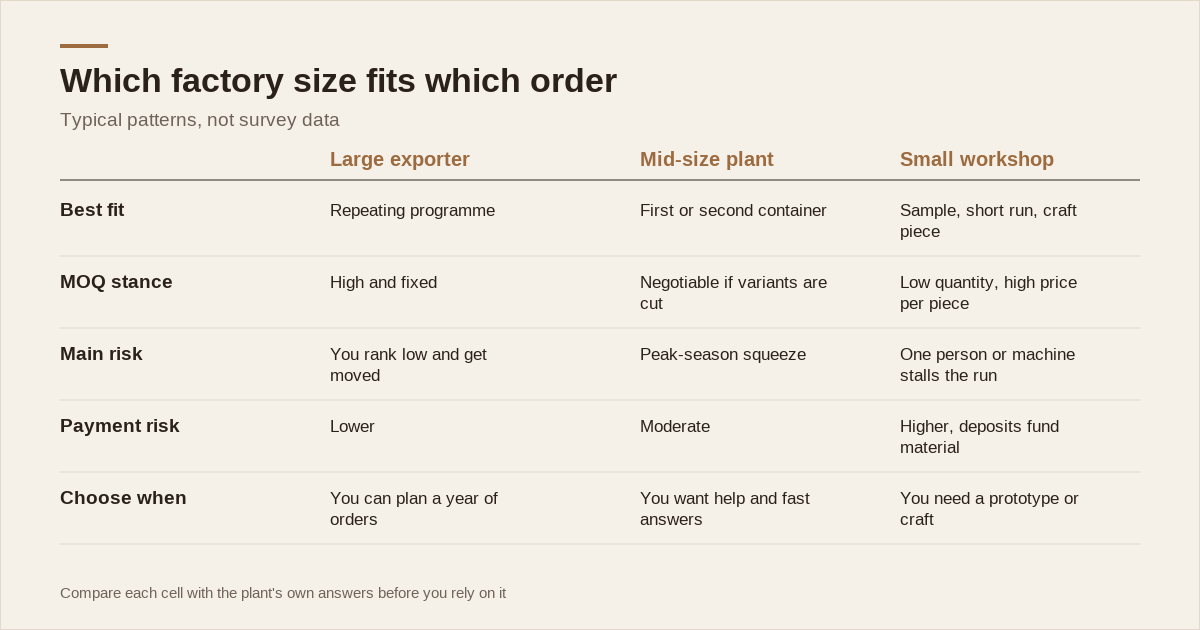
| Criterion | Large exporter | Mid-size plant | Small workshop |
|---|---|---|---|
| Best fit | Repeating programme planned across the year | First or second container of a defined range | Samples, short runs, craft or one-off pieces |
| Who you talk to | A sales team, often one with export experience in your market | A sales manager and a sample engineer, sometimes the owner | The owner or one coordinator |
| MOQ stance | High and fixed because setup is spread across big runs | Negotiable if you cut variants and use standard parts | Low quantity accepted, high price per piece |
| Capacity behaviour | Plans by season; small orders can be moved | Tight in peak months; ask what is booked | Limited by the number of skilled people and machines |
| Subcontracting | Deep, managed, usually audited | Common for metal, glass and upholstery | Often heavy, sometimes including finishing |
| Design and engineering help | Development team and a catalogue range | Sample workshop and drawing review | Craft skill, light drawing and test discipline |
| Compliance paperwork | Usually organised | Varies; ask early | Often thin; may need your help |
| Payment and financial risk | Lower | Moderate | Higher; deposits often fund materials |
| Main risk to you | You rank low and get moved | Peak-season squeeze | One person or one machine stalls the run |
Typical patterns, not survey data. Compare each cell with the plant’s own answers.
Order size against the factory’s usual run
Ask the plant one question: how many pieces of a product like mine do you make in a normal month? Then divide your order by that number in your head.
If your order is a small fraction of one normal run, you are a low priority: the plant fits you between larger jobs, and you carry the risk of delays. If your order is a clear, planned share of a run, you are a normal customer. If your order is many months of the plant’s output, the risk flips: the plant must buy material, hire and finish on a scale it has not done, and a slip hits your delivery date.
A mismatch is not a moral failing on either side. It is arithmetic. The MOQ and order economics guide shows the four per-order costs that set the minimum: setup and jigs, sampling, material buying and line changeover. All four are fixed per order, so they weigh most on small orders and least on large ones.
MOQ: who sets it and who flexes
Large exporters set MOQ by programme: they quote a minimum per model and per finish, and the number follows from how much material and line time one setup takes. Mid-size plants flex most. They respond to fewer variants, standard panel thicknesses, the plant’s own carton and a timing that fills a quiet month. Small workshops accept low quantities because their setup is simple, but the price per piece reflects it.
Cutting variants is the cheapest lever in all three types. One model in one finish on a first order gets a better answer than the same total quantity split across three finishes.
Subcontracting and design help
Every furniture plant subcontracts something. The question is how much of it is managed. A large exporter usually has approved subcontractors and its own checks. A mid-size plant has a few reliable partners for metal, glass and upholstery. A small workshop may send finishing out, which is the step that most changes how the piece looks. Ask for the list and ask which parts you may inspect before assembly.
Design help follows the same gradient. Large exporters offer catalogue ranges and development teams, which makes ODM natural. Mid-size plants usually offer a sample workshop and will review drawings. Small workshops offer craft skill and may need more from your drawing. If you plan to bring your own design, the OEM and ODM comparison covers who owns what.
Need a quote for this product? Get matched with a Vietnam wood factory
Payment and financial risk
Larger plants have a larger balance sheet, and a deposit to them is a smaller share of their working capital. Small workshops often use the deposit to buy your wood. That does not make them dishonest. It means a failure at the workshop hits your money first.
We found no public data on supplier failure by size. Use the same checks at every size: compare the registered business activity with the claim, ask for the largest customer’s share of output and prefer terms where the balance is released against inspection. The National Business Registration Portal has an enterprise search and a Vietnamese and English version of the site, though we did not test the search or which fields a free search returns. Our payment terms and Incoterms guide lays out how deposits and balances are usually split.
Choose which when
- Choose a large exporter when you are placing a repeating programme the plant can plan around for a year, your product matches its core category and you can accept its minimums and schedule.
- Choose a mid-size plant when you are placing a first or second container, you want engineering help, you can reduce variants and you want a factory that will answer by email within days.
- Choose a small workshop when you need a sample, a prototype, a premium or craft piece or a short run, and you are willing to inspect closely and pay a higher unit price.
- Choose a plant with deep subcontracting when the product mixes wood with metal, glass or upholstery. The southern clusters have the deepest base for that.
If a factory of any size does not fit your order, a good one will say so. Treat a plant that accepts every order as a warning sign, not a bonus.
What it costs to pick the wrong type
A large exporter used for a small order means a low place in the schedule and moved dates. A small workshop used for a container order means stalled runs and uneven finish across the load. A mid-size plant loaded with a very large programme can fail at peak season. And a trading company posing as any of the three adds a link you have not priced. The vetting guide has the questions that separate producers from traders.
The cost of a wrong match shows up late, in the second order or in the fifth week of production, when you can no longer change factories. That is why the size question belongs before the first RFQ, not after the first quote.
What to put in the specification
State the quantity per model and per finish, the number of models, the construction per component, the finish with a reference sample, the packing method, the Incoterm and port and the date you need the goods. Say whether you want engineering help and whether you need an NDA. With that in hand, go back to the guide to wood furniture manufacturers in Vietnam to shortlist, and send the specification through the RFQ page. We reply within 24 business hours and match you with up to 3 Vietnamese wood factories that quote you directly.
Sources
- Viet Nam News: Việt Nam’s wood exports reach record $17 billion in value (19 January 2026)
- VnEconomy: FDI enterprises continue to be key growth driver of wood industry (11 March 2025, report by Forest Trends and VIFOREST)
- Timber Trade Portal: Viet Nam timber sector (undated; source not named)
- National Business Registration Portal, Vietnam (English version)
Frequently asked questions
Is a bigger Vietnamese furniture factory always safer?
No. A larger factory usually has a stronger balance sheet and better paperwork, but it plans around its biggest programmes. An order that is small against its normal run can be moved or ranked low. Safer means a good match between your order and the plant's normal run, not the biggest name.
Can a small workshop export a full container?
Some can, but check it. Ask how many pieces of a product like yours the workshop makes in a normal month, who finishes the work and whether a second person can run the line if one worker is absent. Many workshops do best on samples, short runs and craft pieces.
What MOQ should I expect from each type?
We found no public MOQ survey by factory size, so we give no number. The pattern is that large exporters set high fixed minimums, mid-size plants negotiate if you reduce variants and use standard parts, and small workshops accept low quantities at a higher price per piece.
How do I find out which type a factory is?
Ask for the registration number, the kiln and line capacity, the number of containers shipped last month by product and the list of subcontractors. Ask for a live video walk through the plant. A producer answers with numbers, a trader answers with capabilities and size follows from the numbers.
Need a quote for this product?
Send the specification. We match you with up to 3 Vietnamese wood factories and reply within 24 business hours.
Get matched with a Vietnam wood factory