Guides / Choosing a Factory
Wood Furniture Manufacturers in Vietnam: Which Type Fits Your Order and How to Shortlist Three
November 21, 2026
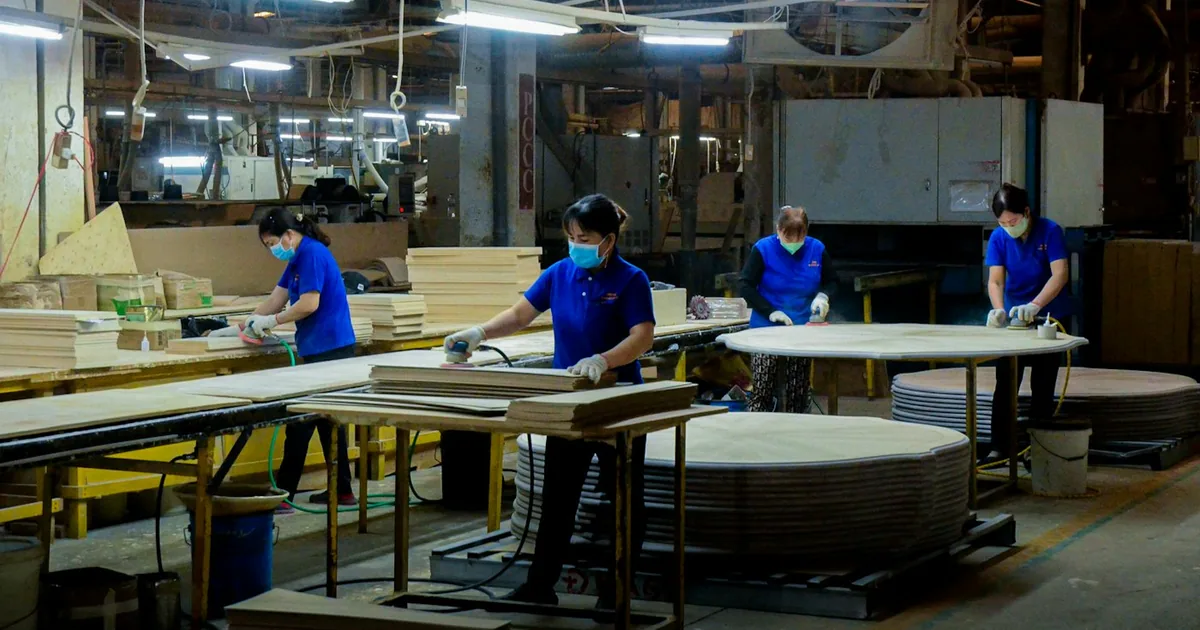
Wood furniture in Vietnam comes from three kinds of factory: large exporters that run retail programmes, mid-size plants that fit most first orders and small workshops that suit samples and short runs. Which one fits depends on your order size against the factory’s normal run, your product category, the region and what the plant does in house, above all finishing and machining. Shortlist on those four points, confirm the company is a producer and not a trader, then compare no more than three. This guide is for importers, brands and buyers who have a product and no factory yet, and it leads to one decision: which three factories get your specification.
We are a matching service. We own no kiln, no machines and no finishing line, and we name no factory on this site. You send one specification and we match it with up to 3 Vietnamese wood factories that quote you directly.
Last reviewed: October 2026. Figures carry the date they were checked; confirm tariffs and regulations with your broker before you rely on them.
- Factory types by size
- Where the factories are
- Vietnam or China first
- Specialist or generalist
- Own design or factory range
- Capability in finishing and machining
- Factory or trader
- Reading the financial health of a factory
- Meeting factories at the fairs
- Ten names to three
- Terms you will meet
- What to send and what to ask
- Next step
Factory types by size
Vietnam’s export furniture industry is large and uneven. Vietnam Customs data reported by Viet Nam News put exports of wood and wood products at $17.2 billion in 2025, and wooden furniture made up nearly 61 per cent of export value in the first 11 months of that year. The number of exporters is large too. A Forest Trends and VIFOREST report on 2024 counted over 4,200 businesses that export directly, of which 777 (18.5 per cent) were foreign-invested and together produced $7.67 billion of the $15.89 billion exported. Fewer than one exporter in five, then, accounts for nearly half the value. A Timber Trade Portal page describes the wider population as about 4,500 export processors, with 93 per cent small or very small, 5.5 per cent medium and 1.5 per cent big, but it gives no year and does not name its source, so read it as a rough shape.
The shape matters more than the counts. You are choosing between three ways of working, and the right one depends on your order against the factory’s normal run.
| Large exporter | Mid-size plant | Small workshop | |
|---|---|---|---|
| Fits an order that is | A repeating programme the plant would plan around | A first or second container of a defined range | A sample run, a short run or a one-off |
| Stance on setup and MOQ | Fixed and high; setup is spread across big runs | Negotiable if you cut variants and use standard parts | Low, with a high price per piece |
| Capacity risk | Your order can be moved when a big customer pushes a date | Moderate; ask what is booked for your window | Low volume, but one machine or one person can stall the run |
| Subcontracting | Deep and managed, usually with its own audits | Common for metal, glass and upholstery | Often heavy, sometimes for finishing as well |
| Design and engineering help | A development team and showroom range | A sample workshop and drawing review | Craft skill, thinner drawing and testing discipline |
| Payment and financial risk | Lower; larger balance sheet | Moderate; check largest-customer share | Higher; deposits fund materials |
Typical patterns from how plants of each size are organised, not survey data. We found no public MOQ or payment survey by factory size.
Read more: Furniture Factory Types in Vietnam: Large Exporter, Mid-Size Plant and Small Workshop
Where the factories are
Vietnam has several furniture industries, not one. As described in our regions guide (typical patterns, not survey data), the south, around Ho Chi Minh City, Dong Nai and Binh Duong, has the widest range of factory sizes, the deepest base of metal, glass, stone, upholstery and carton subcontractors and the port closest to the plants. It suits indoor furniture, cabinets and anything with mixed materials. The centre, around Quy Nhon, grew up around acacia plantations and outdoor furniture, with a thinner subcontractor base. The north, around Hanoi and Hai Phong, is stronger in plywood, panels and components, close to the Chinese panel supply chain.
Place names need one update. On 1 July 2025 Vietnam cut its provincial units from 63 to 34. Binh Duong and Ba Ria-Vung Tau merged into Ho Chi Minh City, Binh Phuoc merged into Dong Nai and Binh Dinh merged into Gia Lai, whose administrative centre is Quy Nhon (Vietnam Briefing, checked October 2026). A plant that says it is in Binh Duong may now carry a Ho Chi Minh City or Binh Duong ward address depending on the document, and the VIFA EXPO venue page itself lists “Binh Duong Ward”. Match addresses by the industrial area and the port the factory ships from, not by the old province alone. The industrial clusters themselves did not move.
Ask every factory which port its FOB price uses. A plant in the centre or north that quotes FOB Ho Chi Minh City has trucking inside the number.
Read more: Vietnam Furniture Manufacturing Regions and Clusters
Vietnam or China first
Buyers often start with the wrong comparison: the same drawing quoted by a factory in Guangdong and one in southern Vietnam. The two quotes usually describe different objects. In the typical pattern, not survey data, the Chinese quote assumes a panel carcass with imported hardware, while the Vietnamese quote assumes solid or edge-glued hardwood. Compare by construction, component by component, and the picture clears up.
In our reading of the typical pattern, not survey data, Vietnam has an advantage in solid plantation hardwood such as acacia and rubberwood, in labour-intensive finishing and in outdoor furniture. It has little advantage in panel furniture with heavy hardware, in products dominated by metal or upholstery or in very small runs. Imported species such as oak and walnut arrive at international prices plus freight. We found no public cost comparison by construction, so compare quotes on the same stated construction.
The policy position deserves its own line. The United States took $9.46 billion of Vietnam’s 2025 wood exports, about 55 per cent of the total (Viet Nam News, 19 January 2026, citing Vietnam Customs). A sector so tied to one market is exposed to that market’s trade policy. A programme built on a tariff gap rests on something neither you nor the factory controls, so base the case on construction and capability, and confirm current duties with your customs broker before you quote a landed price.
Read more: Vietnam vs China for Furniture: Where the Gap Really Is
Specialist or generalist
Many factories answer an enquiry with “we can make anything in wood”. Read it as a disclosure. Specialisation buys four things that do not transfer between categories: jigs that already exist, a known yield per cubic metre of wood, known failure modes and a supplier base chosen for that product. A generalist builds those on your order, and you pay for the discovery.
One question cuts through the sentence: what did you ship the most of last year, by product and by market? A specialist answers in a line, for example a product family, a species and two markets. A generalist answers with a list of capabilities. Follow with what the plant would decline. A factory that names the work it turns away has edges, and edges are what you are buying.
The exception is a true engineering-led generalist, which can be right for an unusual first sample or a contract project with many different items. A short list built from specialists is also shorter: decide the category first, then look for plants whose centre of gravity is that category.
Read more: The Most Expensive Sentence a Furniture Factory Says
Own design or factory range
Almost every Vietnamese factory offers both OEM and ODM, and the words are used loosely. OEM means you bring the design and the plant builds to your drawings on jigs made for you. ODM means the plant sells a design it already owns, sometimes with your finish, size, logo and carton. Most real work is a hybrid, where you bring a concept and the plant adapts one of its platforms. That hybrid is where ownership gets blurred.
| OEM | ODM | |
|---|---|---|
| Unit price | Higher | Lower |
| Tooling and sampling | You pay | Already paid by earlier buyers |
| Lead time to first shipment | Longer | Shorter |
| MOQ | Higher | Lower |
| Design ownership | Yours if the contract says so | The factory’s |
Direction of difference only; we found no public price or MOQ range for OEM against ODM.
Decide which model you are in, in writing, before the first sample. If the design matters commercially, put ownership of drawings and jigs, the scope of exclusivity and a tooling charge you pay in the contract before sampling, and sign an NDA. Our RFQ form has an NDA tick box for this reason. A plain table is hard to protect anywhere, so protect the distinctive parts: a joint detail, a finish recipe, a pack format and the brand.
Read more: OEM vs ODM Furniture Manufacturing in Vietnam Compared
Capability in finishing and machining
Two capabilities separate plants that look alike in a brochure. Finishing decides most of the perceived quality of a piece and is the step most often subcontracted. Machining decides repeatability, especially for knock-down furniture where holes in two parts must line up.
For finishing, ask which parts go on a hand spray booth and which on a flat line. Booths handle any shape but depend on the sprayer. Flat lines give an even film on flat faces such as doors and tops, and need a second step for edges and profiles. Do not accept a coat count as a standard: two plants can both say three coats and differ in film thickness by a factor of two, so ask for dry film thickness or a signed sample. For machining, ask which machine makes which part. A nesting router or point-to-point machine cuts and drills panel parts, a copy lathe or four-axis machine turns legs and spindles and a five-axis centre carves compound curves at a higher cost per hour.
| Question | A good answer sounds like |
|---|---|
| Which of my parts go on the flat line and which in the booth? | A part-by-part list, with edges handled in a named second step |
| How is colour held from the first piece to the last? | Weighed recipes, a signed master sample and the same mixer per batch |
| Which machine cuts my curved part? | A named machine type and a reason, with a programmed test cut |
| What happens to a piece that fails finish inspection? | It is stripped and recoated, and the plant can show the area |
Practical checks drawn from our finishing and machining guides; we found no public benchmark for these answers.
Read more: Furniture Finishing Line Vietnam: Spray Booth vs Flat Line and CNC Wood Machining Vietnam: 3-Axis, 5-Axis, Nesting
Factory or trader
Most sourcing failures in Vietnam are identity failures: the company you contracted was not the one that made the goods. Check in this order, which costs the least time.
- Registration. Ask for the registration and tax numbers and compare the registered business activity with what the company claims. The National Business Registration Portal has an enterprise search and a Vietnamese and English version of the site; we did not test the search or which fields a free search returns, so also ask for a copy of the registration certificate.
- Capacity for your category, in containers per month, and what is already booked for your window.
- Kiln, its size in cubic metres, whether it is owned and the target moisture content for your destination.
- Finishing: who owns the booth, how many coats, who signs the master colour.
- Subcontracting: the list, and which parts you may inspect before assembly.
- Documents and references: export history in your market and two references on a second or third order.
- The sample round, treated as the audit. A plant that asks about tolerance, show face and packing before it builds is thinking about production.
Legal papers belong in step 6, and the rules move. The European Commission’s page on Regulation (EU) 2023/1115 names furniture as an example of a covered derived product and gives 30 December 2026 as the application date for large and medium operators and 30 June 2027 for micro and small operators (30 December 2026 for those already covered by the EU Timber Regulation), after amendments in December 2024 and December 2025 (checked 19 October 2026). In the United States, 16 U.S.C. 3372(f), checked October 2026, requires an import declaration with the scientific name, value, quantity and country of harvest for covered plant products. Whether your shipment is in scope, and what your supplier must hold, is a question for your customs broker.
Read more: How to Vet a Vietnamese Wood Factory Before You Order
Need a quote for this product? Get matched with a Vietnam wood factory
Reading the financial health of a factory
Rising export value is a fact about the industry, not about the plant quoting your product. Customs data put 2025 exports at about 6 per cent above 2024, yet margins at a single plant can be thin. In our analysis four pressures matter: inputs priced abroad, rising domestic costs, compliance as a fixed cost and a few large buyers setting price. We found no public margin survey by plant.
The pressure reaches your order in four ways: substitution of a cheaper species, panel or coating; optimistic lead times; quality that drifts between the first order and the third; and, in the worst case, a plant that goes quiet mid-production. None of this needs an audit firm to detect. Ask what is booked for your window and listen for numbers. Ask what share of output the largest customer takes, and notice any hesitation. Ask what the plant invested in over two years, such as a kiln, a finishing line or compliance capability. Ask for a reference on a later order, not a first one.
The better response to a squeezed supplier is not to push price. Spend the leverage on terms that cost the factory little: the panel supplier named in the contract, moisture readings with each shipment, notice before any substitution and documents delivered before shipment.
Read more: Vietnam Wood Exports Grow While Factory Margins Shrink
Meeting factories at the fairs
Two fairs in Ho Chi Minh City bring hundreds of Vietnamese manufacturers under one roof. The organiser pages we opened on 19 October 2026 list HawaExpo for 3 to 6 March 2027 at SECC, and VIFA EXPO, billed as the 18th edition, for 26 February to 1 March 2027 at WTC EXPO and SKY EXPO. The dates leave one day between the two, so a single trip can cover both. HawaExpo’s page cites 20,000 buyers and visitors, 500 exhibitors and 2,700 booths, and elsewhere on the same page 700 or more manufacturers; these are the organiser’s own marketing figures and do not agree with each other.
Treat a fair as a screening tool. Go with a category, a target order size and your RFQ fields printed, and collect samples, catalogues and the name of the person who answers technical questions. Then run every stand through the same checks as a cold enquiry. A booth shows what the plant wants to sell, not what it can make well at your quantity. The pages we opened do not state visitor eligibility rules, so confirm registration and entry terms with the organiser before booking travel.
Read more: How to Use VIFA EXPO and HawaExpo to Shortlist Furniture Factories
Ten names to three
A long list of ten names is normal after a fair or a search. A scoring sheet turns it into a shortlist without relying on instinct. The method is a weighted sum: give each criterion a weight, score each factory on each criterion, multiply and add. Its known limit is that it works only when scores are on the same scale, so use 1 to 5 on every row.
| Criterion | Example weight | Evidence to score it |
|---|---|---|
| Product category fit | 25 | What the plant shipped most of last year |
| MOQ and order size fit | 20 | Your order against its normal run |
| Capability for your parts | 15 | Finishing and machining answers |
| Export markets served | 10 | Shipments to your market, packing and paperwork habits |
| Region and port | 10 | Subcontractor depth and the FOB port |
| Sample speed and quality | 10 | Questions asked before building, turnaround |
| Reply quality | 10 | Complete answers within a few days |
Example weights that sum to 100; change them to your priorities. Purchasing guides call the same method weighted-point supplier evaluation, and the weights here are our suggestion, not a published norm.
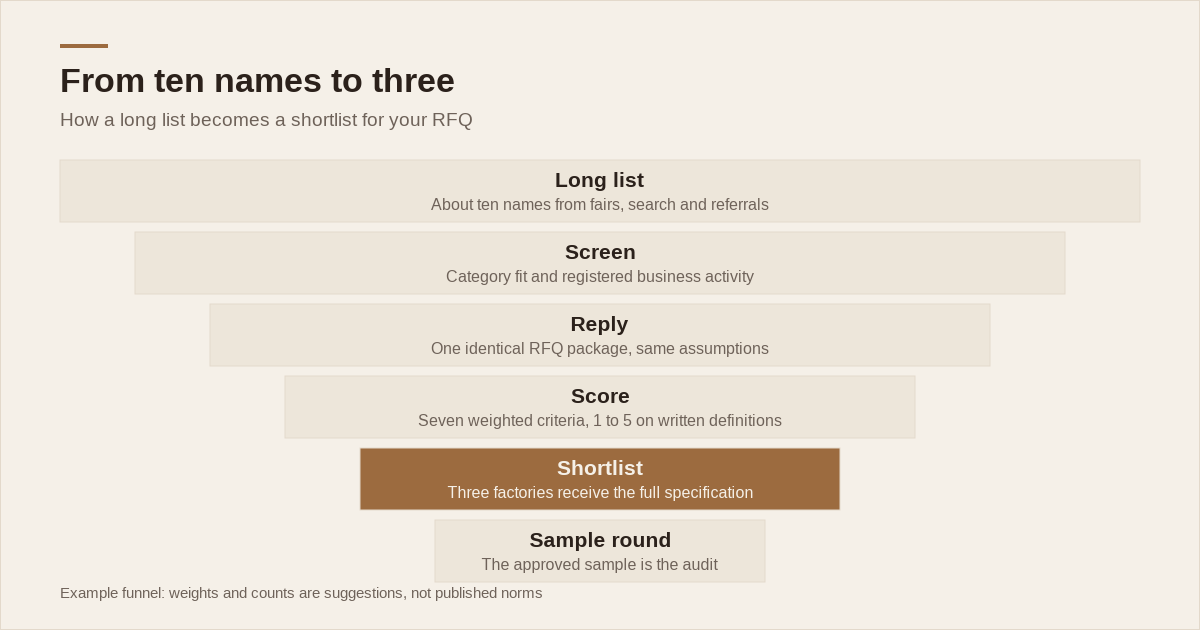
Score the replies, not the brochures. A factory that answers your questions in full, asks sensible ones back and names its subcontractors is usually the one whose production process asks questions too.
Read more: Furniture Factory Shortlist: A Scoring Sheet for Three Vietnamese Factories
Terms you will meet
Factory replies are full of shorthand, and one abbreviation has two meanings. KD means knock-down in furniture and kiln-dried in timber, so ask which one is meant. A few more come up in every first exchange.
| Term | Meaning in an RFQ |
|---|---|
| MOQ | The smallest order the factory will accept per model or per finish |
| FOB | The seller delivers on board the vessel at the named port; a sea and inland waterway term |
| EXW | The buyer collects at the factory; usable for any mode of transport |
| FJ | Finger-jointed wood, short pieces joined end to end |
| OEM or ODM | Your design built by the factory, or the factory’s design sold to you |
Incoterms modes per the US International Trade Administration page, checked October 2026. Read the full rule text of the version named in your contract.
Read more: Wood Furniture Terms: A Buyer Glossary From KD to FOB
What to send and what to ask
A shortlist is only as good as the specification the factories receive. Send the same package to all three.
- A drawing or a reference photo, with dimensions and the show faces marked.
- The construction named per component: solid, finger-jointed, edge-glued, veneered or plywood.
- The species or a grade requirement, and the moisture target for your market.
- The finish, with a sample or colour reference and the performance you need.
- Hardware and packing: carton type, assembled or knock-down, labelling.
- Quantity, the number of models and finishes and your target market.
- The Incoterm and port you want quoted, and the date you need the goods.
- The paperwork your market needs and whether you require an NDA first.
- Your questions: what the plant shipped most last year, what it subcontracts, what is booked for your window.
Quote normalisation is the point of sending one package. Two quotes on different assumptions tell you which factory assumed the most, not which one is better value.
Next step
You do not need ten names to start. Send one specification through the RFQ page. We reply within 24 business hours and match you with up to 3 Vietnamese wood factories, which quote you directly and deal with you directly. Buyers pay nothing to be matched. Before you send, read the factory vetting steps above and keep the signed sample rule: whichever factory you pick, the approved sample is the reference for every later argument about colour, finish or size.
For a view across product categories, see our products pages, and for the process steps see the processes page.
Sources
- Viet Nam News: Việt Nam’s wood exports reach record $17 billion in value (19 January 2026)
- VnEconomy: FDI enterprises continue to be key growth driver of wood industry (11 March 2025, report by Forest Trends and VIFOREST)
- Timber Trade Portal: Viet Nam timber sector (undated; source not named)
- Vietnam Briefing: Vietnam’s provincial mergers, 63 to 34 provinces and cities
- European Commission: Regulation on deforestation-free products
- Cornell Law School LII: 16 U.S.C. 3372, Lacey Act prohibited acts and import declaration
- National Business Registration Portal, Vietnam (English version)
- HawaExpo organiser site: dates, venue and visitor figures
- VIFA EXPO organiser site: dates and venue
- US International Trade Administration: Know Your Incoterms
- Wikipedia: Weighted sum model
- SIPMM: Supplier evaluation and selection, weighted-point method (20 January 2018)
Frequently asked questions
How many wood furniture manufacturers are there in Vietnam?
We found no single count. A Forest Trends and VIFOREST report for 2024 counted over 4,200 businesses that export wood and wood products directly, and a Timber Trade Portal page says about 4,500 wood processors are involved in export. The two use different scopes and dates, so treat both as an order of magnitude, not a list you can work through.
Which type of factory is best for a first order?
Usually a mid-size plant, because it has the engineering and export habits of a large factory but still wants an order of your size. A large exporter may rank you low in its schedule and a small workshop may lack finishing control. The answer changes with order size, so compare your order with the factory's normal run.
Should I choose a factory by region?
Choose by product category first and region second. The south suits indoor furniture, cabinets and mixed materials, the centre suits outdoor and acacia products and the north suits panels and components. A strong factory in the wrong region still beats a weak one in the right region.
How do I tell a factory from a trading company?
Ask who owns the kiln, the machines and the finishing booth, and ask what the plant shipped most of last year by product and market. A producer answers with numbers and names its subcontractors. Compare the registered business activity with what the company claims, and ask for a live video walk through the plant.
How many factories should I send an RFQ to?
Three well matched factories give more usable quotes than fifteen mismatched ones. Score ten names on category fit, order size fit, capability, export history, region, sample speed and reply quality, then send one complete specification to the best three so the quotes can be compared line by line.
Do Vietnamese furniture fairs help me find manufacturers?
Yes, as a way to see many plants and samples in a few days. HawaExpo and VIFA EXPO both list editions between 26 February and 6 March 2027 in Ho Chi Minh City on their organiser pages. A fair does not replace vetting: shortlist from the fair, then check each plant the same way you would a cold enquiry.
Need a quote for this product?
Send the specification. We match you with up to 3 Vietnamese wood factories and reply within 24 business hours.
Get matched with a Vietnam wood factory