Guides / Choosing a Factory
How to Compare Furniture Quotes From Vietnam Factories Line by Line
November 21, 2026
Three furniture factories can quote the same chair at three different prices, and the lowest is often the one that left the most lines blank. To compare furniture factory quotes you have to rebuild each one on the same sheet, line by line, until every factory is pricing the same product on the same terms. Only then does the number at the bottom mean anything.
This guide gives the lines to check, a worked example of why a lower FOB price can cost the same once it is on the ship, and the wording that makes a factory fill the blanks. It builds on our guide to what drives furniture manufacturing cost in Vietnam and on the shortlist scoring sheet, which decides who is allowed to quote in the first place.
Why quotes that look alike are not
A quote is the factory’s answer to the question it thought you asked. If the RFQ said “oak dining chair, 500 pieces”, one factory prices solid white oak with mortise and tenon joints, another prices oak veneer on a plywood seat, and a third prices a rubberwood frame stained to look like oak. All three are honest. None is wrong. They are not comparable.
The gaps come from four places:
- Your specification was open. Every blank in the RFQ was filled by the factory’s habit.
- The factories assumed different standards. Moisture, finish durability, hardware grade and carton strength are rarely written down.
- The terms differ. One quote is ex works, one is FOB at the nearest port, one is FOB at a port far inland from the plant.
- The price has a clock. Timber and exchange rates move, so some quotes hold for a week and some for three months.
The first fix is on your side: a complete package, as described in our tech pack checklist. The second fix is the sheet below.
Step 1: put every quote on the same sheet
Make one row per line item and one column per factory. Do not copy the factory’s own layout. Their layouts differ because they want you to read the total first. Fill each cell from what the quote says, and write “not stated” where it does not. Blanks are the finding.
| Line | What to confirm | How a gap hides here |
|---|---|---|
| Species and grade | Botanical or trade name, grade of visible faces, grade of hidden parts | “Oak” can mean solid, veneer or a stained substitute |
| Construction | Joint type, part thickness, glue, board type for panels | Thinner parts and simpler joints cut cost and strength |
| Moisture | Target range at packing and how it is measured | A cheaper kiln cycle shows up later as cracks and mould |
| Finish | System, number of coats, test or reference swatch | Fewer coats or a lighter system is invisible at the sample stage |
| Hardware | Brand or grade, count per piece, screws and fittings | Hardware is the easiest line to downgrade quietly |
| Upholstery | Foam density, fabric spec, frame material | Not applicable to every product, but a big swing where it is |
| Packing | Carton type, inner protection, KD or assembled | Packed volume sets freight per piece |
| Packed volume | Outer carton size and pieces per carton | The line most quotes omit entirely |
| Incoterm and port | Rule, edition and named port of loading | An ex works price labelled FOB is not an FOB price |
| Quantity basis | MOQ, price breaks, tolerance on quantity | A price at 1,000 pieces is not a price at 300 |
| Tooling and samples | Who pays, when, whether it is credited against the order | A cheap unit price can sit on an expensive set-up |
| Validity | Days the price holds and what triggers a change | A short clock moves the risk of a timber rise to you |
| Payment terms | Deposit, balance, trigger, currency | Terms change the real cost of the order |
| Lead time | Weeks from deposit or from sample approval | The start date for the count is often different |
| Testing and inspection | Who books and pays for lab tests and inspections | Often assumed, rarely priced |
Every “not stated” is a question for the factory, not a reason to guess in its favour.
Step 2: read the Incoterm, not just the word FOB
FOB is a sea and inland waterway rule. The US International Trade Administration notes that EXW and FCA suit any mode of transport while FOB and CIF are for sea and inland waterway only, and that Incoterms do not set the contract price, the payment terms or when title passes. They also say to name the Incoterms edition on the paperwork.
Under Incoterms 2020 the seller delivers the goods loaded on board the vessel you nominate at the named port of loading, handles export formalities and pays for the loading. Risk passes to you once the goods are on board. You contract the carrier and pay the freight to destination and the import side. That is the ICC Academy’s description of the rule.
Three consequences for the quote sheet:
- The named port matters. FOB Ho Chi Minh City and FOB Hai Phong are different quotes. If the factory is far from the port, ask whether the inland haul and port charges at origin are in the price, and ask for a line showing which.
- “FOB” alone is not a rule. Write “FOB, named port, Incoterms 2020” in your RFQ and ask each factory to repeat it in the quote.
- Ask what is outside it. Origin documents, fumigation or treatment certificates and any inspection you require are separate lines unless the quote says they are included.
Our guide to payment terms and Incoterms on Vietnam furniture orders goes further on the deposit and balance side.
Need a quote for this product? Get matched with a Vietnam wood factory
Step 3: convert FOB to cost per piece on the ship
FOB tells you what you pay at the factory’s end. What you pay overall includes the freight, and freight is charged per container, not per chair. The number of pieces in the container depends on the packed volume of each piece, and the packed volume depends on how the factory packs.
DSV lists a 40-foot high cube container at 76.4 cubic metres nominal with an internal size of 12.03 by 2.35 by 2.70 metres and a payload of 28,560 kg, and notes that real figures vary by owner and age. A loaded container never reaches the nominal volume, so use a working figure that your forwarder agrees. Our guide to furniture container loading and CBM shows how to count cartons.
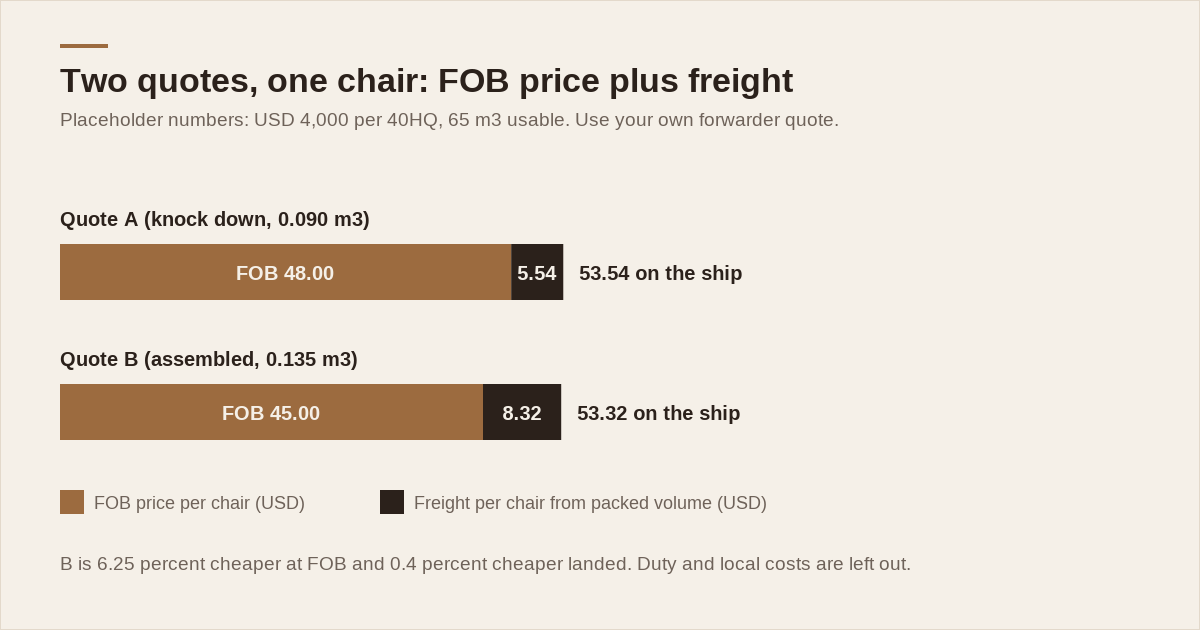
A worked example, with placeholder numbers. The figures below are invented for the arithmetic. Replace them with a forwarder’s quote and the factories’ carton sizes. Assume ocean freight of USD 4,000 for one 40HQ and 65 cubic metres of usable space.
| Quote A | Quote B | |
|---|---|---|
| FOB price per chair | USD 48.00 | USD 45.00 |
| Packing | Knock down, flat cartons | Assembled, in one carton |
| Packed volume per chair | 0.090 m3 | 0.135 m3 |
| Chairs per 40HQ (65 m3) | 722 | 481 |
| Freight per chair | USD 5.54 | USD 8.32 |
| FOB plus freight per chair | USD 53.54 | USD 53.32 |
Quote B is 6.25 percent cheaper at FOB and 0.4 percent cheaper once freight is added. A small change in the freight rate flips the order. Duty, insurance and local costs are left out here and would be applied to both. The point is that the lower FOB hid a packing choice, and the packing choice moved cost to your side of the invoice.
Step 4: ask the questions that fill the blanks
Send one message to all factories with the same questions. Do not tell any of them what the others quoted. A message that works:
Thank you for the quote. To compare it with others on the same basis, please confirm in writing: (1) species and grade of visible and hidden parts; (2) moisture range at packing and how you measure it; (3) finish system and number of coats; (4) hardware brand or grade and count; (5) outer carton size, pieces per carton and pieces per 40HQ; (6) the Incoterm, edition and named port; (7) how many days the price holds and what would change it; (8) what is included for tests and inspections.
Reply quality is part of the score. A factory that answers in numbers is easier to manage in production than one that answers “as per sample”.
The sample is the reference. Under the UN Convention on Contracts for the International Sale of Goods (CISG), goods must have the qualities of a sample or model the seller presented unless the parties agreed otherwise, and must be packaged in the usual manner or in a way that preserves and protects them. The convention entered into force for Vietnam on 1 January 2017 and for the United States on 1 January 1988. Your contract may exclude the convention, so read it, but the principle is the useful part for a quote: say which sample the price is for, and say what the packing must survive.
What to do with the result
Rank the sheet on landed cost per piece. Then look at the blanks. A factory with the lowest landed cost and four unanswered spec lines is not the cheapest, it is the least defined. Prefer the factory that answered every line, even if it is not the lowest, then use the others to ask for a revised price on the same lines.
Two practical rules:
- Ask for a revised quote, not a discount. “Please re-quote with oak solid in the frame and the carton sizes below” gets a comparable number. “Can you do it cheaper” gets a cheaper product.
- Freeze the specification before the second round. Changing the spec after quoting restarts the comparison.
For the next stage, our guide to furniture MOQ and order economics explains why the quantity basis on the sheet moves the price more than most buyers expect.
What to put in the specification
State the species and grade, the construction of each part, the moisture range and where it is measured, the finish system with a reference swatch, the hardware, the packed carton size and pieces per carton, the Incoterm with the named port and edition, the quantity and price breaks, the validity period and the tests you require. Then send it through the RFQ page. We reply within 24 business hours and match you with up to 3 Vietnamese wood factories that quote you directly.
Sources
- ICC Academy: Incoterms 2020, FAS or FOB
- US International Trade Administration: Know your Incoterms
- DSV: high cube dry container dimensions
- CISG-online: Article 35 CISG, conformity of the goods
- UNCITRAL: CISG status, contracting states
Frequently asked questions
How do I compare furniture quotes from different factories?
Rebuild each quote on one sheet with the same lines: species and grade, construction, finish, hardware, packing, packed volume per piece, Incoterm and port, MOQ, validity and payment terms. Mark every line a factory left blank or changed. Then add freight per piece from the packed volume and compare landed cost, not the headline FOB price.
Why is one furniture quote much cheaper than the others?
Usually because it prices a different product. Common gaps are a cheaper species or grade, thinner parts, a lighter finish system, cheaper hardware, thinner cartons, a quote made ex works and called FOB, or a price that expires in days. Ask the factory to confirm each line in writing before you treat the low quote as a saving.
What does an FOB furniture quote include?
Under Incoterms 2020 the seller delivers the goods loaded on board the vessel you nominate at the named port, handles export formalities and carries the cost of loading. Risk passes to you once the goods are on board. Ocean freight, import clearance and duty are yours. Always read which port and which rule version the quote names.
Should I choose the lowest quote?
Only after the quotes describe the same product. Rank on landed cost per piece, then on proof: a sample that matches the drawing, a clear answer on every spec line and a plan for moisture and packing. A lowest quote that answers the specification with 'as per sample' and nothing else is a risk, not a saving.
Need a quote for this product?
Send the specification. We match you with up to 3 Vietnamese wood factories and reply within 24 business hours.
Get matched with a Vietnam wood factory