Guides / Choosing a Factory
Prototype and Sample Development With a Vietnam Wood Factory
October 31, 2026
A sample is the moment when your idea meets the factory floor. It tests whether the plant can build what you drew, and it tests whether you drew what you meant. Many orders go wrong because the sample stage is rushed, skipped or treated as a favour. A good sample round costs a few hundred dollars and a few weeks, and it prevents problems that cost tens of thousands after production starts.
This guide walks through the sample process step by step, lists typical costs and timelines and shows how to approve a sample so that it becomes a clear standard for production.
What you send to start
A factory can only sample what it understands. The more complete your package, the faster the first sample arrives and the closer it is to what you want.
- Drawings. Dimensioned views in PDF with units, tolerances and the datum edges that matter. Add a DXF or DWG file for flat profiles.
- Material list. Species, construction (solid, finger joint, veneered, panel), thickness and grade for each part.
- Finish. Colour reference, sheen level, finish system and a physical colour chip or a photo with a colour card in the frame.
- Hardware and fittings. Model numbers or dimensions, and who supplies them.
- Reference photos. The look you want, from several angles, with notes on what to copy and what to change.
- Quantity and target price. Even if you only want one sample, the plant needs to know the order scale so it builds with the right method.
If you have no drawing, say so. Some plants draw from a photo for a fee, and others will not start. The OEM and ODM guide explains the difference between building your design and adapting theirs.
The drawings, BOM and finish callouts you send with a sample request are listed in the furniture tech pack checklist.
The stages of a sample round
| Stage | What happens | Typical time |
|---|---|---|
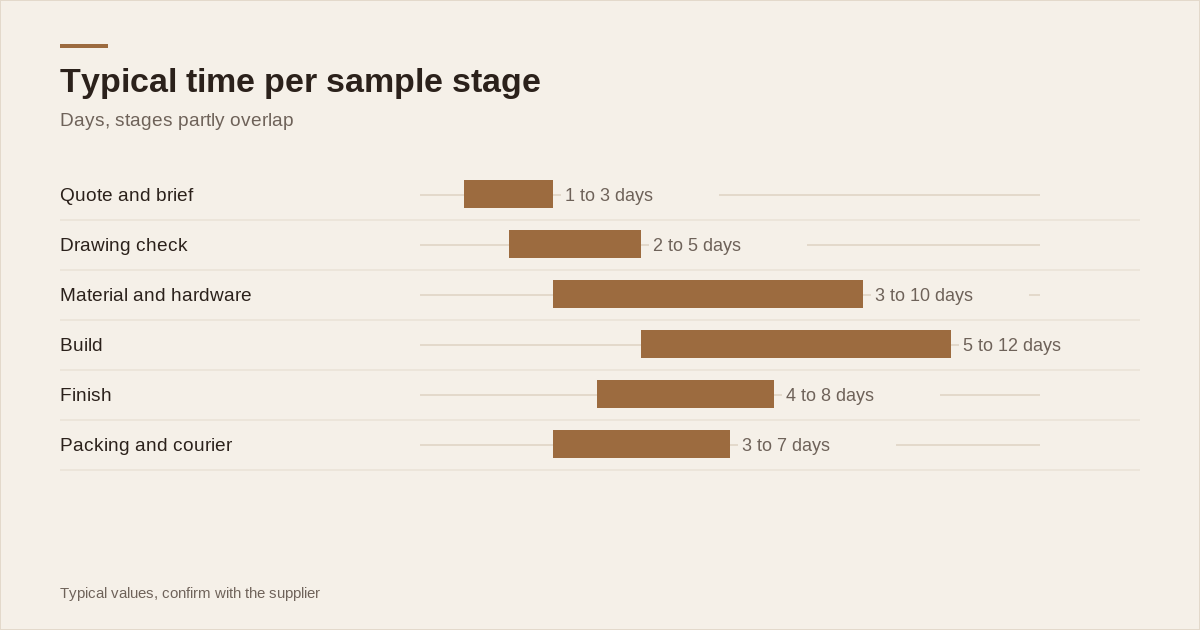
| Quote and brief | Factory reviews files and confirms scope, cost and timing | 1 to 3 days |
| Drawing check | Factory redraws in its own format and sends it for approval | 2 to 5 days |
| Material and hardware sourcing | Wood, panels and fittings arrive | 3 to 10 days |
| Build | Machining, assembly, sanding | 5 to 12 days |
| Finish | Staining, spraying, drying | 4 to 8 days |
| Packing and courier | Photos, packing, dispatch | 3 to 7 days |
These ranges are typical and run partly in parallel, so a simple piece may take two to three weeks and a complex one up to six. The lead time guide shows how the sample stage connects to production dates.
Types of sample
Not every sample answers the same question, and mixing them up leads to confusion.
Development sample. A first build to check the design, proportions and joints. Finish may be basic, and parts may be hand fitted. Its job is to find design problems.
Colour and finish sample. A small panel or part finished in the proposed colour and sheen. Its job is to approve the look before the full product is built.
Pre production sample. A complete product built with production materials, machines and finish. Its job is to prove that the plant can build the real product, and it becomes the reference for quality control.
Golden sample. The approved pre production sample, signed and sealed, held by both sides. Every production unit is judged against it.
Production sample. A random unit from the first production run. Its job is to check that production matches the golden sample before the rest of the order ships.
Treat each as a separate gate. Approving a development sample does not approve the finish, and approving a finish does not approve the production run.
What a sample costs
Sample cost has three parts: material, labour and tooling. Material and labour for a simple solid wood piece often fall in a range of tens to a few hundred dollars. Complex upholstered pieces, carved parts and items with many fittings cost more, because they need more hours and more skilled workers. Courier cost depends on size and speed. Sea freight is cheaper but slow, so most samples ship by air or express courier.
Tooling is the cost that surprises first time buyers. A custom moulded part, a metal bracket, a special cutter or a jig for repeat assembly all cost money, and the plant often passes the cost on. State who pays and who owns it before work starts.
Many plants credit part of the sample fee against a confirmed order. This is a negotiation point, not a standard rule. Ask before you pay, and write the answer into the sample quote.
How to review a sample
When the sample arrives, review it in the order below, using the drawing, not memory.
- Dimensions. Measure overall size, key heights, widths and any fit points. Record each number and compare with the drawing.
- Joints and structure. Test the product by sitting, leaning and pushing in the way a user would. Check that joints are tight and that nothing rocks or flexes more than expected.
- Surfaces. Look at the finish in daylight and under the lighting your customer uses. Check for runs, dust, sanding marks and colour mismatch between parts.
- Hardware. Open and close doors and drawers, tighten and loosen fittings and check that every part works.
- Packaging. If a packed sample was sent, check how it arrived and whether the pack protected the product.
- Details against the brief. Compare each point on your reference photos and notes.
Write a numbered list of required changes and send it with photos. A vague “please improve the finish” wastes a round. “Darken colour by about one step, reduce sheen to satin, round the leading edge to 3 mm radius” gives the plant something to build.
Need a quote for this product? Get matched with a Vietnam wood factory
Why samples fail
Most failed samples trace back to one of four causes. The drawing was incomplete, so the factory guessed. The brief mixed two different looks, so the plant picked one. The sample was built by hand with methods the production line cannot repeat, so the approved piece cannot be copied at volume. Or the buyer approved on a photo and found a different colour in daylight.
Each cause has a cheap remedy: a complete drawing, one clear reference, a question about how production will build the part and a physical sample reviewed in real light. Spending an extra day on these checks saves a full round.
Shipping samples and customs
Samples travel as parcels, and parcels meet customs. Wood products often need a declared value, a description and sometimes a plant health or origin statement, depending on the destination. Ask the factory to ship with a commercial invoice marked “sample, no commercial value” with a realistic declared value, and check your own country’s rules on wood and veneer parcels. Some destinations hold wooden parcels for inspection, which adds days, so plan for it in your sample calendar.
Rounds and revisions
Expect one to three rounds before approval. A first sample with no corrections is rare, and a plant that claims perfect first time results on every design is either very experienced or not testing hard enough.
Control the number of rounds by being specific and by changing one thing at a time. If you change the design, the finish and the hardware in the same round, you cannot tell which change caused a new problem. Keep a log of each round with the date, the changes requested and the changes delivered.
Set a limit in advance. Many buyers agree to a number of included revisions in the sample quote, after which each extra round carries a fee. That keeps both sides honest about scope.
From approved sample to production
Approval is a document, not a conversation. Write down the approval date, the version of the drawing, the finish reference and any permitted variation, and sign it on both sides. Photograph the golden sample from all sides and include the photos in the file.
Then check that the plant moves from sample to production with the same people, materials and methods. A beautiful sample hand built by the best worker in the workshop proves little about what the line will produce. Ask who built the sample, which machines were used and whether production will use the same ones. The vetting guide explains how to check the plant behind the sample.
Add a production sample check to the contract. The plant builds one or two units from the first production run, ships photos and measurements and waits for your approval before completing the order. That check catches drift early, when it is cheap to fix.
Protecting your design
Sampling shares your design with the factory. Think about how much you want to protect. A simple non disclosure agreement, signed before you send drawings, sets expectations. Mark your drawings with your company name and a date. Keep records of what you sent and when.
Be realistic: a signed agreement does not stop copying by a determined party, but it gives you a basis for action and it signals that you take the matter seriously. Do not rely on secrecy as your only protection. Registered designs and trademarks in your main markets give stronger rights, and a lawyer who knows your market can advise.
What to put in the sample order
State the product, the drawing version, the material and finish references, the number of samples, the revision allowance, the sample fee and credit terms, the tooling ownership, the dispatch method and the target date. Add the approval rule: no production starts until you sign the golden sample.
If you are ready to start a sample round, the RFQ page matches your drawing with up to three Vietnamese wood factories and replies within 24 business hours, so you can compare sample quotes before you commit.
Frequently asked questions
How long does a furniture sample take in Vietnam?
Plan on two to four weeks for a first sample of a simple piece and longer for upholstered, carved or complex products. Time starts when the factory has a complete drawing, material choice and payment for the sample, not when you send the first email. Courier time adds three to seven days.
Do I pay for samples?
Usually yes. Most plants charge a sample fee that covers materials and labour, and some credit part of it against a confirmed order. Free samples are rare for custom designs, since the plant builds the part by hand rather than from stock.
Who owns the drawings and moulds after sampling?
State it in writing before the first sample. Without an agreement, the factory holds its own working drawings and any jigs it built. If you pay for tooling, such as a mould or a metal fixture, put the ownership and the right to move it into the order terms.
Need a quote for this product?
Send the specification. We match you with up to 3 Vietnamese wood factories and reply within 24 business hours.
Get matched with a Vietnam wood factory