Guides / Sourcing Guide
The Furniture Tech Pack: Drawings, BOM and Finish Callouts a Vietnamese Factory Can Quote From
November 21, 2026
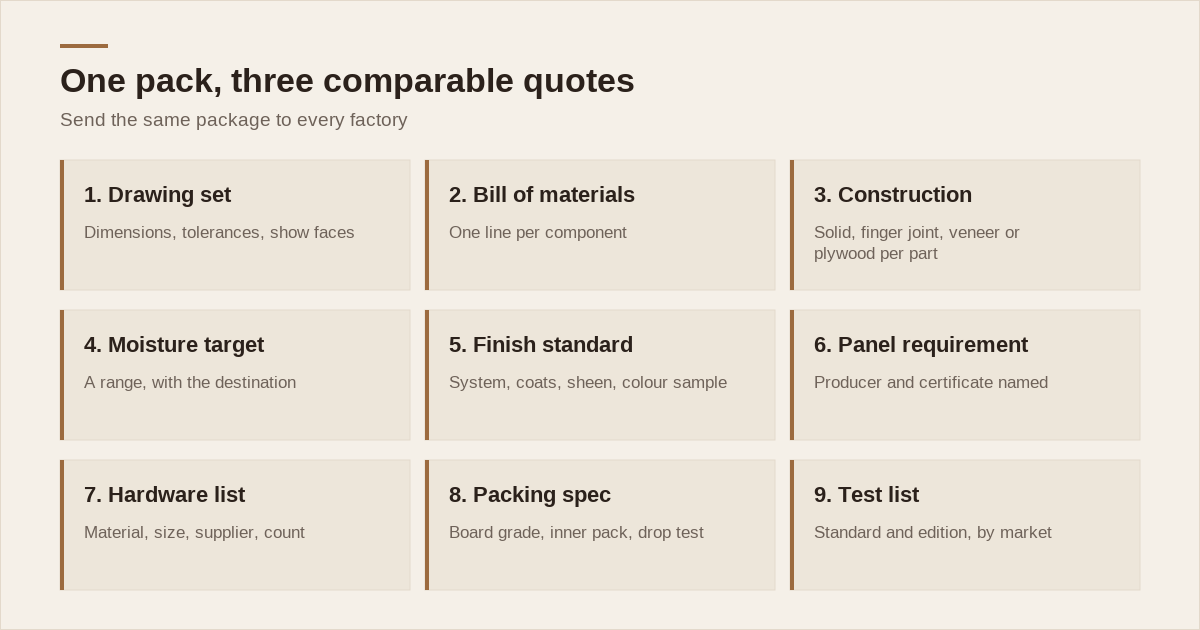
A furniture tech pack is the set of documents a Vietnamese factory prices and builds from: a dimensioned drawing set, a bill of materials, the finish standard, the hardware list, the packing specification and the tests the product must pass. A complete pack lets three factories quote the same object, and a missing line lets each factory fill it with its own assumption. This post is part of our guide to importing furniture from Vietnam, and it works through the pack in four stages: before the RFQ, the RFQ itself, reviewing quotes and before shipment.
Stage 1: before the RFQ, build the pack
Each item below has a reason and a sign that it is done properly. If you do not know an item, write that down: “open to factory recommendation on construction” is information, and a blank line is not.
| Item | Why it is in the pack | What good looks like |
|---|---|---|
| Drawing set | The factory cannot price what it cannot measure | Dimensioned views with units, tolerances on fit points and the show faces marked |
| Bill of materials | Cost sits in the parts, and quotes diverge when each factory lists different ones | One line per component with species or material, construction and thickness |
| Construction per component | Solid, finger-jointed, edge-glued, veneered and plywood are different prices | The word for each part, or “open” with a must-hold requirement |
| Moisture target | Furniture moves toward the moisture of the room it lives in | A range and the destination, for example the Wood Handbook’s 8 per cent average for interior use in most US areas, with 6 to 10 per cent for individual pieces; our moisture guide gives 8 to 10 per cent at production, so the ranges overlap at 8 and the factory should confirm the range for your destination |
| Finish standard | Colour and sheen are the usual argument after production | System, coat count, sheen, a physical colour reference and the faces coated, undersides included |
| Panel requirement | Panel emissions are regulated in the US | The panel type and the producer’s certificate named, against the federal limits in 40 CFR 770.10 |
| Hardware list | Fittings change cost and strength | Material, size, supplier and count per unit |
| Packing specification | The carton is the only thing between the finish and four handling points | Board grade, inner protection, carton dimensions, labelling and a drop test if needed |
| Test list | The test decides which paperwork the factory must supply | Tests by market, with the standard and edition |
Reasoning drawn from our sourcing guides. Moisture values: USDA Wood Handbook Table 13-2. Panel limits: 0.05 ppm hardwood plywood, 0.09 ppm particleboard, 0.11 ppm MDF, 0.13 ppm thin MDF, checked October 2026.
Two items deserve more detail. For the finish, sheen is measurable: ASTM D523 is the test method for specular gloss, with 20, 60 and 85 degree geometries, so write the angle with the number. We did not read the standard text and cite its catalogue page only. For the test list, the rule for clothing storage units in the United States defines them as free-standing furniture intended for storing clothing, typical of bedroom furniture, and requires compliance with ASTM F2057-23, a stability standard approved on 1 February 2023 (16 CFR 1261.1 and 1261.2, checked October 2026). We did not read F2057 itself. Which tests your product needs is a question for a test lab or a customs broker, and a factory test report is the factory’s, not ours.
For help with design choices that change the pack, our guides to wood finishes for export furniture and knock-down design and hardware cover the finish and the fittings in detail.
Stage 2: the RFQ, one package to every factory
Send the same package to every factory. If one factory gets a drawing and another gets a photo, you will be comparing the questions you asked and not the factories you asked. Our RFQ form takes the pack in short form:
- Contact: name, work email, company and country.
- Target market, which fixes the paperwork and the moisture target.
- Product description, with sizes, and the product category.
- Quantity band, from a sample or trial order to more than five containers.
- Wood species, construction and finish, with “open to the factory” or “not decided yet” where that is true.
- Incoterm and the date you need the goods.
- Paperwork your market needs.
- An attachment: PDF, DWG, DXF, STEP, image or spreadsheet.
- An NDA tick box, if the design must stay private before it is shared.
Why the Incoterm line matters: under FOB the seller delivers the goods on board the vessel the buyer nominates at the port of shipment (ICC), so a quote on a named port is a quote on a stated set of costs. Say which port you want, and say the quantity per model and per finish, because setup is paid per model and per finish.
Need a quote for this product? Get matched with a Vietnam wood factory
Stage 3: reviewing quotes against the pack
Lay the quotes beside the pack and check line by line. Ask these questions of each:
- Does the construction in the quote match the construction per component in the pack?
- Is the finish the system and coat count you named, with undersides included?
- Are the panel producer and certificate named?
- Does the hardware list match yours, with material and count?
- Does the carton specification match, and is a drop test priced if you asked for one?
- Is the Incoterm and the port the same in every quote?
A factory that comes back with questions about tolerance, show face or carton format is reading your pack. A factory that returns a price in a day with no questions has probably filled the gaps itself. Neither is proof, but the questions are worth noting, and our guide to sample development shows how the same pack feeds the sample round.
Stage 4: before shipment, close the loop
Before the container ships, the pack becomes the inspection standard.
- Golden sample. The approved pre-production sample, signed and dated, with photos from every side. It settles later arguments about colour and finish.
- Inspection pack. The pack plus the golden sample photos, the colour limit samples and the AQL levels you agreed, handed to the inspector.
- Packing. The carton count and marks match the specification. If cartons travel on wooden pallets or with dunnage, the factory should be able to say what ISPM 15 mark the wood carries; the standard excludes packaging made from wood processed to be pest-free, such as plywood (IPPC).
- Documents. The paperwork named in the RFQ, ready before the container is loaded.
Red flags in a tech pack exchange
- A factory that quotes without asking a single question about the drawing.
- A quote that does not name the species, the panel or the hardware material.
- “As per sample” with no sample number or approval date.
- A finish described as “natural” or “same as photo” with no standard.
- A factory that refuses a signed sample or an NDA on a design that matters.
What to put in your pack and your RFQ
State the drawing set, the construction per component, the species or grade, the moisture range, the finish standard with a sample, the panel requirement, the hardware list, the packing method and the test list, with the quantity per model and per finish, the Incoterm and port and the date you need the goods. When the pack is ready, return to the guide to importing furniture from Vietnam for the order of the steps and send it through the RFQ page. We reply within 24 business hours and match you with up to 3 Vietnamese wood factories that quote you directly.
Sources
- ASTM International: D523 Standard Test Method for Specular Gloss (D523-25 catalogue page, listed as active; the standard text was not read)
- Cornell Law School LII: 40 CFR 770.10, formaldehyde emission standards for composite wood products
- Cornell Law School LII: 16 CFR 1261.1, clothing storage units, scope
- Cornell Law School LII: 16 CFR 1261.2, requirements for clothing storage units
- IPPC: Regulation of wood packaging material in international trade (ISPM 15)
- USDA Forest Products Laboratory: Wood Handbook, FPL-GTR-190 (2010), copy hosted on Wikimedia Commons
- ICC Academy: Incoterms 2020, FAS or FOB
Frequently asked questions
What is a furniture tech pack?
It is the package of documents a factory prices and builds from: a dimensioned drawing set, a bill of materials, the construction and finish standard, the hardware list, the packing specification and the tests the product must pass. A complete pack lets three factories quote the same object.
Do I need CAD drawings to ask for a quote?
Not always. A dimensioned sketch or a reference photo with sizes lets a factory start, and our RFQ form accepts PDF, DWG, DXF, STEP, image and spreadsheet files. State plainly what is open, such as construction, so the factory knows which lines to recommend.
How detailed should the finish callout be?
Name the finish system, the coat count, the sheen and a physical colour reference, and say where the finish applies, including undersides. Sheen can be measured with a gloss meter, so a callout such as satin at a stated angle is checkable. Send a colour chip or a signed sample, because a screen colour is not a standard.
Should the pack list the tests the product must pass?
Yes, by market. For a dresser or chest sold in the United States, federal rules require compliance with ASTM F2057-23 for clothing storage units, as of the page we checked in October 2026. Ask your customs broker or test lab which tests your product and market need.
Need a quote for this product?
Send the specification. We match you with up to 3 Vietnamese wood factories and reply within 24 business hours.
Get matched with a Vietnam wood factory