Guides / Choosing a Factory
Mould in a Furniture Shipping Container: Causes, Prevention and What to Do When a Container Opens Damp
November 21, 2026
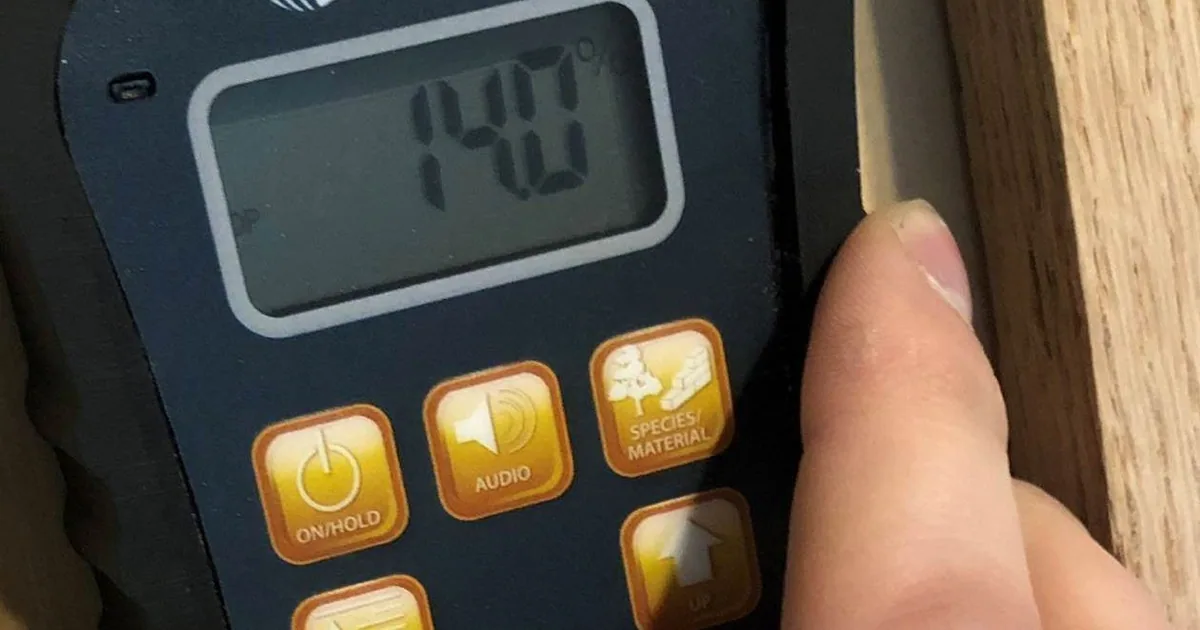
Mould in a furniture shipping container (also written mold in the United States) almost always traces to moisture that was packed in with the goods or that formed inside the container during the voyage, and it is cheapest to prevent at the factory. This post is part of our guide to importing furniture from Vietnam. It explains the causes in a table, what the references say about moisture and mould, how to specify and check a dry pack and what evidence to keep if a container arrives damp.
What the references say about wood, moisture and mould
Three sources frame the problem, and none of them is specific to finished furniture.
The US EPA’s mould guide says that none of the many types of mould will grow without water or moisture, and that wet items should be dried within 24 to 48 hours to prevent mould growth.
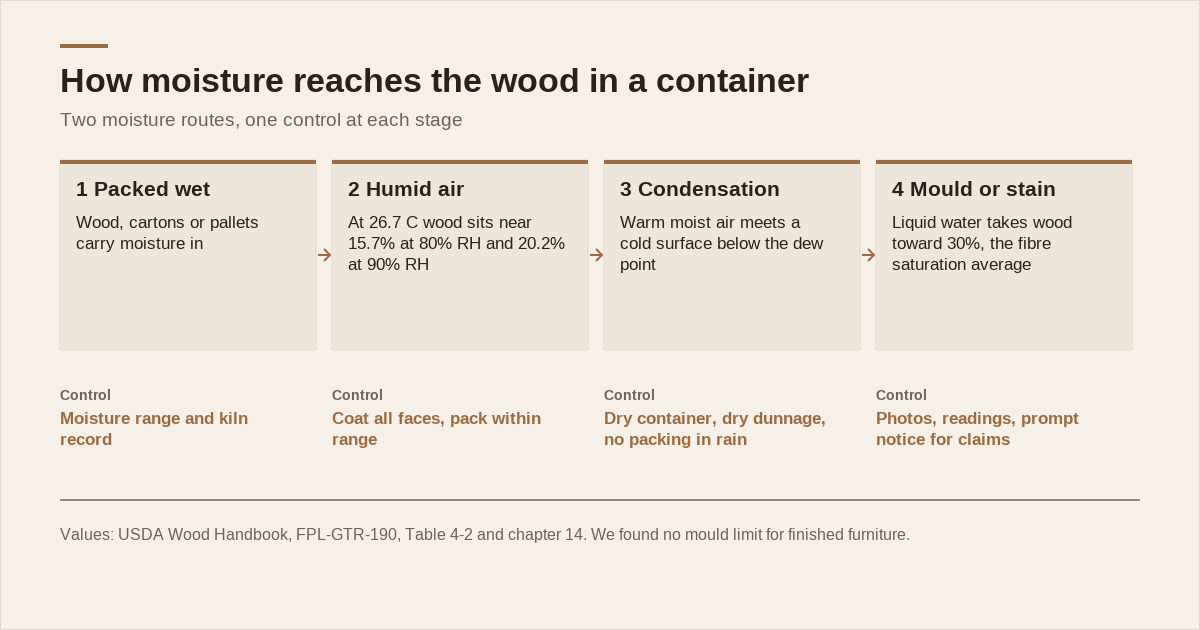
The USDA Wood Handbook (FPL-GTR-190) adds numbers for wood. At 26.7 degrees Celsius, wood in equilibrium with air at 80 per cent relative humidity sits at about 15.7 per cent moisture content, at 85 per cent about 17.7 per cent, at 90 per cent about 20.2 per cent and at 95 per cent about 23.6 per cent. The Handbook says that humid air alone will not wet wood enough to support significant decay but will permit development of some mould fungi, and that serious decay needs the wood above the fibre saturation point, averaging 30 per cent, which happens when dried wood is wetted by rain or condensation. It describes fully air-dried wood, usually not above 20 per cent, as having a reasonable margin of safety. It also notes that mould and stain fungi raise the absorbency of wood, which can cause over-absorption of paint during later processing.
West P&I Club, a marine insurer, notes that sea air at main deck level will normally exceed 80 per cent relative humidity. It describes cargo sweat as condensation on the exposed surfaces of the stow when warm, moist air meets much colder cargo, and ship sweat as condensation on the ship’s structure that can drip onto the cargo. It also warns that hygroscopic packaging such as wood or paper can harm cargo by absorbing moisture.
The causes in one table
| Symptom on opening | Likely cause | Prevention | Limit to write into the contract | Who pays |
|---|---|---|---|---|
| Fuzzy or discoloured growth on raw undersides or backs | Uncoated faces took up moisture, or wood was packed above the agreed range | Coat all faces; moisture range at packing; kiln record | No visible mould on any surface at inspection and on arrival | Depends on evidence; see the claims section |
| Mould on carton board, cartons soft or stained | Cartons or dunnage were wet at packing, or condensation formed in transit | Dry cartons, dry pallets, no packing in rain, dry container checked at loading | Cartons and pallets dry at loading, with a photo | Depends on evidence |
| Water drips from the container roof onto top cartons | Container sweat when the surface cools below the dew point | Avoid trapped humid air; ask the forwarder about routing and container type | Not a defect limit; a claim and insurance matter | Depends on terms and insurance |
| Dark spots or stain on timber before or after finishing | Unseasoned or re-wetted wood stored or stacked damp | Kiln records, covered storage between kiln and machining | Moisture range at the start of machining, with readings | Factory, if the contract names the range |
| Mould appears only after weeks in a warehouse | Goods were packed at a moisture content above the destination’s equilibrium | Pack within the range for the destination market | Moisture range at packing and on arrival | Depends on readings at each point |
We found no published standard that sets an acceptance limit for mould on finished furniture, so the limit is a contract line, not a standard clause. Typical causes are drawn from the references above and our own guides.
Moisture before the box
Most mould claims start earlier than the voyage. Wood that leaves the kiln dry can climb again if it waits in an open yard, and finished goods stored for weeks before a container is available pick up moisture on uncoated surfaces. The Wood Handbook says unseasoned stock piled in warm, humid weather may be noticeably discoloured within 5 or 6 days, which is why storage between kiln and machining matters.
Set a range and not a single number. The Handbook’s table of recommended moisture content for interior furniture gives 8 per cent on average for most areas of the United States, with 6 to 10 per cent for individual pieces, and 11 per cent, with 8 to 13, for damp, warm coastal areas. Our guide to wood moisture content for export furniture gives 8 to 10 per cent at production for the usual destinations, which overlaps those figures. The Container Handbook points out that packing too dry also does harm, naming cracking lumber, so the range has two ends.
Condensation in transit
Dry goods can still sweat. The Container Handbook lists the causes of container sweat as moisture sources inside the unit, a temperature difference between the air and the cargo or the walls, changes in outside temperature and cooling after high humidity has built up inside. Sun on the container can make the air under the inner surfaces warmer than the outside air, which widens the day and night swing. Repeated cycles can increase the damage.
A forwarder, not the factory, controls routing and container type, so raise the question when you book. We found no public rule for how many days a wood cargo can safely cross the Pacific, and we do not give one.
Packing a dry container
Four practices come from the references and from ordinary packing discipline:
- Check the container at loading. Floor, roof and door seals dry and sound, with a photo.
- Keep wet items out. The Container Handbook says not to use wet dunnage, pallets or packaging, and not to pack in rain, because cargo and pallets left outside carry water in.
- Be careful with plastic. It advises protective film where needed, but its section on moisture-sensitive goods says paper or gunny cloth works better than plastic sheeting, which can move condensation under the sheet and onto the cargo.
- Use desiccant by agreement. Desiccant bags are common in the trade and our inspection guide mentions them. We found no public performance figure and did not open a source, so ask the factory how many it puts in each container and why.
At the destination, the Container Handbook says opening the doors stops sweat forming. A second Handbook page also notes that the first opening can itself cause a one-off condensation event when the air inside is humid and the air outside is cooler, and that this usually happens only once and seldom does serious damage. Tell your warehouse to open in a dry spell and look before unloading.
Need a quote for this product? Get matched with a Vietnam wood factory
When a container opens damp: evidence and claims
Whether a loss is the factory’s, the carrier’s or the insurer’s depends on the cause, and a photo cannot show a cause. The terms set where risk of loss moves. Under FOB, the International Chamber of Commerce says the risk of loss or damage passes to the buyer when the goods are on board the vessel, and under CIF the seller must buy cargo insurance of at least Institute Cargo Clauses (C) cover at 110 per cent of the contract price. Those rules allocate risk of loss. They do not decide whether goods packed wet breached the contract, which turns on your specification and your evidence. Whether cargo sweat or mould is covered by a given policy is a question for your insurer, and we did not read any policy wording.
Keep the evidence from every point:
- Moisture readings at packing, with the kiln record.
- The inspection report and the photos taken at loading, including container condition and the sealed doors with the seal number.
- Photos at opening, before anything is moved, showing where the growth is.
- Moisture readings on several pieces on arrival, with the meter type and the date.
- The packing list, the carton count and the bill of lading.
Tell your forwarder and your insurer promptly. We found no single public notice deadline, so ask them for theirs. Do not discard affected goods before an assessor has seen them. The EPA notes that porous materials may have to be thrown away once mouldy, so cleaning is a separate decision from the claim.
Contract lines to write
Write the limit into the order so an argument has an answer.
Moisture content at packing: 8 to 10 per cent, measured on at least 10 pieces per product, with the readings and the kiln record supplied before shipment. All faces coated, including undersides. Cartons, pallets and dunnage dry at loading. Container checked dry and sound at loading, with photos. No visible mould on any surface at inspection or on arrival; arrival readings taken within a stated number of days.
The numbers are an example. Set the range for your destination, and set the number of days with your forwarder.
What to put in the specification
State the moisture range and where it is measured, the faces to be coated, the kiln record requirement, the packing and dunnage standard, the container check and the inspection and loading supervision you want. Then return to the guide to importing furniture from Vietnam for the order of the steps. For the inspection side, see our guide to furniture quality inspection and container loading. Send your specification through the RFQ page. We reply within 24 business hours and match you with up to 3 Vietnamese wood factories that quote you directly.
Sources
- USDA Forest Products Laboratory: Wood Handbook, FPL-GTR-190 (2010), copy hosted on Wikimedia Commons
- US EPA: A Brief Guide to Mold, Moisture and Your Home
- West P&I Club: Cargo ventilation and precautions to minimise sweat
- Container Handbook: container sweat (condensation)
- Container Handbook: loss prevention for moisture-sensitive cargo
- ICC Incoterms 2020: rules for sea and inland waterway transport (library page)
- ICC Academy: Incoterms 2020, FAS or FOB
Frequently asked questions
What causes mould in a furniture shipping container?
Moisture. It can come with the goods, from wood or packaging that was packed wet, or from condensation inside the container during the voyage when warm moist air meets a cold surface. Humid air alone raises wood toward a higher moisture content, and liquid water takes it much further.
Is mould also called mold, and is it the same problem?
Yes. Mold is the US spelling of mould, and the cause is the same: mould does not grow without moisture, according to the US EPA. A claim or a spec written for a US buyer may use either spelling, so use the same word in the contract and in the photos you take.
How dry must furniture wood be to avoid mould in transit?
We found no public mould threshold for finished furniture. The USDA Wood Handbook says fully air-dried lumber, usually at 20 per cent moisture content or less, has a reasonable margin of safety against fungal damage. Set a range for your destination and check it with a meter.
Who pays when a container arrives with mould?
It depends on the cause, the evidence and the terms. Under FOB, risk of loss passes to the buyer once the goods are on board, but goods packed wet may breach the contract before that point. Cargo insurance may respond to some causes. Keep readings, photos and the inspection report, and ask your insurer.
Need a quote for this product?
Send the specification. We match you with up to 3 Vietnamese wood factories and reply within 24 business hours.
Get matched with a Vietnam wood factory