Guides / Choosing a Factory
Spray Booth or Flat-Line Finishing: What Vietnamese Factories Run
November 21, 2026

Almost every furniture finish made in Vietnam starts in one of two places: a spray booth where a person holds the gun, or a flat line where a conveyor carries flat parts through coating machines. Many plants have both, and which one handles your parts changes the price, the lead time and how well the colour matches from the first piece to the ten thousandth.
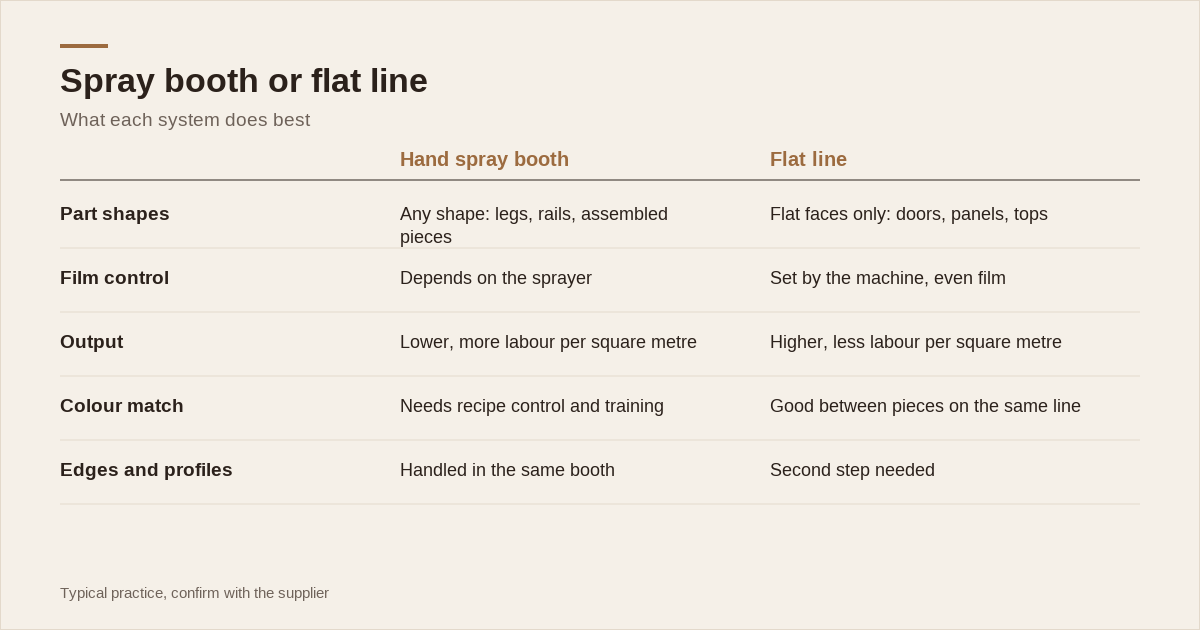
This guide explains the two systems in plain terms, then lists the questions that reveal whether a plant can hold your finish standard across a full container.
Finishing is one of the capability checks in our guide to wood furniture manufacturers in Vietnam.
How a hand spray booth works
A spray booth is a room with an air flow system that pulls overspray away from the operator through a filter wall or a water curtain. The operator holds an air spray, airless or air assisted gun and applies stain, sealer or topcoat by hand. Parts sit on a trolley, a turntable or a hanging rack.
Spray booths handle almost any shape: chair legs, curved rails, carved details, assembled pieces and large cabinets. The quality depends on the person. A good sprayer keeps an even distance and speed, overlaps passes correctly and reads the wet film by eye. A tired or untrained one leaves runs, dry spray and thin edges.
Most Vietnamese plants run several booths in parallel with a drying room or a drying tunnel next to them. Spray lines for solid wood furniture typically follow a sequence of sanding, stain, sealer, sanding, topcoat and sometimes a second topcoat, with a drying time between each coat.
How a flat line works
A flat line is a set of machines in series. Panels or doors lie flat on a conveyor and pass under a roller coater or a spray head that applies a controlled amount of coating. Next they go through an oven, often a UV curing tunnel or an infrared and hot air tunnel, and finally through a sander that scuffs the surface before the next coat.
A roller coater applies a precise film to flat parts, and a spray head with fixed nozzles applies stain or topcoat across the part width. Because the machine sets the film thickness, parts on a flat line show less variation between the first and the last piece. Throughput is higher than in a booth, and labour per square metre is lower.
The limit is shape. A flat line only coats flat faces. Edges, profiles, grooves and any three dimensional part need a second step in a booth or on a profile sprayer.
Which parts go where
| Part type | Usual route | Why |
|---|---|---|
| Table tops, desk tops | Flat line or booth | Large flat face, finish quality shows |
| Cabinet doors and drawer fronts | Flat line for faces, booth for edges | Many identical parts, consistent colour needed |
| Veneered and MDF panels | Flat line (often UV) | Hard film, high output |
| Chair legs, rails and spindles | Booth | Shapes cannot go on a conveyor |
| Assembled chairs and tables | Booth | All faces and joints need coating at once |
| Carved or turned parts | Booth | Detail needs hand control |
| Outdoor furniture | Booth, often oil or stain based | Penetrating systems, many small parts |
Most orders are a mix, and a well run plant uses both for the right parts. Ask which parts of your product go on which line.
Coat counts and typical sequences
A conventional lacquered interior piece often receives a stain or colour coat, a sealer, a light sand and one or two topcoats. A UV cured flat line sequence is shorter in time but not always in steps, because each UV coat cures in seconds and the parts move straight to sanding or the next coat.
Do not accept a coat count alone as a quality standard. Two plants may both say “three coats” and deliver films that differ in thickness by a factor of two. Ask for dry film thickness or at least for a finished sample, and describe the performance you need, such as resistance to a wet glass ring or a hot dish. The guide to wood finishes for export furniture lists the common systems and their durability.
Coating systems on each line
Three coating families dominate Vietnamese furniture finishing, and they suit the two lines differently.
Polyurethane (PU) solvent based. The long standing system for booth spraying. It gives a clear, hard film, and it dries within hours at room temperature or faster in a drying room. It works on any shape. Solvent emissions are the main drawback, and plants that serve strict markets are moving some lines to alternatives.
Water based. Lower in solvent, slower to dry, and more sensitive to humidity and to the wood. Buyers in the European Union and parts of the United States ask for it more often. It is used in booths and on flat lines, and it needs good drying control to avoid a soft or cloudy film.
UV cured. Applied by roller or spray on flat parts and cured under ultraviolet lamps in seconds. It gives a very hard film and a fast cycle, so it suits high volume flat parts. It cannot cure in shadow areas, so shaped parts need a different system.
When you choose a system, think about repair as well as first appearance. A hard UV film is difficult to touch up in a customer’s home, while an oil finish is easy to refresh but marks more easily. State how the piece will be used and who will maintain it, then let the factory propose a system for you to approve by sample.
Common finishing defects
| Defect | What you see | Typical cause |
|---|---|---|
| Orange peel | Dimpled surface like fruit skin | Wrong spray distance, wrong viscosity or fast drying |
| Runs and sags | Drips down vertical faces | Too much coating on one pass |
| Fish eyes | Small round craters | Surface contamination such as oil or silicone |
| Dust nibs | Small bumps in the film | Dirty booth, poor filters or dusty drying room |
| Grain raising | Rough feel after water based stain | Insufficient pre-sanding or wetting of the wood |
| Blushing | Milky haze in the film | Moisture trapped during fast drying |
A plant that knows these names and can show how it prevents each one is a plant with a process, not a plant that depends on a lucky day.
Need a quote for this product? Get matched with a Vietnam wood factory
Consistency across a large order
Colour match between the first and the last piece is the hardest thing in finishing. Three habits help.
Mixing control. A plant that weighs stains and mixes in batches to a recorded recipe can reproduce a colour. One that mixes by eye cannot. Ask whether they keep a recipe card for each colour and whether the same person mixes every batch.
Wood preparation. The same stain looks different on heartwood and sapwood, on two species and on two sanding grades. A flat line cannot fix that. Approve a sample made from the same material as production.
Environment. Humidity and temperature affect drying and gloss. Plants in the south of Vietnam run hotter and wetter than plants in the north in many months, so ask how the drying rooms are controlled.
A good practice is to keep a master sample, signed by both sides, and to compare each lot against it under the same light. The quality inspection guide explains how to set acceptable colour variation.
Cost and capacity
A flat line costs more to install and less to run per square metre, so plants with one tend to push flat panel work onto it and quote lower prices for large volumes of identical flat parts. Booths cost less to install and more per unit in labour, so complex or small batch work lands there.
Capacity matters in peak season. Many plants run finishing as the bottleneck, because each coat needs drying time and floor space. When a plant says it can finish 20 containers a month, ask for the number of booths, the size of the drying area and the shifts it runs. Those three numbers tell you more than the headline figure. The lead time and production schedule guide shows how finishing capacity fits into the whole calendar.
Environmental and worker safety points
Finishing uses solvents, and the emissions and the worker protection differ between plants. Look for working extraction in the booths, filters that are changed on a schedule and operators wearing respirators. These points matter for ethics and also for quality, because a booth with poor air flow leaves dust in the film.
If your market has coating regulations, such as limits on volatile organic compounds, formaldehyde or heavy metals in paint, name them in the specification and ask the plant for the coating supplier’s data sheet. Do not assume a coating meets a rule because it is common in the plant. The furniture test standards guide shows how to link a specification to a test report.
Questions to ask before you order
- Which of my parts go through a flat line and which through a booth?
- How many booths and how many drying slots do you have?
- Do you keep a written recipe for each colour, and who mixes it?
- What is the dry film thickness on a finished sample?
- How do you control temperature and humidity in drying?
- Can I see a video of the line running?
Ask the same questions of every factory you compare, and write the answers down in one table, so the comparison does not depend on memory. Pay attention to who answers: a production manager who can quote the number of booths and the drying time from memory is a better sign than a sales contact who promises to check.
The answers tell you whether the plant understands its own process. Vague answers usually point to a plant that finishes by experience alone, which can still be fine for small batches but is risky for container programs.
When you are ready to compare finishing capability across factories, send your specification through the RFQ page. The matching service finds up to three Vietnamese wood factories whose lines suit your parts and replies within 24 business hours.
Frequently asked questions
Which is better for solid wood chairs, a spray booth or a flat line?
A spray booth. Chairs have curved legs, spindles and joints that a flat line cannot reach, so they are sprayed by hand or on a rotating carrier. Flat lines are made for flat parts such as doors, panels and table tops.
Does a flat line always give a better finish?
It gives a more consistent film thickness on flat parts, which helps with colour match across a large order. It does not give a better look on shaped parts. A skilled sprayer in a clean booth can match or beat a flat line on complex pieces.
How many coats should a dining table top have?
A typical lacquered table top has one sealer coat and two top coats, with sanding between coats. Counts vary with the system and the sheen. Put the coat count and the dry film thickness you want in the specification, and approve a finished sample.
Need a quote for this product?
Send the specification. We match you with up to 3 Vietnamese wood factories and reply within 24 business hours.
Get matched with a Vietnam wood factory