Guides / Materials
Vietnamese Plywood and MDF: Quality for Furniture Use
November 21, 2026
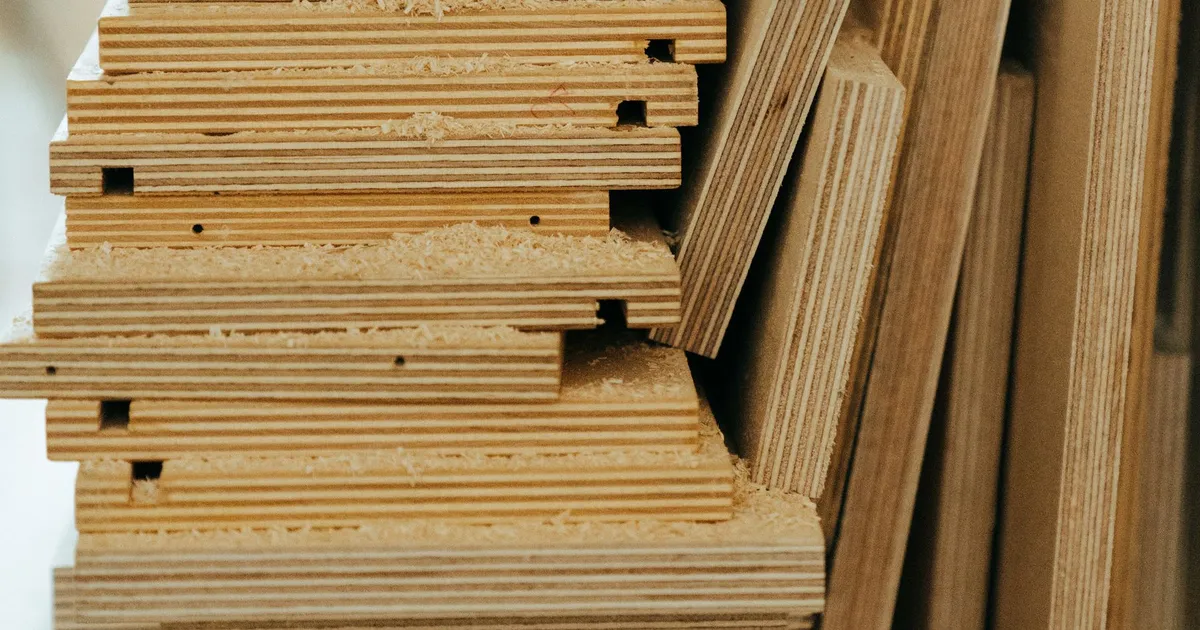
Furniture made in Vietnam is not all solid wood. Beneath many veneered tops, painted cabinet doors and flat pack carcasses sit sheets of plywood, MDF or particleboard. Vietnam makes a lot of these panels and also imports them, and quality runs from basic to excellent. Buyers who treat panel as a commodity and accept whatever is cheapest often discover the difference after shipment, when edges swell, screws pull out or an odour comes out of the carton.
This guide explains how plywood and MDF are made, where the quality differences come from and what to write into a specification so the panel suits the product.
How plywood is made
Plywood is a stack of thin wood layers, called plies or veneers, glued together with the grain of each layer at right angles to the next. The crossing grain makes the sheet stable across its width and length and strong for its weight. An odd number of layers keeps the sheet balanced.
In Vietnam, plywood veneers are peeled from plantation logs, mainly acacia and eucalyptus, with other species used in some lines. The veneers are dried, graded, glued and pressed in a hot press, then trimmed, sanded and sometimes faced with a decorative veneer.
Quality depends on four things: the quality of the core veneers, the glue, the pressing and the sanding. Cores with voids, overlapped layers or patched holes create weak spots and surface defects. A good furniture plywood has a tight, even core, a sanded face and a consistent thickness.
How MDF is made
MDF stands for medium density fibreboard. Wood chips, often from plantation acacia, rubberwood and pine, are cooked, refined into fibres, mixed with resin and wax, formed into a mat and pressed into boards under heat. The result is a uniform, smooth panel with no grain, which machines cleanly and takes paint well.
Typical MDF density runs from about 650 to 800 kilograms per cubic metre, with variations between producers and between thicknesses. Density affects screw holding, edge quality and weight. MDF is heavier than plywood of the same thickness, and it holds screws less well in the edge.
MDF swells when wet, and standard grades do not stand up to damp. Moisture resistant grades, often tinted green, use extra resin or additives and handle higher humidity, but they are not waterproof. Fire retardant grades are another variant.
Plywood or MDF: where each fits
| Use | Plywood | MDF |
|---|---|---|
| Painted cabinet doors and drawer fronts | Possible | Common, smooth for paint |
| Veneered carcass and panels | Common | Common |
| Structural parts and bed slats | Good | Not suited |
| Curved and bent parts | Bendable plywood types | Special flexible boards |
| Screw holding in the edge | Good | Weak |
| Moisture exposure | Exterior grades exist | Poor, moisture resistant grade only |
| Weight | Lighter | Heavier |
| Surface for paint | Needs filling for grain | Very smooth |
A well designed product often uses both: plywood where strength matters, MDF where a smooth painted or routed surface matters.
The specification points that matter
Plywood and MDF quotes mix terms, so write numbers.
Thickness and tolerance. Nominal and actual thickness differ. A sheet sold as 18 mm may measure 17.5 to 18.3 mm, and variation within one sheet matters for fit. Ask for the tolerance in writing, and for a sanded to thickness panel when the product has tight joints.
Face grade. Plywood faces carry grades that describe knots, patches and colour. Grading terms differ by producer, so ask for a photo of each grade and a limit such as maximum patch size.
Core. Ask whether the core is full veneer, has voids or uses mixed species. For furniture, a void free core is the safer choice.
Glue and bond class. European standards define bond classes that describe suitability for dry, humid and exterior conditions. Plywood for furniture is typically made for dry or humid conditions, and exterior use needs a higher class.
Density and internal bond for MDF. Ask for the density range and the internal bond strength from the test report.
Formaldehyde class. This ties directly to compliance, covered below.
Formaldehyde and compliance
Resin in plywood and MDF can release formaldehyde, and many markets limit it. In the European Union, panels are classed by emission, with E1 as the usual requirement. In the United States, the Toxic Substances Control Act Title VI and the California Air Resources Board rules set limits on composite wood and on finished products that contain it. In Japan, panels carry star ratings for emissions, with the highest rating widely required for building and furniture use.
Do not take a verbal assurance. Ask for the test report for the lot, from an accredited lab, and for the producer’s certification where your market requires it. For United States sales, panel suppliers and fabricators need third party certification under the rules, and the CARB and TSCA guide explains what to request. The furniture test standards guide lists related tests.
A plant that buys panels from several mills may switch supplier mid order. The substitute may not carry the same certificates. Ask the factory to name the panel producer and to tell you in writing before any change.
Local panels or imported panels
Vietnamese plants use panels made in Vietnam and panels imported from other countries. Local panels are often cheaper and easier to get. Imported panels may offer a specific grade or a certification that a buyer needs, such as a particular emission class or a premium face veneer.
Neither source is better by default. Ask the plant which panel producer it uses for your product, request the producer name and ask whether the panel is made in Vietnam or imported. That one question often reveals a lot about how well the plant controls its supply.
Need a quote for this product? Get matched with a Vietnam wood factory
Typical thicknesses and what drives price
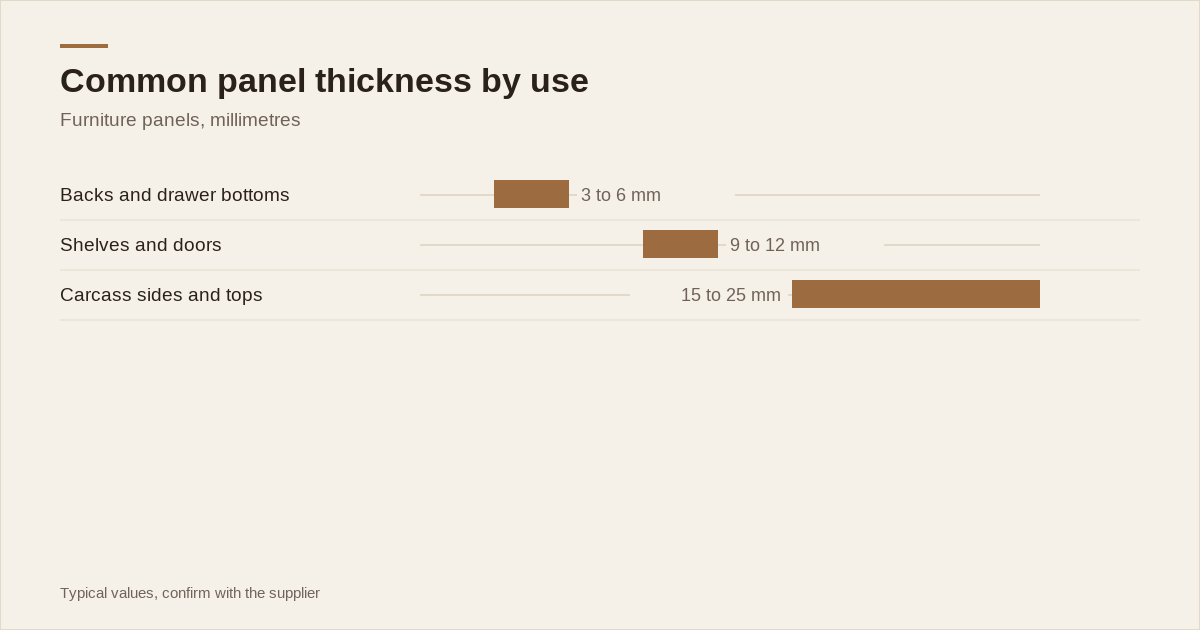
Furniture panels come in a few common thicknesses: 3 to 6 mm for backs and drawer bottoms, 9 to 12 mm for shelves and doors, and 15, 18 and 25 mm for carcass sides and tops. Price rises almost in line with thickness, so a thicker panel than the design needs is a direct cost.
Four items move the price of a panel. The face (a plain sanded face costs less than a decorative veneer), the core quality (void free cores cost more), the glue class (water resistant glue costs more than standard) and the emission class (lower emission resins cost more). When two quotes differ by a large margin, ask which of the four differs before you decide that one plant is cheaper.
Particleboard is a third panel type, often used for budget flat pack furniture. It is cheaper than MDF, rougher in the edge and weaker in screw holding. If a quote lists particleboard in a part you expected to be MDF or plywood, ask why, and ask for the density and the emission data.
Failure modes seen in the field
| Failure | What happens | Common cause |
|---|---|---|
| Edge swelling | Edge puffs up after contact with water | Raw or poorly sealed edge on MDF |
| Screw pull out | Fitting loosens in the panel edge | Low density MDF or wrong screw type |
| Delamination | Layers peel apart | Weak glue or poor pressing |
| Warping | Sheet bows after cutting | Uneven moisture, unbalanced build |
| Telegraphing | Core defects show through the face | Voids or uneven core under a thin veneer |
| Odour | Strong smell on opening a carton | High emission resin or poor curing |
Most of these are visible in a sample, and most can be prevented at the specification stage. Ask the plant to show how it solves each one for your product.
Handling and edge treatment
Panel edges are the weak point. Raw MDF edges absorb moisture and swell, and raw plywood edges show layers that need covering. Plants close edges with edge banding, solid lipping, paint or filler, as discussed in the veneer and edge banding guide. For parts that face moisture, such as kitchen doors, ask for sealed edges and a water resistant adhesive for the edge band.
Panels also need storage in a dry place on flat supports. Panels stacked on a damp floor or leaned against a wall bow and absorb moisture. Ask to see the panel store during a video call.
Inspection checks
A few simple checks reveal panel quality. Measure thickness at several points on several sheets. Check flatness by laying a sheet on a flat surface. Look at the edge for voids and delamination. Smell the sheet, since a strong chemical odour hints at high emissions or poor curing. Cut a sample and look at the glue line and the core. Compare the face with the approved sample under daylight.
The quality inspection guide explains how to add these checks to an inspection plan. For deeper construction choices, the solid wood versus engineered panel guide covers the trade offs between panel and solid parts.
Reading a panel supplier’s data sheet
Ask the plant for the data sheet of the panel it plans to use. A useful sheet lists thickness and tolerance, density, internal bond strength, swelling after water soak, bending strength and the emission class with the test method. Check that the sheet is dated, names the producer and matches the panel in the sample. A sheet for a different grade, or one that is several years old, proves little.
If the sheet and the sample disagree, trust the sample and the test. Send a few panels to a lab for a spot test when the order is large, since a small test fee is minor beside the cost of a shipment that fails compliance.
What to write in the quote request
For each panel part, state the type (plywood or MDF), thickness and tolerance, face grade, core, glue or bond class, formaldehyde class and certificates, edge treatment and the producer name. Add a rule that the plant must ask for approval before changing the panel supplier.
To compare factories that use quality panel for furniture, send your specification through the RFQ page. The matching service finds up to three Vietnamese wood factories and replies within 24 business hours.
Frequently asked questions
Is Vietnamese plywood good enough for furniture?
It can be, when the grade, glue and core are specified. Quality ranges from basic packing grade to furniture grade with sanded faces, void free cores and low formaldehyde glue. The word plywood alone does not tell you which one you are buying, so ask for the face grade, the core type, the glue class and the thickness tolerance.
What does E1 or E0 mean on MDF?
They are formaldehyde emission classes. E1 is the common European limit class for panels, and E0 or similar labels indicate lower emissions, with the exact limit set by the scheme used. For the United States, the relevant rules are CARB Phase 2 and TSCA Title VI. Ask for the test report and the certificate that match your market.
Can MDF be used outdoors or in a bathroom?
Standard MDF swells when it gets wet and fails in damp conditions. Moisture resistant MDF handles higher humidity but is still not for outdoor use. For wet areas, marine or exterior grade plywood or other water resistant materials are the usual answer, and sealed edges are essential.
Need a quote for this product?
Send the specification. We match you with up to 3 Vietnamese wood factories and reply within 24 business hours.
Get matched with a Vietnam wood factory