Guides / Choosing a Factory
Export Furniture Packaging: Carton Specs and Drop Tests
October 25, 2026
Furniture usually arrives at its destination after at least four handling points: a truck or barge in Vietnam, a port crane, a sea voyage of three to five weeks and a truck or warehouse at the other end. The carton is the only thing standing between the finished surface and all of them. A poorly specified carton shows up as scratches, crushed corners and returns that eat the margin on an order.
This guide explains the layers of furniture packaging, the numbers worth putting in a specification and how drop tests and inspections prove the pack works.
The layers of a furniture pack
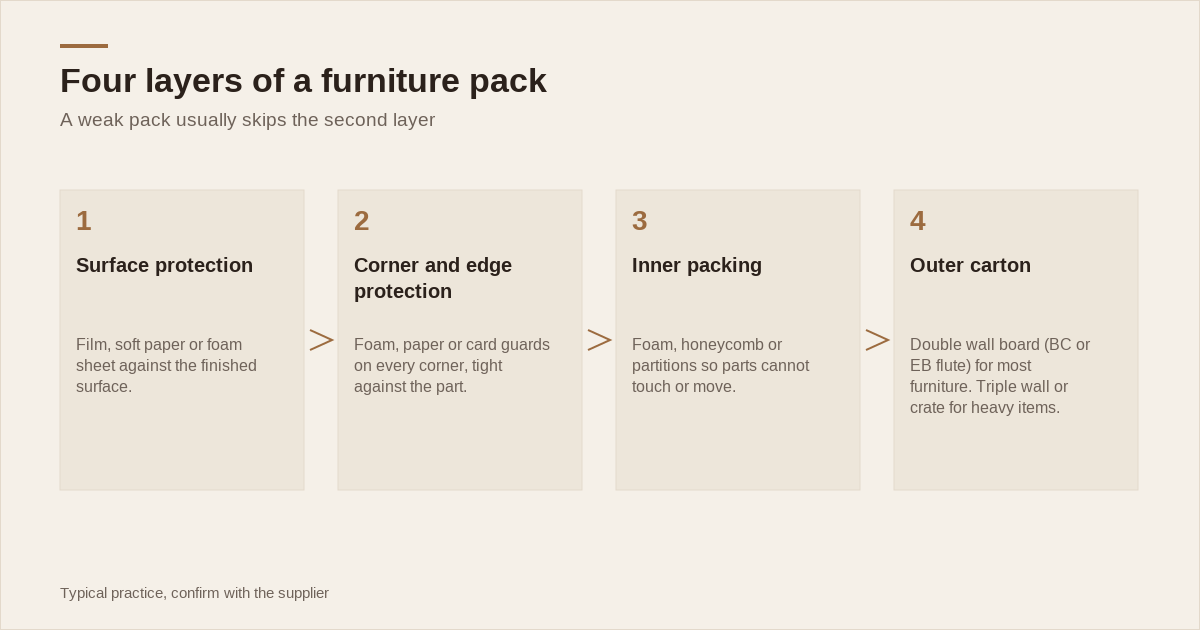
A good furniture pack has four layers, and a weak one usually skips the second.
Surface protection. A film, a paper wrap or a foam sheet touches the finished surface. It prevents scuffing from the next layer and from other parts. For polished or lacquered surfaces, use a soft, non abrasive material, since coarse paper can mark a fresh finish.
Corner and edge protection. Corners take the hardest hits. Moulded foam or paper corner protectors, cardboard edge guards or EPS corner blocks go on every corner, and they should sit tight against the part so they do not slide.
Inner packing. Foam, honeycomb paper, bubble wrap or partitions separate parts inside the carton and stop them from moving. Parts that touch each other during a drop damage each other, so separation matters more than total padding.
Outer carton. Corrugated board holds the load of stacking and protects against impact. The board grade, the carton dimensions and the sealing decide how well it performs.
Corrugated board basics
Corrugated board is described by the number of walls and the flute type. A single wall board has one fluted layer between two liners. Double wall has two fluted layers and three liners. Triple wall has three.
| Board | Typical use | Strength notes |
|---|---|---|
| Single wall (B or C flute) | Light items, small accessories | Low stacking strength |
| Double wall (BC or EB flute) | Most furniture cartons | Good stacking and puncture resistance |
| Triple wall | Heavy tables, marble tops, long stacking | High strength, higher cost |
| Wooden crate or pallet frame | Very heavy or fragile pieces | Highest protection, adds weight and cost |
Two test ratings describe strength. Burst strength measures resistance to pressure on the face, and edge crush test (ECT) measures the load the board edge can carry, which relates directly to stacking in containers and warehouses. Ask for the rating on the carton board, and ask the packaging maker for a data sheet. A carton that looks thick can be weak if the paper is recycled and low grade.
Humidity matters on the route. Sea transport exposes cartons to damp air, and board loses strength as it absorbs moisture. Cartons that pass a dry factory test can collapse in a damp container. For humid routes, ask about coatings or higher grade paper and keep stacking heights in the container within the carton’s stated limits.
Carton size and design
Carton size affects freight and damage. A carton that is too large lets the product move and wastes container space. A carton that is too tight crushes the product at the first impact. Allow a small clearance and fill it with inner packing, so the product is held in place.
Check these details on the carton drawing:
- Internal dimensions, with the clearance for protection on each side.
- The carton style, either regular slotted container or a tray and sleeve for tall items.
- Handholds, which help workers but can weaken a carton and let in dust.
- Print and labelling areas.
- Strapping or tape pattern. Plastic strapping around a carton adds stacking strength and keeps it closed.
If the product is knock down, the carton also has to hold the hardware bag in a fixed place, as described in the knock down furniture guide.
Carton dimensions decide how many pieces fit a container: see furniture container loading by CBM.
Labelling and shipping marks
Carton labels do work for the buyer and for customs. Common marks include the product code, a description, quantity, carton number (1 of 3), gross and net weight, dimensions and country of origin. Retail programs often add a barcode and handling marks such as “this side up” and “fragile”.
Wood packaging itself brings a compliance point. Wooden crates and pallets used in international shipping need to meet the international standard for treating wood packaging material, usually shown by a stamped mark with heat treatment or fumigation. Ask the factory how its crates and pallets are treated and request the mark in the photo record.
Drop tests and what they prove
A drop test packs a finished product in its final carton and drops it from a set height onto a hard floor. The standard sequence drops the carton on a corner, on edges and on faces. After the drops, a technician opens the carton and checks the product for damage.
Test standards for packaged products exist at national and international level, and many retailers have their own rules. The test height depends on the weight of the packed unit. Heavier cartons are dropped from a lower height. Ask your buyer or testing lab which protocol applies to your product, and write it into the order.
A drop test tells you three things: whether the inner packing holds the part in place, whether the corners survive and whether the carton holds its shape. It does not tell you how the pack performs in a stack in a hot container for five weeks. Compression testing of the carton and a stacking check cover that question. The furniture test standards guide lists the usual tests and who runs them.
Need a quote for this product? Get matched with a Vietnam wood factory
Pallets, strapping and stacking
Many furniture programs ship loose cartons packed floor to ceiling in a container, and others ship palletised cartons. Palletising speeds loading and protects the bottom cartons from forklift damage, but it wastes container height and weight capacity when the pallet itself is large. Check which method your buyer wants and ask the factory for a loading plan that shows cartons per container for each method.
If cartons ship loose, the stacking pattern becomes a design input. Cartons stacked in columns carry load through their corners and edges, so the stacking strength of the board in the vertical direction is what counts. Cartons stacked in a brick pattern, where upper cartons sit across two lower ones, lose a large share of that strength. Ask the factory to confirm the column pattern in the loading plan.
Strapping helps cartons keep their shape during handling, but it can cut into soft board if the tension is too high. A good practice is two bands around each carton with edge protectors under the band, or a stretch film wrap on a pallet load with corner boards.
Retail ready and sample packing
Retail programs often add a second layer of packaging requirements: a printed master carton, an inner box per item, a barcode on a set position and a shelf ready format. These add cost and lead time, because print runs and approvals take time. Settle them early. A printed carton artwork file takes days to approve, and a late change can delay the whole order.
Sample shipments deserve their own packing standard. A sample sent by air courier faces more handling and less cushioning in the supply chain than a container does, so over pack it. A broken sample wastes a round of time, and the broken part tells you nothing about the factory’s quality.
Common packaging failures
| Failure | What you see on arrival | Likely cause |
|---|---|---|
| Crushed corner | Dent or break at one corner | No corner protection or weak carton |
| Scuffed surface | Rub marks on finish | No film or paper wrap, or abrasive wrap |
| Loose fittings | Rattle inside the carton, scratches | Parts not separated or held |
| Wet carton | Soft, stained board | Water in the container, no moisture barrier |
| Split carton | Carton opens during handling | Weak tape, poor sealing, overfilled |
| Missing parts | Customer gets an incomplete unit | Wrong carton count or hardware bag left out |
Each failure has a cause that can be fixed at the factory. If the same failure repeats on shipment after shipment, change the pack, not the supplier.
Cost and where to save
Packaging usually costs a small percentage of the product price, but it can swing that number a lot. Triple wall board and foam inserts cost more than double wall with paper corners. Do not cut the spend blindly. First find what actually damaged the product in past shipments, then spend on that.
Savings that rarely cost quality include a better carton size, standard rather than printed cartons for samples and trade packaging, and consolidated inner parts. Savings that tend to backfire include thinner board without a test, removing corner protection and using recycled low grade paper for heavy products. The MOQ and order economics guide shows how packaging cost fits into total unit cost.
Container loading
Packaging is only half of the story. How cartons are loaded into the container affects damage as much as the cartons themselves. Heavy cartons go at the bottom, cartons are stacked in columns that line up so the load passes through the board edges, and gaps are filled with dunnage or air bags so the load does not shift. The quality inspection and container loading guide explains how to check the loading before the container is sealed.
What to put in the order
State the carton material and ECT or burst rating, the inner protection list, the carton size with clearance, the labelling layout, the wood packaging treatment, the drop test protocol and the loading plan. Request a photo of the first packed unit before mass packing starts, and approve it in writing.
To compare how different factories pack the same product, send your specification through the RFQ page. The matching service finds up to three Vietnamese wood factories and replies within 24 business hours.
Frequently asked questions
What carton board should I specify for furniture?
Most furniture cartons use double wall corrugated board, often written as BC or EB flute, with a stated burst or edge crush rating. Heavy items such as solid wood tables may need triple wall board or a wooden crate. Ask the packaging maker for the test rating of the board, not just the number of layers.
What is a drop test?
A packed unit is dropped from a set height onto a hard surface on specified faces, edges and corners, then opened and checked for damage. Heights and the number of drops vary by standard and by the buyer's rules. Typical retail programs use a drop from 0.5 to 1 metre in a series of drops.
Who pays for packaging damage in transit?
It depends on the terms and on the cause. If the packaging was built to the agreed specification and the damage came from handling at sea, insurance covers it under most terms. If the packaging was weaker than the specification, the factory carries the cost. Write the packaging spec into the order, so that this question has an answer.
Need a quote for this product?
Send the specification. We match you with up to 3 Vietnamese wood factories and reply within 24 business hours.
Get matched with a Vietnam wood factory