Guides / Sourcing Guide
Furniture Spec and Packing Data Sheet: What US Importers Ask Factories to Fill In
November 21, 2026
A furniture packing data sheet is the spreadsheet an importer sends a factory to fill in for each model before the first purchase order ships. It holds the size, weight, materials, barcode, carton and pallet facts that the importer’s systems, freight forwarder and customs broker all need. Every importer’s template is a little different and most are private, so this guide covers the fields that recur, who in your factory owns each one and where wrong data costs money. It is for the owner or export sales engineer of a furniture factory.
Why importers ask for it
SPS Commerce, a retail supply chain software company, describes item setup as the step where a supplier’s product data is loaded into the retailer’s system before the item can be ordered. Its list of required data covers identifiers such as the GTIN or UPC, physical specifications such as weight, dimensions and case pack, category and attributes, and compliance data such as country of origin and materials. It also lists what goes wrong: items stay “pending” and never reach “approved for ordering” when data is incomplete, and actual case dimensions that differ from the entered values can trigger receiving exceptions and delays.
Not every furniture importer runs a retail system. A designer, a contract supplier or an online seller may send a plainer sheet. The fields are still the same ones, because freight, customs and the warehouse need the same facts.
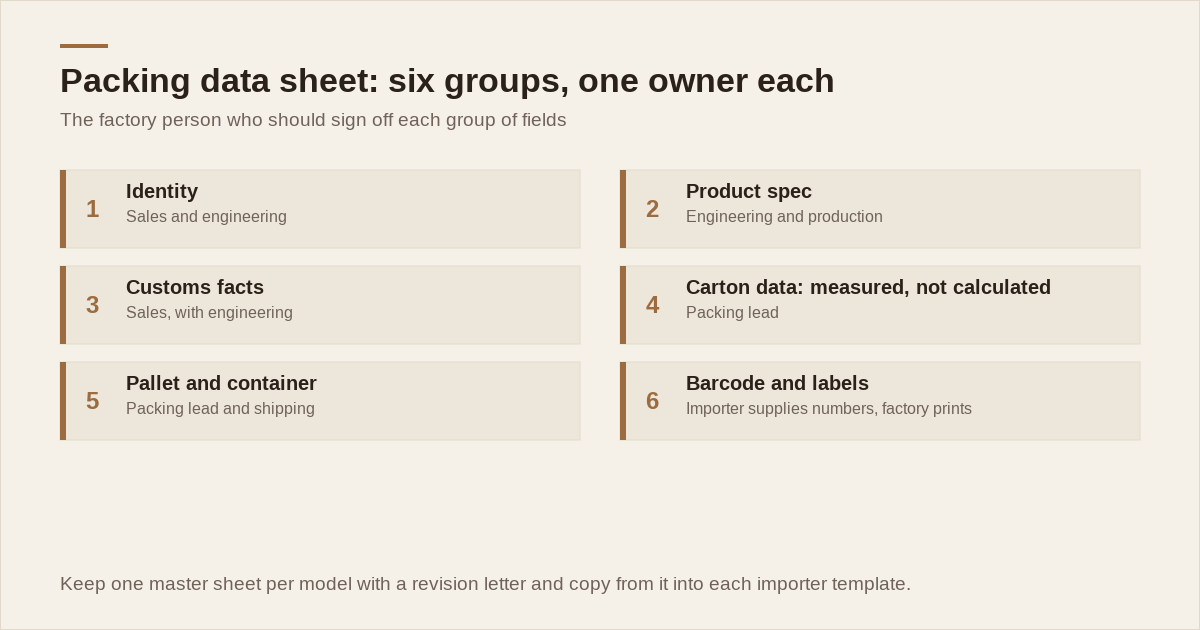
The six groups of fields
| Group | What to fill | Owner in your factory |
|---|---|---|
| Identity | Model code, description, colour or finish code, revision of the drawing the data came from | Sales and engineering |
| Product spec | Assembled and flat-pack size, net weight, species and panel types, finish system, hardware list, number of parts | Engineering and production |
| Customs facts | Materials by component, how it is made, intended use, country of origin | Sales, with engineering |
| Carton data | Number of cartons per model, carton marking such as 1 of 3, outer size, gross and net weight, pieces per carton | Packing lead |
| Pallet and container | Cartons per layer and per pallet, pallet size, cartons per container type | Packing lead and shipping |
| Barcode and labels | The GTIN at each level the importer wants and the label layout | Importer supplies, factory prints |
Ask each importer which units the sheet uses and give both metric and imperial if the sheet allows. Many US teams work in inches and pounds. A conversion done by hand is a common source of a wrong figure, so let the spreadsheet convert and keep the metric number as the master.
Carton data: measure, do not calculate
The carton fields cause most of the trouble because they come from drawings and then meet a real box. The product’s size is not the carton’s size. The carton adds board thickness, corner protection and strapping to every dimension, and the first packed unit often differs from the plan.
Measure the first fully packed carton of each model with the protection in place. Weigh it on a scale, photograph it on the scale and next to a tape, date the photo and put the figures on the sheet. Cubic metres are length times width times height in metres. As an illustration only, a carton of 1.20 by 0.40 by 0.18 m is 0.0864 m3. Our guide to furniture container loading and CBM shows how those numbers become a container plan.
Send final carton data after the first packed unit, not before. SPS Commerce describes item data as locked once approved: corrections can mean resubmitting the full item file and repeating approval, which it says can delay a launch by weeks. A sheet marked “draft, carton data to be confirmed on first packed unit” is more useful to the importer than a confident wrong number.
Barcodes: ask who supplies the numbers
If the importer wants barcodes, ask whether they will send the GTINs. SPS Commerce says retailers check identifiers against the GS1 registry and expect the brand owner in the registry to match the company being onboarded, so a factory should not invent codes or reuse numbers from another customer.
Packaging levels matter. In SPS Commerce’s guide, the single consumer item carries a GTIN-12 (UPC) and the shipping case carries a GTIN-14. Putting the consumer UPC on a case is described as incorrect and as a cause of compliance fines, and one retailer, according to the same guide, wants a code at every level from the single item to the pallet. Put each number in its own field on the sheet and say which carton it prints on.
Customs facts: you supply the facts, the importer classifies
The importer of record, not the factory, answers to US Customs and Border Protection. CBP’s reasonable care publication says the importer must use reasonable care to enter, classify and value the goods, and that CBP then fixes the final classification. Its checklist asks the importer whether it knows what it ordered, where it was made, how it was made and what it is made of.
That list is the brief for your side of the sheet. Give materials by component in plain words (solid rubberwood legs, MDF top with melamine, steel fasteners), say how the piece is made and what it is for, and keep the description identical on the data sheet, the commercial invoice and the packing list. If you write a customs code, mark it “proposed” and let the importer’s broker decide. For the legality side of the wood, the documents are in Vietnam wood export documents.
Need a quote for this product? Get matched with a Vietnam wood factory
Country of origin marking
CBP’s marking guide says each foreign article must carry the English name of its country of origin, unless an exception applies, and that the mark must be legible, conspicuous and as indelible and permanent as the product allows. Abbreviations are acceptable if they clearly indicate the country, but CBP prefers the full name. CBP’s reasonable care checklist also asks importers whether they told their foreign supplier the marking rules before the goods shipped, so expect the importer or its broker to tell you where the mark goes on furniture, on a label or on the carton. Do not decide this yourself. Ask, then write the answer on the sheet.
Packing tests the importer may name
An importer may name a packing test on the sheet. ISTA lists protocols for different cases. Its 2C procedure is for individually packaged furniture shipped in a container, specifically case goods, and the 3M project protocol is for international direct import from Asia-Pacific to US distribution or fulfilment centres. Which protocol applies, if any, is the importer’s call. Ask for the name and the version, book the test before mass packing starts and file the report with the sheet. The carton side of this is in export furniture packaging: carton specs and drop tests.
Keep one master sheet per model
A factory that fills in a new form for each importer will contradict itself. Keep one master sheet for each model with a revision letter, the date and the name of the person who measured the carton, and copy from it into any importer’s template. Link it to the drawing revision in your tech pack. When anything changes (a new foam, a thicker carton, a different hardware supplier), change the master, raise the revision letter and tell the importer in writing, because the importer’s copy is the one that will be locked.
Mistakes that cause holds
- Carton data copied from the drawing, not measured from the packed box.
- One barcode used for the unit and the case.
- Different materials wording on the sheet, the invoice and the packing list.
- A carton or foam change after the importer approved the data, with no written notice.
- Origin marking left to the packing crew without the importer’s instruction.
- A finished sheet sent with blanks that the importer then fills in itself.
Talk to us
We are a matching service. We do not set up items for importers, classify goods or print labels. If your factory builds furniture in Vietnam and wants export requests that fit what you already make, talk to us through the for suppliers page. We reply within 24 business hours.
Sources
- SPS Commerce: why item setup matters, a guide for new retail suppliers
- SPS Commerce: GS1 standards for new suppliers, GTINs, UPCs and case codes
- CBP: Reasonable Care, informed compliance publication (2017 revision)
- CBP: Marking of country of origin on US imports
- ISTA: test procedures, 2 series and 3 series
The SPS Commerce pages are a software vendor’s guidance, directional and aimed at retail suppliers in general. Importer templates and customs rules differ and change, so confirm each point with your importer and its customs broker. This guide is general information, not legal advice.
Frequently asked questions
What is a furniture packing data sheet?
It is a spreadsheet or form, usually from the importer, that holds the facts about each model: size, weight, materials, finish, barcode, carton count, carton size and weight, cartons per pallet and country of origin. Importers use it to set up the item in their system, book freight and fill customs entries.
Who classifies the furniture for US customs, the factory or the importer?
The importer of record. CBP's reasonable care guide says the importer must use reasonable care to enter, classify and value the goods, and CBP then fixes the final classification. The factory's job is to supply accurate facts: what the piece is made of, how it is made and what it is for.
Do I need a barcode on every furniture carton?
Not always. Some orders need none and many retail programs do. Ask the importer whether it wants barcodes, which level (single item or case) and who supplies the numbers, because retailers check them against the GS1 registry and expect a different code at each packaging level.
What happens if the carton size on the sheet is wrong?
One retail supplier guide describes mismatched case dimensions as a cause of receiving exceptions and delays at the distribution centre, and says corrections to locked item data can mean resubmitting the file and waiting for approval again. Measure the first packed carton and send the real numbers.
Need a quote for this product?
Send the specification. We match you with up to 3 Vietnamese wood factories and reply within 24 business hours.
Get matched with a Vietnam wood factory