Guides / Choosing a Factory
Wood Species Substitution: How to Handle a Factory Swap Proposal
November 21, 2026
Sooner or later a factory writes: “We can make it in a different wood and it will look the same.” The message may be honest and useful, or it may be the first step toward a product that differs from the one you approved. Species substitution is a normal part of sourcing wood furniture, and the way a buyer handles it affects price, quality, legal risk and the relationship with the plant.
This guide explains why swaps happen, how to judge which ones are safe, what to put in the contract and how to check at inspection that the wood in the carton matches the paper.
Swaps are one part of the wider order process in importing furniture from Vietnam.
Why swaps are proposed
Plants have four main reasons to suggest a change.
Supply. The quoted species is out of stock or late. Imported hardwoods are exposed to shipping delays, and plantation woods can run short in some seasons.
Price. The lumber price rose after the quote. A plant that cannot pass on the rise may propose a cheaper wood to hold the price.
Yield. A species dries badly or yields too few usable parts, so the real cost is higher than planned. The plant looks for an easier wood.
Schedule. A deadline cannot be met with the quoted wood, and a stock species allows faster production.
Whatever the reason, the plant knows something you do not: the real state of its supply and its yields. Ask for it. A direct question such as “what is the problem with the quoted species” often reveals whether the issue is temporary and whether other fixes exist, such as waiting a week or paying a modest premium.
What changes with a different species
A different wood changes more than the label. Think through each item before you answer.
| Area | What can change |
|---|---|
| Appearance | Colour, grain, figure, how it takes stain |
| Weight and strength | Joint strength, screw holding, load rating |
| Stability | Movement with humidity, warping risk |
| Surface | Dent resistance, wear |
| Finishing | Absorption, blotching, colour match, coating adhesion |
| Durability | Resistance to decay and insects, relevant outdoors |
| Compliance | Legal documents, species declarations, tests |
| Price | Material cost and waste |
| Marketing | Product description, label, claims |
A swap that looks minor on one line can be major on another. A pine table that replaces an acacia table matches in colour after stain and fails in dent resistance. A swap from oak to a pale hardwood stained to look like oak may pass the eye and fail the legal description on your listing.
Low risk and high risk swaps
Judge by use of the part and by how visible it is.
| Situation | Typical risk | Reason |
|---|---|---|
| Hidden frame part in upholstered furniture | Low | Not visible, strength matters more than looks |
| Painted part, similar density species | Low to medium | Paint hides colour, but check stability and knots |
| Visible part with clear finish | High | Colour and grain show |
| Structural part such as chair legs | High | Strength and joint holding change |
| Outdoor part | High | Durability changes |
| Part sold under a species name | High | Label and legal description change |
Species with similar density and drying behaviour, from the same family of plantation woods, are easier to swap. Two woods with different density or very different grain are hard to swap even when they look similar after stain. The acacia versus rubberwood guide shows how close species can behave differently, and the wood species reference lists qualitative differences between common Vietnamese options.
How to respond to a swap request
Use a fixed routine so that each request gets the same treatment.
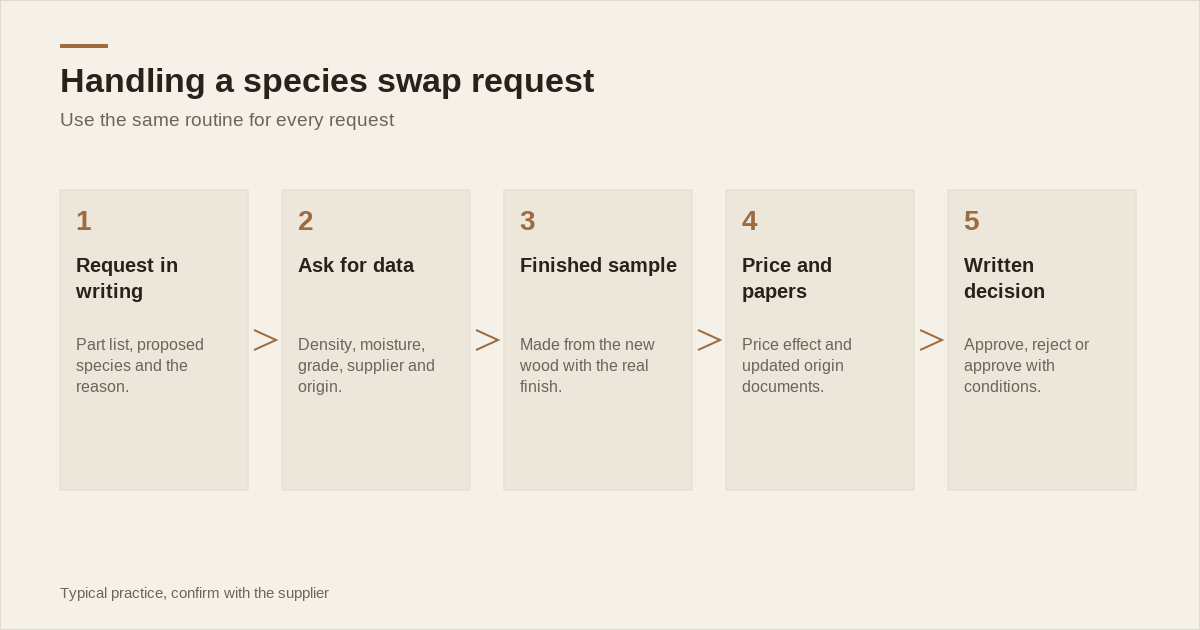
- Ask for the request in writing. Include the part list, the proposed species and the reason.
- Ask for data. Density range, moisture content, grade, supplier and origin of the proposed wood.
- Ask for a sample. A finished piece from the proposed wood, made with the real finish, not a rough board.
- Ask for the price effect. A change should come with a price change, in your favour if the new wood is cheaper.
- Check compliance. The new species needs its own origin documents and may have different rules.
- Compare with the approved sample. Check appearance, weight and finish side by side under daylight.
- Decide in writing. Approve, reject or approve with conditions, and keep the reply.
A reply within a day or two keeps the schedule moving. If you need time, say so and give a date. Silence tends to be read as consent by a plant under deadline pressure.
Price and fairness
If the proposed wood is cheaper, the price should fall. A plant that swaps to a cheaper wood and keeps the price is moving margin from you to itself. If the proposed wood is dearer, the plant may ask for a surcharge, and the right answer depends on why: a supply problem on the quoted wood that the plant could not predict is different from a quoting error.
Agree in the contract how supply price changes are handled. A common approach is a price validity period, with a clause that allows adjustment for a defined index or for documented lumber price changes above a threshold. The MOQ and order economics guide shows how material cost fits into the full price.
Need a quote for this product? Get matched with a Vietnam wood factory
Compliance and legal effects
Each species has its own paper trail. A change from one wood to another changes the species name on the packing list, the origin documents and the due diligence records. Buyers in the European Union need species and origin data for each product under EUDR, and buyers in the United States need accurate species and origin information for Lacey Act declarations. A mismatch between the declared species and the real species is a serious problem for the importer, not only the factory.
Read the legality documents guide and the EUDR guide for the data your market asks for. Ask the plant to update all documents for any approved swap before shipment, and check that the packing list names the new species.
Certificates matter as well. If the product carries a certified claim such as FSC, the new wood must come from certified supply under the same chain of custody, as explained in the FSC guide.
A worked example
A buyer orders a bookcase in oak veneer over MDF with solid oak edges. Two weeks into production, the plant writes that oak lipping is delayed and proposes ash for the edges, stained to match. The buyer follows the routine.
The request in writing names ash as the replacement for the edge lipping only. The data shows similar density, a pale ring porous grain and good staining behaviour. The plant sends a finished corner sample of oak veneer face with ash edge. Side by side in daylight, the grain pattern at the edge is a little coarser, and the colour matches after the stain. The buyer judges that the edge is a small visible area and accepts the change for the edge only, asks for a price credit for the cheaper wood and asks the plant to correct the packing list and the species declaration.
Compare the alternative. If the plant had swapped without notice, the buyer would have found ash on a product labelled all oak, with a species declaration that did not match the wood. The actual wood is nearly the same, and the difference is who decided and who documented it.
Contract clauses that prevent surprises
Four short clauses cover most of the risk.
- Species lock. The species of each part is as stated in the specification. Any change needs written approval before production.
- Notification time. The plant must notify the buyer before cutting material, not after.
- Documentation. Species, origin and grade are stated on the proforma and the packing list, and match the actual wood.
- Remedy. If an unapproved species is found, the buyer may reject the lot, require rework at the plant’s cost or claim a price reduction.
Keep the language plain. A short clause that both sides understand works better than a long clause that neither reads.
Checking the wood at inspection
Visual checks catch many swaps, and a few simple tools help.
- Compare colour and grain with the retained approved sample under daylight.
- Weigh a part and compare with the sample of the same size. A large difference in weight points to a different density.
- Look at end grain with a hand lens, since pore size and pattern differ between species.
- Check the finish at a cut edge, where the colour of the wood under the coating shows.
- Keep a small retained piece of the approved sample from the start.
For a firm answer, send a small piece to a wood identification laboratory. Many labs can name the species or genus from the cell structure for a modest fee, and a result gives you evidence in a dispute. The quality inspection guide shows where to place such checks.
Relationship value of a good process
Plants remember buyers who answer swap requests quickly and fairly. A buyer who replies within a day with clear conditions gets early warning next time, because the plant learns that honesty works. A buyer who rejects every request without discussion, or who ignores messages, trains the plant to swap quietly and explain later. The process protects both the product and the information flow.
What to put in the specification
State the species of each part, a list of acceptable alternatives if you are willing to consider any, the rule on written approval and the documents you need for each species. If you are open to a swap that saves cost, say so, and ask the plant for options up front. That conversation is much easier before the order than during production.
To compare factories on species, supply and documentation, send your specification through the RFQ page. The matching service finds up to three Vietnamese wood factories and replies within 24 business hours.
Frequently asked questions
Why do factories ask to change the wood species?
Common reasons are a supply shortage of the quoted species, a price rise in the lumber, a high reject rate in drying or a deadline that cannot be met with the original wood. A request is a normal event, and the useful response is a structured one: ask for the reason, the data, a sample and the price effect in writing.
Is a species swap always a bad sign?
No. A plant that asks before changing is acting honestly, and a well matched swap can protect your schedule. The bad sign is a swap without notice, which suggests weak control or an attempt to cut cost. Your contract should say that any change needs written approval.
How can I check which species was used?
Visual checks help but are not conclusive. Compare weight, colour, grain and end grain with the approved sample, and keep a retained piece from the sample. For a firm answer, send a small cut piece to a wood identification lab, which can usually name the species or the genus from the cell structure.
Need a quote for this product?
Send the specification. We match you with up to 3 Vietnamese wood factories and reply within 24 business hours.
Get matched with a Vietnam wood factory