Guides / Sourcing Guide
Dining Tables and Chairs Made in Vietnam
October 18, 2026
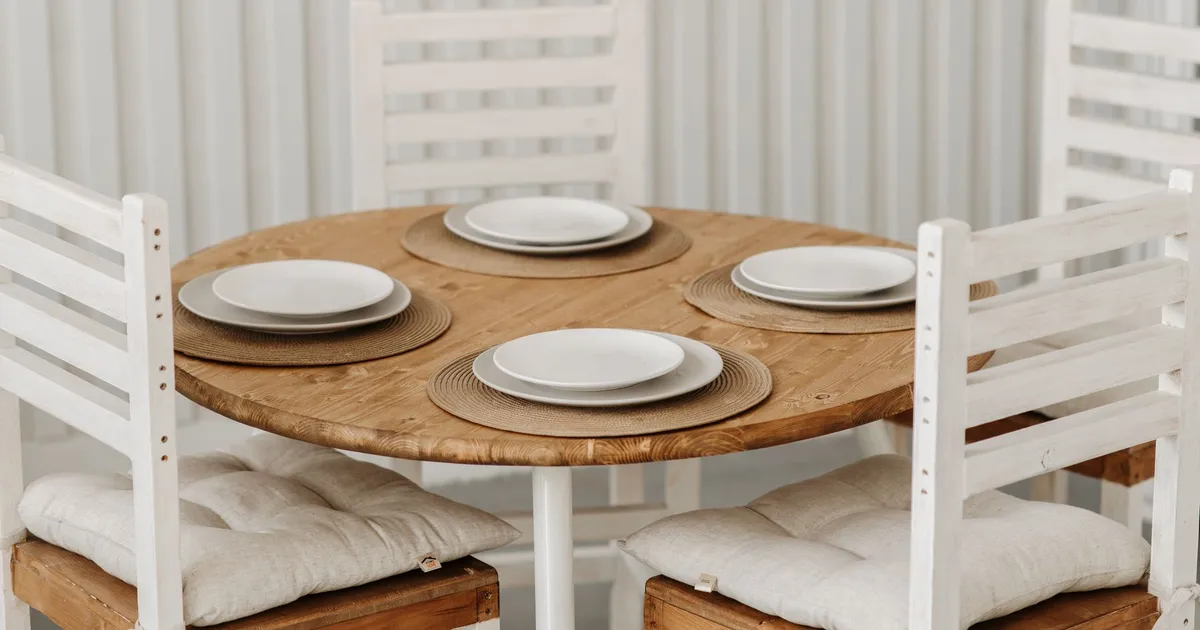
Dining tables and chairs are the core of many Vietnamese export programs. The sets look similar from one factory to the next, and they behave very differently in use. A table that stays flat and a chair that does not rock loose after a year depend on how the joints, the wood and the finish are built, not on how the product looks in a photo.
This guide covers table and chair construction, dimensions, extension mechanisms, tests and the questions that separate careful plants from careless ones.
How a dining table is built
A dining table has a top, an apron or frame under the top and legs or a base.
The top. Most solid wood tops are edge glued panels, as explained in the panel guide. Narrow staves are glued side by side and sanded flat. Veneered tops use a stable core with a thin face. Thick tops of 30 to 50 mm give a heavy look and need careful drying.
The attachment. Wood tops move across the grain with humidity, and a top screwed tightly to a rigid frame will crack or lift. Good designs use figure eight fasteners, buttons or slotted screw holes that let the top slide a little. Ask how the top is fixed.
The legs and aprons. Joined by mortise and tenon, dowels, bolts or metal brackets. Legs that bolt on make the table flat packable, and they need a strong corner block or bracket to stop racking.
The base. Pedestal bases and trestle bases have a different load path from four leg tables. Heavy bases need a stable footing so that the table does not tip when someone leans on the edge.
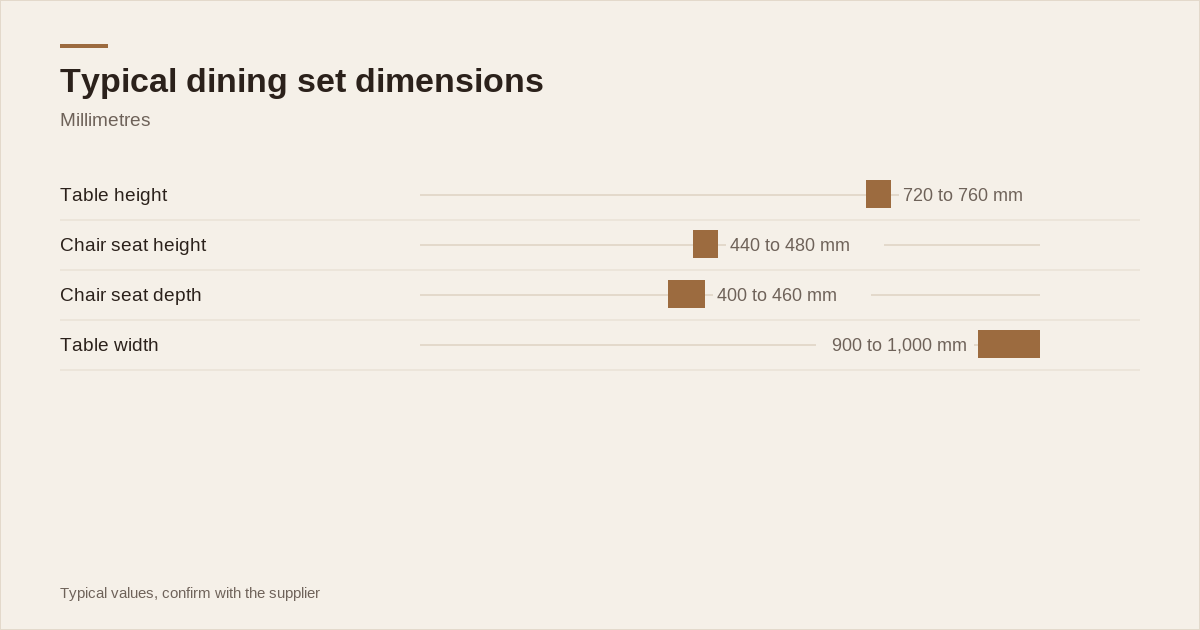
Typical dimensions are 720 to 760 mm in height, 900 to 1,000 mm in width for a rectangular table and 1,400 to 2,400 mm in length for four to ten seats. A seat needs roughly 600 mm of table edge per person. State the knee clearance under the apron as well, since thick aprons can bump knees.
Extension tables
Extension tops add risk. Butterfly leaves, drop leaves and slide out leaf mechanisms all rely on hardware and tight tolerances. Check three things: whether the hardware has a stated load rating, whether the leaf aligns flat with the main top and whether the mechanism works smoothly after a dust and humidity cycle. Ask for a sample and operate it a few hundred times before approval.
How a dining chair is built
A chair is a small structure under a large load. The back legs take much of the force when someone leans back, and the joints between legs and seat rails take the rest.
Legs and rails. Back legs often have a curve, which means cutting across the grain unless they are bent or laminated. Cross grain cut legs are weak at the curve, so good plants either use a thicker blank, a laminated blank or a steam bent part. Ask which method is used.
Joints. Mortise and tenon joints, with glue and often a pin or a screw, give the strongest results. Double dowels are common and acceptable for lighter use. A joint with a single dowel or a butt joint with screws is weak and loosens in service.
Corner blocks and stretchers. Blocks under the seat corners and stretchers between legs prevent racking. A chair without them may look the same and fail sooner.
Seat. Solid wood seats are carved or flat. Upholstered seats have a wood or plywood base, foam and fabric. Woven seats use cane, rope or paper cord. Each has its own checks on foam density, fabric rubbing and weave tension.
Back. Slats, spindles or an upholstered back panel. Spindle chairs need tight fit in the rail and the crest.
Typical seat height is 440 to 480 mm, with seat depth of 400 to 460 mm and an overall height of 850 to 950 mm. Match the chair height to the table height so that there is enough thigh space and not so much that the user sits too low.
Common chair joint types
| Joint | Strength | Cost | Notes |
|---|---|---|---|
| Mortise and tenon, glued | High | Higher | Standard for good solid wood chairs |
| Double dowel, glued | Medium to high | Medium | Common, depends on dowel size and glue |
| Dowel with corner block | Medium | Medium | Block adds racking resistance |
| Screws and brackets | Medium, can loosen | Low | Used in knock down and metal assisted designs |
| Single dowel or butt joint | Low | Low | Avoid for load bearing joints |
Ask the plant to show a cutaway or a broken sample, since the inside of a joint tells you more than the outside of a chair.
Strength and durability tests
Chairs and tables are tested against standards for strength, durability and stability. Tests apply static loads to the seat and back, repeated cycles of load, drop impacts on the seat and forces on the arms, and tests of tipping and sliding. Standards differ between domestic use and contract or commercial use, and between regions.
Name the standard in your order and ask for a test report from an accredited lab on the product, not on a similar model. If the chair will go to restaurants, cafés or hotels, use the contract standard, which loads the product harder and over more cycles. The furniture test standards guide explains how to choose, and the hospitality guide covers commercial programs.
Finish and wear
Dining furniture takes heat, spills, scratches and cleaning products. A finish should resist water rings, light chemicals and abrasion. For tables, ask for a test such as a wet glass ring on the finished surface, and for chairs ask for a rub test on the seat and the legs. The finishes guide lists the common systems and their durability.
Colour matching between table and chairs matters, since the set is sold as one. Plants that finish the table and chairs in the same batch and from the same wood lot get the best match. If the chairs and table come from different workshops, the risk of mismatch is higher and the colour must be approved on both products together.
Need a quote for this product? Get matched with a Vietnam wood factory
Species and construction choices
Tables in solid acacia, rubberwood, oak or ash, and in veneered panel are common. Chairs use harder species where joints carry load, and softer species where the part is a panel or a hidden element. The acacia versus rubberwood guide and the oak and ash guide help match the wood to the part. If the plant suggests a different species, apply the routine in the species substitution guide.
MOQ, sets and mix
Dining sets raise a practical question: how many chairs per table? A typical set sells with four or six chairs, and a retail program may sell tables and chairs separately in different quantities. A plant that sets a minimum per model can find that a table order and a chair order need different totals, and the ratio matters for planning. Chairs are made in higher numbers, and many plants offer a lower minimum on chairs because the same chair serves several tables.
Ask the plant for its minimum per model, per colour and per container. The MOQ guide explains how to combine models to reach a container. Packing matters, since chairs stack in cartons efficiently when they are knock down or have a stackable design, as covered in the packaging guide.
Common failures in the field
| Failure | What the customer sees | Usual cause |
|---|---|---|
| Loose chair | Rocking, creaking, wobbling legs | Weak joint, dry glue, wood shrinkage |
| Split table top | A crack along the grain | Top fixed rigidly to the frame |
| Cupped top | Edges lift, surface is no longer flat | Wet wood, one sided finish, dry house |
| Wobbly table | Rocks on a flat floor | Leg length error or warped base |
| Seat wear | Fabric worn or foam collapsed | Low density foam, weak fabric |
| White rings | Marks from hot or wet items | Soft finish film |
Each failure points back to a spec line. A buyer who writes the joint type, the top fixing method, the finish test and the foam density into the order has already prevented most of them.
Leg levellers, glides and floor protection
Small parts decide whether a dining set damages the floor. Felt pads, plastic glides and adjustable levellers sit under every leg, and a cheap hard plastic glide scratches wood floors. Adjustable feet let a table sit steady on an uneven floor, which prevents the wobble complaints that cost the most in returns. Add the glide type to the spec, and include a spare set in the carton for products that sell to consumers.
Think about the floor in your market. Hard floors, carpet and outdoor decks each need a different foot. A chair designed for restaurant use may need a replaceable glide, since glides wear down and then the leg end scrapes the floor.
Checks before shipment
- Measure heights, widths and depths on several units against the drawing.
- Rock and load a chair by hand, and check for movement in legs and rails.
- Check table tops for flatness with a straight edge, and look at glue lines.
- Operate extension mechanisms and drawer slides.
- Compare the colour of table and chairs under daylight.
- Open random cartons and confirm quantity, hardware and instructions.
The quality inspection guide explains how to turn this list into an inspection plan.
What to put in the specification
For tables, state the top construction and thickness, the fixing method, the base type, the extension hardware and load rating, the dimensions and the finish. For chairs, state the joint type at each connection, the leg and rail construction, the seat build, the dimensions, the foam and fabric data and the test standard. Add the colour matching rule for sets.
To compare factories that make dining sets, send your specification through the RFQ page. The matching service finds up to three Vietnamese wood factories and replies within 24 business hours.
Frequently asked questions
What is the standard height of a dining table and chair?
A dining table is commonly 720 to 760 mm high and a dining chair seat commonly sits about 440 to 480 mm above the floor, which leaves a gap of roughly 250 to 300 mm between seat and table underside. Dimensions vary by market and design, so state them in the drawing and approve them on a sample.
Why are chairs harder to make than tables?
A chair carries a moving load at an angle, through small joints, with the forces concentrated in the back legs and the seat rails. A table is a large flat part on a stable frame. Chairs fail at joints after months of rocking, while tables fail at the top or the base after humidity changes. Plants with strong chair joinery are the safest choice for sets.
Do I need strength tests for dining chairs?
For commercial use, and for many retail programs, yes. Strength and durability tests apply loads, repeated cycles and impacts to the seat, back and legs. Standards differ between domestic and contract use, so name the standard in the order and ask for a test report from an accredited lab on the actual product.
Need a quote for this product?
Send the specification. We match you with up to 3 Vietnamese wood factories and reply within 24 business hours.
Get matched with a Vietnam wood factory