Guides / Materials
Eucalyptus Wood From Vietnam: Uses, Grades and Limits
October 22, 2026
Eucalyptus is one of the most widely planted trees in Vietnam, and most of it never becomes furniture. A large share of plantation eucalyptus goes to chip mills for pulp and paper. A smaller but growing share is sawn into boards, peeled into veneer for plywood or cut into parts for pallets, crates and furniture frames. If a quote lists eucalyptus, you are looking at a lower cost material with real strengths and real limits.
This guide explains where eucalyptus comes from, what it is used for, how it behaves in drying and in service and what to write into a specification so that the wood arrives as expected.
Where Vietnamese eucalyptus comes from
Eucalyptus was introduced to Vietnam and planted widely on hill land in the north, the centre and parts of the south. Plantations are managed on short rotations, often six to ten years for pulp and longer for sawn timber. The trees are fast growing, straight and cheap to harvest, which keeps log prices low compared with slower hardwoods.
Several species and hybrids are planted, and they differ in colour, density and behaviour. The word eucalyptus on a quote hides that variation. Two lots can come from different species grown on different soils and behave very differently in the kiln. Ask which species or hybrid the plant uses and where the logs come from.
Plantation origin matters for compliance as well. The legal origin of the logs, the harvest records and the chain of custody are the documents buyers in the European Union and the United States ask for, as described in the legality documents guide and the EUDR guide.
What the wood looks like and how it works
Eucalyptus heartwood runs from pale pink to light or medium brown. The grain is often straight to interlocked, with a fine to medium texture. Interlocked grain produces a ribbon figure on quarter sawn faces and makes the wood harder to plane without tear out.
Density and hardness vary by species and age, from moderately soft to quite hard. Young fast grown trees have a higher share of juvenile wood, which is lighter, weaker and less stable than mature wood from the same species. That is one reason the same word describes very different boards.
The wood machines and sands well when it is dry and sharp tools are used. It takes stain and clear finish, although colour can be blotchy on some boards. Because of its colour and grain, it often receives opaque paint or a dark stain in furniture, which hides variation.
Where it is used
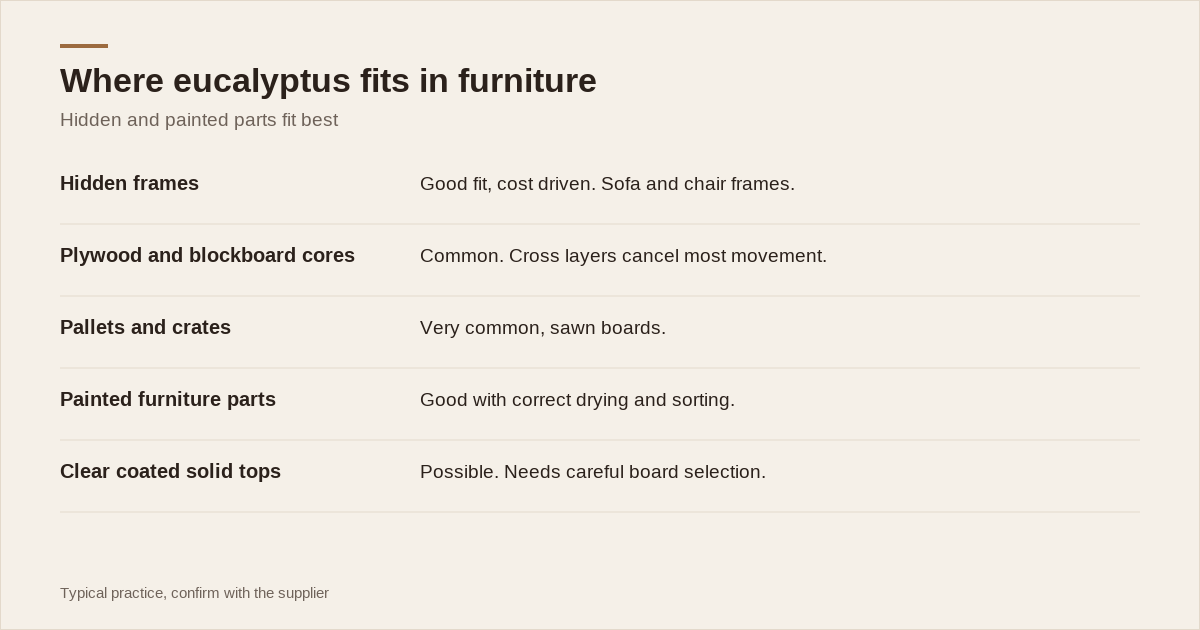
| Product | How eucalyptus is used | Fit |
|---|---|---|
| Hidden frames in upholstered furniture | Sawn or finger jointed bars inside sofas and chairs | Good, cost driven |
| Plywood and blockboard cores | Peeled veneer layers or strips | Common |
| Pallets and crates | Sawn boards | Very common |
| Painted furniture parts | Finger jointed and edge glued panel | Good with correct drying |
| Solid wood tops with clear finish | Edge glued panel | Possible, needs good selection |
| Outdoor furniture | Treated or naturally durable species only | Check carefully |
| Flooring and decking | Some use in lower grade products | Needs species and treatment details |
Frames and painted parts are the easiest fit, because the wood is hidden or covered. Visible, clear coated parts are the hard fit, because every colour variation and every board movement shows.
Drying and stability limits
The main technical limit is drying. Eucalyptus is known for end splitting, surface checking, collapse in some species and distortion when dried too fast. Plants that dry it well follow slow schedules, stack boards with even spacers, protect end grain and equalise moisture content before machining.
Typical target moisture content for furniture grade eucalyptus is the same as for other export wood, a few points either side of the final destination humidity. The moisture content guide gives typical ranges. What changes with eucalyptus is the margin: the wood moves more readily when the balance shifts, so a plant that is careless on moisture produces more rejects than it would with a more stable species.
Growth stress is the second limit. Boards cut from stressed logs can bow after sawing, even when properly dried. Plants manage it by cutting logs in a way that releases stress early, by selecting stable boards and by allowing a conditioning period before final machining. Finger jointed and edge glued panels from short, sorted pieces reduce the effect, as described in the panel guide.
Sawn timber, panel and plywood routes
Eucalyptus reaches furniture by three routes, and each has a different risk profile.
Sawn solid boards. The most demanding route, since every board has to be dried, sorted and kept stable. It gives the most visible wood and the most variation.
Finger jointed and edge glued panel. The most forgiving route for solid wood. Short pieces with growth stress and defects are cut out, the sound pieces are sorted and glued, and the panel spreads movement across many narrow strips.
Peeled veneer and plywood. Fast growing logs peel well into thin layers. Plywood made from eucalyptus veneer is used for furniture parts, packaging and construction, and the cross grain layers cancel most movement. Glue type and face veneer quality decide the grade. The plywood and MDF guide covers panel quality in more detail.
Choosing the route is usually more important than choosing the species. A buyer who wants stable, low cost parts is often better served by a panel route in eucalyptus than by wide solid boards in the same species.
Need a quote for this product? Get matched with a Vietnam wood factory
Inspection checks for eucalyptus lots
A short checklist at inspection finds most problems. Measure moisture content on a spread of boards, since a single average hides wet pieces. Look at the end grain of boards for fine checks and splits, and count how many boards bow when laid on a flat surface. Cut a few parts open to see whether internal checks appear. Compare the finished sample against the production lot under daylight, since colour can vary between boards.
Keep a record with photos of each lot. If rejects rise, the record tells you whether the cause is the supply of logs, the kiln or the machining, and it gives you a basis for a conversation with the plant rather than an argument. The quality inspection guide explains how to set acceptance limits for natural variation.
Durability and outdoor use
Eucalyptus durability depends on species. Some species are naturally durable in ground contact and are used for poles and posts, while the species commonly planted for pulp in Vietnam are not durable outdoors without treatment. Do not assume that a eucalyptus quote for outdoor furniture means a durable product.
If a design is meant for outdoor use, ask for the species, the preservative or thermal treatment, the finish system and the expected service life under defined conditions. The outdoor furniture guide compares the usual options and shows how to write the specification.
Grades and sorting
Eucalyptus grading is done by the plant, and terms vary. A common structure runs from a select grade with few knots and little colour variation to a rustic grade with knots and colour change, and a utility grade for hidden parts. Sorting by moisture and by stress is often more important than sorting by appearance, because a clean looking board that bows is worse than a knotty board that stays flat.
Write grades in terms you can check: maximum knot size, allowed cracks, end split length, permitted bow per metre and moisture content range. A statement such as “free of open cracks wider than 1 mm and end splits longer than 10 mm” is clearer than “A grade”.
Cost position
Eucalyptus usually sits below acacia and rubberwood on price per cubic metre, because plantation supply is large and the log is cheap. The saving narrows when rejects rise. A board that costs less but yields less after sorting and drying costs more per usable part. Ask the plant for its yield figure, the share of sawn wood that becomes finished parts, and compare it with other species on the same basis.
Seasonal supply also affects price. Harvest and sawing slow in the wet months, and kiln capacity tightens before the year end shipping peak, so a quote in a tight month can carry a premium or a longer lead time than the same quote in a quiet one.
The acacia versus rubberwood guide covers the more common alternatives, and the solid wood versus engineered panel guide shows how construction choice interacts with species.
Questions to ask the factory
- Which species or hybrid is this lot, and where do the logs come from?
- What is the kiln schedule, and how do you check moisture content?
- How do you handle growth stress, and what is the typical reject rate?
- Which parts of my product use eucalyptus, and which use other species?
- Can I see a finished sample made from the lot, not a showroom piece?
- What legal origin documents come with the wood?
Plants that run eucalyptus well can answer each question without a pause, and they are happy to show boards in the stack.
What to put in the specification
For each part, state the species or a list of acceptable species, the construction, the thickness, the grade limits, the target moisture content, the finish and the documents required. Add a rule on substitution: the factory must ask for approval before changing species. The species substitution guide explains how to handle that conversation.
To compare factories that work with eucalyptus and other plantation woods, send your specification through the RFQ page. The matching service finds up to three Vietnamese wood factories and replies within 24 business hours.
Frequently asked questions
Is eucalyptus a hardwood?
Yes, botanically it is a hardwood, but hardness and density vary a lot between eucalyptus species and between trees of the same species. Some plantation eucalyptus is moderately soft and easy to work. Ask the factory for the species and the density range of the lot, not just the word eucalyptus.
Why does eucalyptus have a reputation for splitting and warping?
Fast grown plantation eucalyptus carries growth stress in the log. When the log is sawn, the stress releases and boards can bow, twist or split at the ends. Careful sawing, proper stacking and slow, controlled kiln drying reduce the problem. Plants without that discipline produce unstable boards.
Is eucalyptus a good alternative to acacia or rubberwood?
For some parts, yes. It can work as a lower cost option for hidden frames, panel cores, pallets and painted components. For visible solid wood parts that need a clear finish and tight stability, acacia or rubberwood are the more common and more predictable choices in Vietnam.
Need a quote for this product?
Send the specification. We match you with up to 3 Vietnamese wood factories and reply within 24 business hours.
Get matched with a Vietnam wood factory