Guides / Choosing a Factory
Furniture Overruns, Underruns and Seconds: Who Owns the Surplus and the Rejects
November 21, 2026
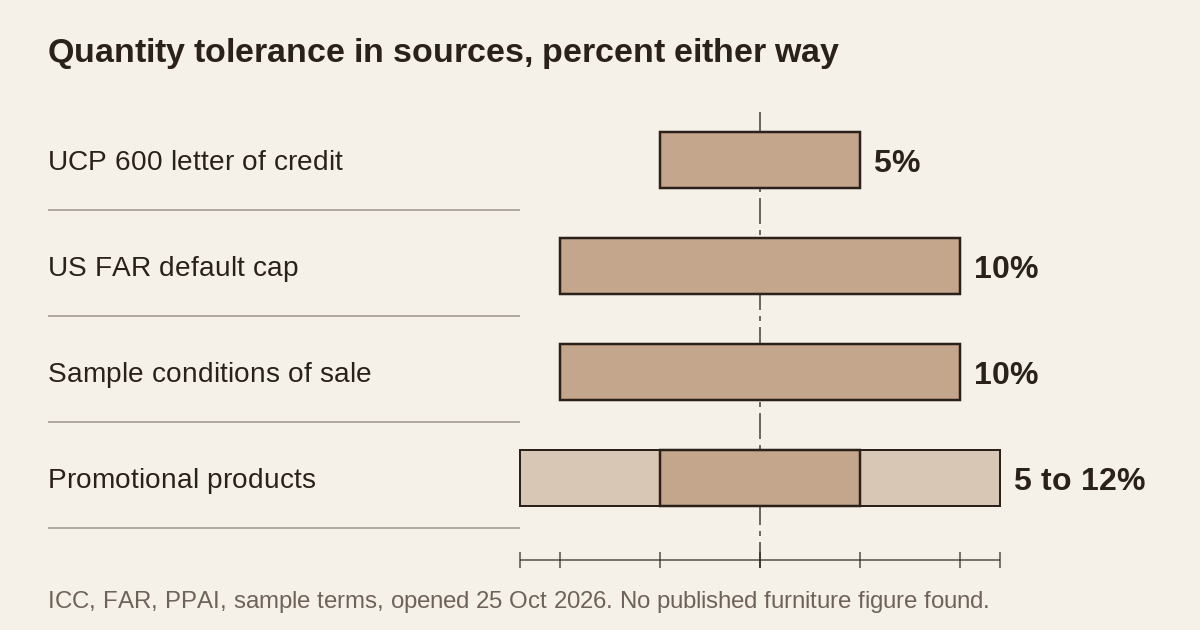
An overrun is more pieces than you ordered, an underrun is fewer, and a second is a piece that failed inspection for a minor flaw but still exists. None of the three has a standard answer in furniture: who owns the extra pieces, what you pay for and what happens to the rejects are contract terms, and the purchase order is the place to set them. This post is part of our guide to importing furniture from Vietnam and gathers the tolerance figures we could find, what they do and do not cover, and a clause list you can adapt.
Overrun and underrun in plain terms
Manufacturing never produces exactly the ordered number. Scrap, loading and packing leave the quantity a little over or a little under. A tolerance clause says how far either way you accept and what you pay. Without one, the factory and the buyer each assume their own rule, and the argument comes at shipment.
For furniture the issue is sharper than for bulk goods. A chair is counted in pieces and cannot be cut to a length, so the tolerance is a few pieces and not a continuous quantity. A 5 per cent allowance on an order of 20 sofas is one sofa. Write the rule as a number of pieces for small lots.
The figures we found
We found no published tolerance for furniture. What exists comes from other settings, and we list them so you can see the range.
| Source | Figure | What it covers |
|---|---|---|
| US Federal Acquisition Regulation 11.701 | No standard percentage; default cap plus or minus 10% | Government supply contracts; the percentage should follow normal commercial practice for the item |
| UCP 600 article 30(b) | 5% more or 5% less | Quantity under a letter of credit; not allowed where the credit states quantity as packing units or individual items |
| Sample general conditions of sale | Under-runs and over-runs of not more than 10% | Sample clause text, unless the order requires exact quantities |
| Promotional products trade, as reported by PPAI | 5 to 12% | Quoted by several suppliers; billed for what ships |
Sources: acquisition.gov (FAR 11.701), ICC Digital Library (UCP 600 note), Law Insider sample clauses, PPAI Media Hub. Opened 25 October 2026. The sample clauses are contract wording, not standards, and the promotional products figures come from a different industry.
Two points come out of it. First, the FAR text says plainly that there should be no standard or usual percentage, and that the allowed variation should reflect the normal commercial practices of the particular industry and item. Second, the letter of credit rule excludes goods counted as packing units or individual items. If your payment is a letter of credit and it states the number of sofas, the 5 per cent tolerance does not apply to that number. See our payment terms guide for how credit terms interact with the purchase order.
Who pays for the extra pieces
The FAR clause on excess deliveries is a useful picture of what is open to negotiation. The contractor must deliver the specified quantity within the allowed variation. For excess items worth more than 250 US dollars, the government may keep them and pay the contract unit price, or have them returned at the contractor’s expense. The PPAI contributors describe the commercial version: most suppliers bill for what actually ships, one contributor writes “No overship, undership OK” on purchase orders and another says asking for an exact quantity may carry an upcharge.
For a furniture order, decide these four things before you sign.
- Allowance. Plus and minus how many pieces, per SKU or per order?
- Price basis. Do you pay for the ordered quantity, the shipped quantity or the accepted quantity?
- Excess. May you refuse extra pieces, and who pays to store or return them?
- Shortfall. Does the factory remake missing pieces, credit them or ship them later at its cost?
An underrun hurts more than an overrun on a set. If you order 200 tables and 200 chairs and receive 190 chairs, the set is incomplete. Write the tolerance per component and say sets ship complete.
What a second is
Wikipedia describes factory seconds as retail items with a minor manufacturing flaw, sold at a reduced price instead of being discarded. They usually fail the factory’s inspection for cosmetic, not functional, reasons, and may carry a weaker warranty. That is a description of retail practice. We found no furniture-industry definition or regulation of a “second” grade.
So the grade has to be defined by you. In your QC specification, state what makes a piece first grade, what makes it a second and what makes it scrap, with photos and sizes. Our posts on in-process quality control and damage claims show the evidence a claim needs.
Need a quote for this product? Get matched with a Vietnam wood factory
Labels, brand and design on rejects
A reject made to your design carries your decisions: the model, the finish colour, the carton print and often your label. If the contract is silent, the factory holds a finished piece in your design and no clause stops it from selling it.
The California Bureau of Household Goods and Services states a specific rule for one label. In its January 2020 FAQ, it says BPC section 19087 makes it unlawful for any person other than the purchaser, for own use, to remove, deface or alter the law label on upholstered furniture, bedding or filling material, and that importers, wholesalers and retailers may not sell unlabeled products in California. That rule is about the law label in one state, and it is not a general rule about seconds. Rules in other markets differ, so ask your customs broker or adviser. Nothing here is legal advice.
What you can settle in the contract:
- Rejects are photographed, counted and listed in the final inspection report.
- Rejects are reworked to first grade, destroyed, or sold only with your written consent.
- If a second may be sold, state the market, remove your brand, carton print and design codes, and keep any legally required label intact.
- Tooling, patterns and drawings stay yours, as covered in our post on ODM design ownership and NDAs.
A clause list to adapt
- Quantity: ordered quantity per SKU, with plus or minus [number] pieces, and sets shipped complete.
- Price: invoice for accepted pieces at the unit price, no charge for pieces above the allowance.
- Rejects: grade definitions with photos, a reject count in the inspection report, no sale or release without consent.
- Labels: required labels stay on pieces that are sold, and branding is removed from any piece sold outside the programme.
- Disposal: the method, the evidence and who bears the cost.
When you are ready to ask factories to quote against clauses like these, send the specification through the RFQ form. We reply within 24 business hours and match you with up to three Vietnamese wood factories. They quote you directly. Back in the import guide, the order steps come in sequence.
Sources
- FAR 11.701, Supply contracts, quantity variation
- ICC Digital Library, note on UCP 600 article 30 tolerances
- Law Insider, quantity tolerance clauses (sample wording)
- PPAI, Question: over and above (overruns and underruns)
- Wikipedia, Factory second
- California Bureau of Household Goods and Services, labeling requirements FAQ (January 2020), PDF
All pages opened on 25 October 2026. These are contract and regulation references, not legal advice.
Frequently asked questions
What is an overrun in a furniture order?
An overrun is a quantity shipped above the ordered quantity, and an underrun is a quantity below it. A purchase order usually allows a percentage either way unless it says exact quantities. For furniture counted in pieces, write the allowance as a number of pieces or as a percentage rounded down, and say whether you pay for what ships.
What are factory seconds in furniture?
Seconds are units that fail the factory's inspection for a minor, usually cosmetic flaw and are sold at a lower price. Wikipedia describes them that way for retail goods generally. We found no furniture-industry definition or rule, so your contract should define the grade limits with photos and say who may sell a second and under what label.
Can a factory sell my rejected furniture?
Only if the contract lets it. Without a clause, rejects made to your design, carton and label sit with the factory, which may sell them. Write that rejects are destroyed, reworked or de-branded and photographed first. In California the law label on upholstered furniture may not be removed, defaced or altered except by the buyer for own use.
Need a quote for this product?
Send the specification. We match you with up to 3 Vietnamese wood factories and reply within 24 business hours.
Get matched with a Vietnam wood factory