Guides / Sourcing Guide
How to Move Furniture Production From China to Vietnam, in Stages
November 21, 2026
Move in stages, not in one season. Pick a small group of products, build the data pack a new factory needs, settle who owns the tooling, qualify two or three Vietnamese factories on the same specification, run a small parallel order while China keeps supplying, prove the origin of what you ship, and only then move volume. Each stage has a gate, and you do not pass it until the evidence is in.
This plan is for importers and brands that already buy furniture from China and want a second or main source in Vietnam. It does not argue whether to move. For the cost and capability comparison, read our analysis of Vietnam versus China for furniture. This is the work after the decision.
Step 1: say why you are moving
The reason decides the pace and the products. A buyer moving to cut tariff exposure needs the origin evidence first. A buyer moving for capacity needs lead time and a second source. A buyer moving to reduce concentration risk can start slowly and keep both. Write one sentence and keep it in the project file, because every later trade-off is judged against it.
Then check what the duty position really depends on. Three things in the official record are worth knowing, and all of them can change:
- Some US duties follow the product, not the country. Presidential Proclamation 10976 of 29 September 2025 set a 25 percent Section 232 duty on upholstered wooden furniture and on kitchen cabinets and vanities from 14 October 2025. A later proclamation postponed the planned rises to 30 percent and 50 percent from 1 January 2026 to 1 January 2027. The White House text says the rises will not apply to countries that reach an agreement on wood products. Read the current text and confirm the status with a customs broker before you plan around it.
- Some orders follow the country. The US antidumping duty order on wooden bedroom furniture from China dates from January 2005. In an expedited second sunset review in March 2016 Commerce found that revoking it would likely lead to renewed dumping, and the notice states that the scope is not limited to complete bedroom sets. Check the current status in the Commerce case record before you rely on it. If your product is in that scope, real Vietnamese origin takes it out of the order, and false origin does not.
- Rates move. Do not copy a rate from an article, including this one. Ask your broker for the duty on your tariff code, by origin, on the date you will enter the goods.
Step 2: choose the first products
Pick a pilot of a few products, not the catalogue. Our judgment on what suits a pilot:
| Easier to move first | Harder, move later |
|---|---|
| Solid wood or panel casegoods with common joints | Products with a hard-to-source component such as glass, stone or electronics |
| Dining and occasional tables, chairs and benches | Upholstered pieces with imported foam and fabric from the old supplier |
| Items where the finish is a standard system | Items with a special finish or a proprietary process |
| Products you already hold a full drawing set for | Products where the factory owns the design |
| Items sold in steady volume | Fashion items that change every season |
The test is simple: how much of the product depends on the old factory’s local supply chain? Each dependency is a lead-time risk in Vietnam.
Step 3: build the data pack before you contact anyone
A Vietnamese factory cannot reproduce a product it has only seen in photos. Take the pack from the product, not from the Chinese factory’s goodwill:
- Drawings with dimensions and tolerances for every part.
- A bill of materials: species and grade, board type, hardware, fabric, foam, fittings.
- The finish specification with a reference swatch and any test results.
- A golden sample, or two, from current production.
- The carton drawing, packing method, pieces per carton and pieces per 40HQ.
- Labels, barcodes and any compliance marks.
- Test reports for the destination market.
- The defect history: returns, claims and the faults that took more than one round to fix.
Our tech pack checklist lists the fields in detail. The defect history is the item buyers forget, and it is the cheapest way to avoid repeating old problems.
Step 4: settle tooling and the old supplier
Tooling includes jigs, templates, moulds, cutting dies and fixtures. Ask the old factory in writing which tools were paid for by you, what your agreement says about ownership and what it would charge to release them. Do this before you announce a move, because the answer shapes your plan.
Three options, in order of cost:
- Take the tools and ship them to the new factory, if they are yours and suit its machines.
- Rebuild in Vietnam from the drawings, and use the chance to simplify the construction.
- Redesign for the new factory’s process where a product depends on a specialist machine, and accept a different look.
Keep the old supplier informed to the extent that you need continued supply during the transition. How much you tell them is a commercial decision, so decide it before the first message goes out.
Step 5: qualify the Vietnamese factories
Shortlist three, not one. Use the scoring sheet to rank them and the vetting guide to check the one you want to place the pilot with. Send the same package to each and compare the replies on the line by line quote sheet, not on the headline price.
Then run sample rounds against your golden sample. Our guide to furniture samples from Vietnam covers the stages and the reasons a sample fails. Two rules for a move:
- Judge the sample against your old product, not against the drawing. A drawing allows more variation than a customer will.
- Write the differences down. Colour, gloss, joint appearance, weight and hardware feel. Approve or reject each, and put the approved differences in the contract.
Need a quote for this product? Get matched with a Vietnam wood factory
Step 6: prove the origin of what you ship
Moving the final assembly is not the same as changing origin. US Customs and Border Protection says that a substantial transformation occurs if a new article with a different name, character and use is created, and that origin is the country of manufacture, production or growth. If the Vietnamese factory only assembles parts made elsewhere, the answer can differ from what the invoice says. For complex cases CBP says you can ask for a binding ruling.
The enforcement record shows why this matters. In EAPA case 7603, CBP found substantial evidence that an importer of wooden cabinets, vanities and components had transshipped goods of Chinese origin through Vietnam without paying the duties that applied to the Chinese goods, and it converted the importer’s entries to duty-bearing entries and reviewed its bonds. We do not suggest your plan resembles that case. We use it to show that CBP looks at what is made where.
What to ask each Vietnamese factory, and keep on file:
- The bill of materials with the country of origin of each major component.
- Purchase records for timber and panels, and the legality documents that go with them. See our guide to wood legality documents from Vietnam.
- Production records showing where cutting, joining, finishing and assembly happen.
- The factory’s own photos of the stages, dated.
- A written statement that no stage is subcontracted outside Vietnam without your approval.
The importer of record declares the origin, with the customs broker’s help. That decision is not the factory’s.
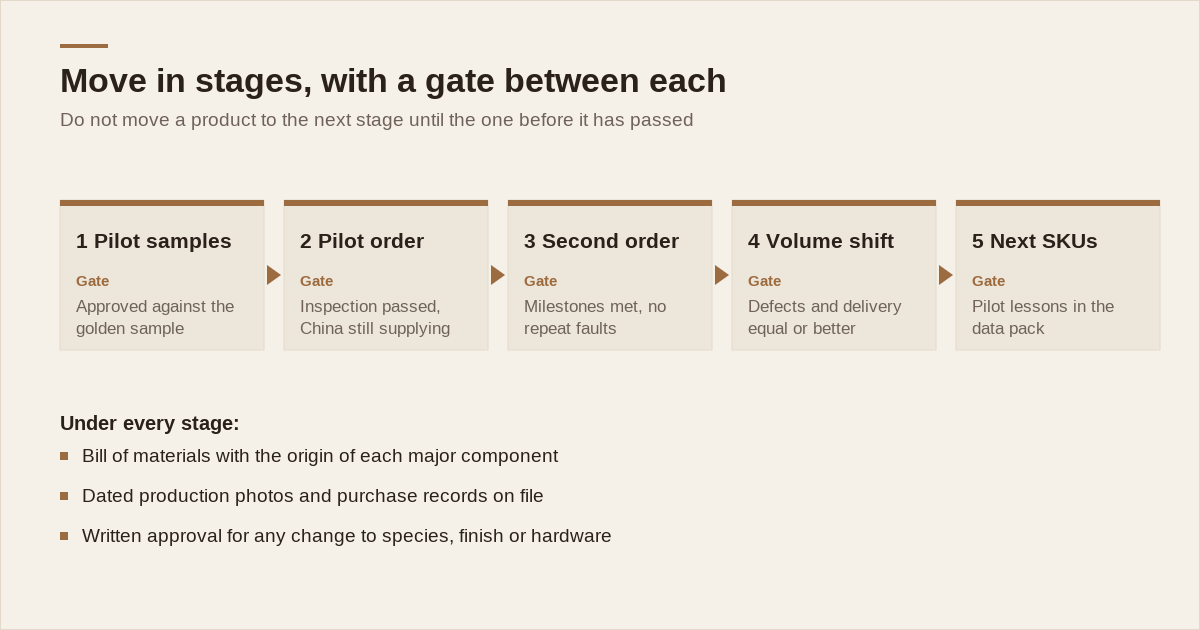
Step 7: run in parallel, then move volume
Use gates. Do not move a product to the next stage until the one before it has passed.
| Stage | What happens | Gate to move on |
|---|---|---|
| Pilot samples | 2 to 3 factories make samples of the pilot SKUs | Sample approved against golden sample, differences recorded |
| Pilot order | A small first order at one factory, China still supplying | Inspection passed, packing and moisture checked, lead time as quoted |
| Second order | A larger order, with in-process checks | Milestones met, no repeat of the first order’s faults |
| Volume shift | Share of the SKU moves, China keeps a share | Defect rate and on-time shipping equal or better than China |
| Next SKUs | Repeat for the next group | The pilot lessons are in the data pack |
Use the milestone method in our production milestones guide from the pilot order onward. A factory that is new to your product needs weekly evidence, not a final report. Plan the lead time with the lead time guide and keep China stock cover for at least one full Vietnam cycle.
What usually goes wrong
- The sample is perfect and the order is not. A sample is made by the best craftsman. Check the first production pieces, not only the sample.
- A component is not available locally. Hardware, foam or fabric from the old supply chain arrives late or is replaced without telling you.
- Moisture and finish change. A new climate and a new kiln mean new readings. See our guide to wood moisture content for export furniture.
- The old supplier slows down. Orders in transition get less attention. Keep order dates clear and avoid leaving the old factory with unfinished stock.
- Documents lag. Legality, treatment and origin records are easier to collect at the start than after the goods ship.
What to put in the specification
State the product list and which are pilot SKUs, the golden sample reference, the bill of materials with origin for major components, the finish reference, the packing and pieces per 40HQ, the Incoterm and named port, the tooling position, the tests for your market and the documents you need with each shipment. Then send it through the RFQ page. We reply within 24 business hours and match you with up to 3 Vietnamese wood factories that quote you directly.
Sources
- US Customs and Border Protection: Marking of Country of Origin on US Imports
- US Customs and Border Protection: EAPA Case 7603, wooden cabinets and vanities (determination of evasion)
- Federal Register, 9 March 2016: Wooden Bedroom Furniture From the People’s Republic of China, final results of the expedited second sunset review
- White House: Amendments to Adjusting Imports of Timber, Lumber and Their Derivative Products Into the United States
Frequently asked questions
How long does it take to move furniture production from China to Vietnam?
There is no standard figure, because it depends on the product, the tooling and how many sample rounds the first factory needs. Plan it as stages with gates: data pack, sample approved against your reference, a small parallel order, then volume. Keep the China supply running until the Vietnam order has shipped and passed inspection.
Can I move my tooling and moulds from a Chinese factory?
Only if you own them, and ownership is a contract question, not a habit of the trade. Check who paid for each tool and what your supply agreement says. Ask in writing before you tell the factory you are moving. If the tool is theirs, budget to remake it in Vietnam and use the move to simplify it.
Will Vietnam-made furniture be treated as Vietnamese origin if parts come from China?
Not automatically. US Customs and Border Protection says origin changes only if processing creates a new article with a different name, character and use. Simple assembly of imported parts may not do that. Ask the factory for a bill of materials with the origin of every major component and seek a binding ruling if the case is unclear.
Should I move all products at once?
No. Move the products with the simplest construction and the most local materials first, as a pilot of a few SKUs. Use what you learn about drawings, finishes, packing and lead times before you move the rest. A full switch in one season leaves you without a second source if the new factory underperforms.
Need a quote for this product?
Send the specification. We match you with up to 3 Vietnamese wood factories and reply within 24 business hours.
Get matched with a Vietnam wood factory