Guides / Choosing a Factory
Pre-Production Meeting for Furniture: What to Settle Before the Factory Cuts Wood
November 21, 2026
A pre-production meeting, or PPM, is the call or visit that happens after the deposit and the sample approval and before the factory cuts wood. Its job is to turn the quote, the sample and the drawing into one agreed set of instructions for the production floor. If you skip it, the cutting list is written from the factory’s habits, and you find the differences in the white wood stage or at loading.
This checklist gives ten agenda items, who should be in the room, what the minutes should record and how to approve the first pieces. It sits between two guides we already have: the tech pack checklist, which you send before the quote, and the production milestones guide, which tells you what to look for each week after the meeting.
Why the meeting matters
A quote is signed by sales. Production is run by people who may not have read it. The PPM is the point at which they meet the specification for the first time, and it is cheaper to find a gap on a call than in a stack of cut parts. Quality-control firms treat the start of production as its own inspection stage for the same reason. QIMA describes an initial production check as an on-site inspection that starts before production begins and runs until about 20 percent of the order is finished, covering raw materials, storage, production set-up, the first units, dimensions and packing. A PPM is the buyer’s own version of that early look, done before the saw starts.
One more reason is legal in nature. Under the UN sales convention (CISG), goods must have the qualities of a sample or model the seller presented to the buyer unless the parties agreed otherwise (Article 35). That only helps you if both sides agreed which sample is the reference. The PPM is where you write it down.
Who should attend
- From the factory: the sales contact, the production planner, the quality lead and the finishing lead. If the factory buys timber for you, the purchasing contact too.
- From you: the person who owns the specification, and your inspector if you have one.
A meeting with sales alone is not a PPM. Sales will agree. Production decides. Ask for the production planner by name in the invitation, and ask the factory who will attend before the day.
Before the meeting
Send these in writing, with the revision number on each file:
- The drawing set and the bill of materials.
- The approved sample record: photos, the date of approval and the list of approved differences.
- The finish reference and the swatch number.
- The packing specification.
- A one-page agenda with the ten items below.
Ask the factory to bring, or send, its cutting list, its material purchase plan and its proposed schedule. Compare them with your files before you speak.
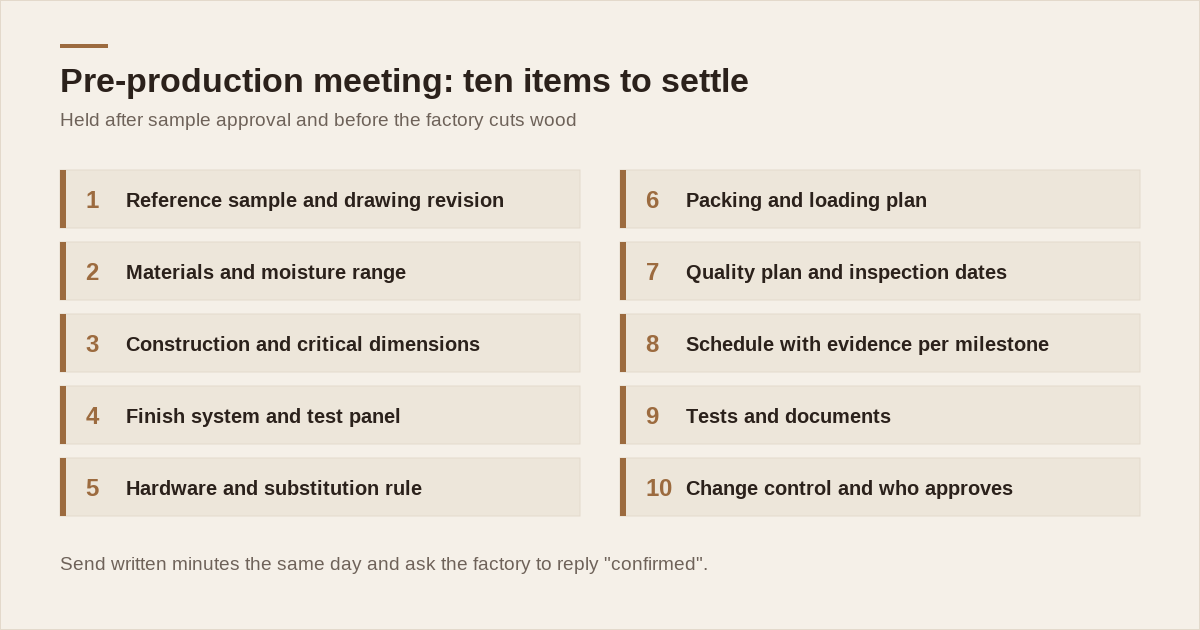
The ten agenda items
| # | Item | What to settle | What to record |
|---|---|---|---|
| 1 | Reference | Which sample and which drawing revision is the standard | Sample ID, drawing revision, list of approved differences |
| 2 | Materials | Species, grade of visible and hidden parts, board type, supplier of timber, kiln records, moisture range at packing | Names, grades, the moisture figure and where it is measured |
| 3 | Construction | Joint types, part thicknesses, critical dimensions and how they are measured | The dimension list and the measuring method |
| 4 | Finish | System, number of coats, test panel, when you approve the colour | The test panel number and the approval step |
| 5 | Hardware and components | Brand or grade, counts per piece, lead times, approved alternates | The hardware list and the rule for substitutions |
| 6 | Packing | Carton specification, inner protection, labels, pieces per carton, pieces per 40HQ | Carton size, load plan, label artwork |
| 7 | Quality plan | Acceptance criteria, sampling level, in-process checkpoints, inspection dates, who books them | The inspection calendar and the pass criteria |
| 8 | Schedule | Milestones with a date and an evidence type for each, holidays, when the lead time count starts | The milestone table |
| 9 | Tests and documents | Lab tests and when, legality records, treatment certificates, shipping documents | The document list with owners and dates |
| 10 | Change control | Who may approve a change, in what form, and what triggers a stop | Names and the rule |
Spend most of the time on items 2, 4, 5 and 7. They are where quotes and samples most often diverge from what ends up on the floor.
Item notes
Reference. Say the sentence out loud: “The standard for this order is sample number X, drawing revision B, with the differences listed in the minutes.” If the factory cannot say which sample it is working to, stop and fix that first.
Materials. Ask where the timber is today. Is it already in the factory, ordered or still to order? A species swap is easiest to propose when the timber is not yet bought, and our guide to species substitution when a factory proposes a swap covers how to judge one. Moisture is a number, a place and a meter. See wood moisture content for export furniture.
Finish. Agree the system and the number of coats, and ask for a finished test panel on the actual species before bulk finishing starts. A swatch on a different wood is not a reference. Our guide to finishes for export furniture covers the systems.
Hardware. Hardware is the easiest line to change without telling you. Agree the brand or grade, the count per piece and the rule for substitutions: none without written approval.
Packing. The carton size sets freight per piece, as the quote comparison guide shows. Confirm the specification in our guide to furniture packaging and carton specs and the loading plan from the CBM guide.
Quality plan. Agree the acceptance criteria and the sampling level in writing. Racklify, a warehouse marketplace, lists the same topics on its pre-production meeting checklist, including acceptance criteria and sampling levels, packaging and labelling, first-run size and who signs off production start. Treat that page as a vendor view, not a standard. Then fix dates for the in-process checks. Our guide to in-process QC shows what each check covers.
Schedule. Convert the lead time into milestones with dates and evidence. Do not accept “ten weeks” without the checkpoints. The count should start from a stated event, such as deposit received and sample approved. See the lead time guide.
Change control. Any change to species, construction, finish, hardware, packing or quantity needs a written approval before it is made. Name the person on each side who can give it. A change agreed on a call and not recorded is the one that starts a dispute.
Need a quote for this product? Get matched with a Vietnam wood factory
Approve the first pieces, not just the plan
A plan agreed on paper still has to survive the floor. Ask for first production pieces to be held for approval before the rest of the batch moves to the next stage. Typical hold points:
- The first assembled piece in white wood, before finishing.
- The first finished piece against the test panel.
- The first packed carton against the packing specification.
Photos with the job number in frame are enough for a first look. For a larger order, an inspector at the first stage catches the same faults earlier. Our guide to furniture quality inspection and container loading explains who should do it.
Run the meeting and write the minutes
Keep to the order of the table. Ask each item as a question, not a statement: “What moisture range will you pack at, and how do you measure it?” is better than “Moisture will be fine, OK?”. Write each answer on screen as you go.
Send written minutes the same day. Use this shape:
Order and date. Attendees. Reference sample and drawing revision. Materials agreed. Finish agreed with test panel number. Hardware list and substitution rule. Packing specification. Inspection dates and acceptance criteria. Milestone table. Document list with owners. Change rule. Open items: item, owner, due date.
Ask the factory to confirm by reply. An answer such as “noted” is not a confirmation. Ask for “confirmed” or a list of changes.
Common mistakes
- Treating the PPM as a courtesy call. If no one writes the minutes, nothing was agreed.
- Meeting with sales only. The people who run the floor never hear it.
- Accepting “no problem”. Ask for the number or the name.
- Starting before the finish test panel exists. You will approve the colour on the finished goods, when it is too late to change.
- No rule for substitutions. Every line that can be replaced eventually is.
- No date for the first inspection. Without one, the first look is the final inspection.
What to put in the specification
State the reference sample and drawing revision, the species and grade, the construction, the moisture range, the finish system with a test panel requirement, the hardware list and substitution rule, the packing specification, the inspection plan, the milestone schedule and the change-control rule. Say that you require a pre-production meeting with the production planner before cutting starts. Then send it through the RFQ page. We reply within 24 business hours and match you with up to 3 Vietnamese wood factories that quote you directly.
Sources
- QIMA: Initial Production Check (IPC) for pre-production quality control
- Racklify: What is a pre-production meeting? A manufacturer’s checklist (vendor page, directional)
- CISG-online: Article 35 CISG, conformity of the goods
Frequently asked questions
What is a pre-production meeting for furniture?
A pre-production meeting, or PPM, is a call or visit between buyer and factory after the deposit and sample approval and before timber is cut. It confirms the specification, materials, finish, hardware, packing, quality plan, schedule and who approves changes, and ends with written minutes that both sides keep.
Who should attend a furniture pre-production meeting?
From the factory: the sales contact, the production planner, the quality lead and the finishing lead. From the buyer: the person who owns the specification and, if you use one, the inspector. Meeting only with sales is the common mistake, because sales will agree to things production has not seen.
Do I need a pre-production meeting for a small furniture order?
Yes, a short one. A small order has the same cutting list, finish and packing questions as a large one, and less room to absorb a mistake. Use the same ten items, keep the call to an hour or so and still send written minutes.
What should the minutes of a pre-production meeting record?
The reference sample and drawing revision, the agreed materials and finish, the hardware list with approved alternates, packing and carton details, inspection dates and acceptance criteria, the milestone schedule, who may approve changes and the open items with an owner and a date for each. Both sides confirm them in writing.
Need a quote for this product?
Send the specification. We match you with up to 3 Vietnamese wood factories and reply within 24 business hours.
Get matched with a Vietnam wood factory