Guides / Sourcing Guide
Sourcing Furniture From Vietnam: A Guide for DTC and Amazon Brand Owners
November 21, 2026
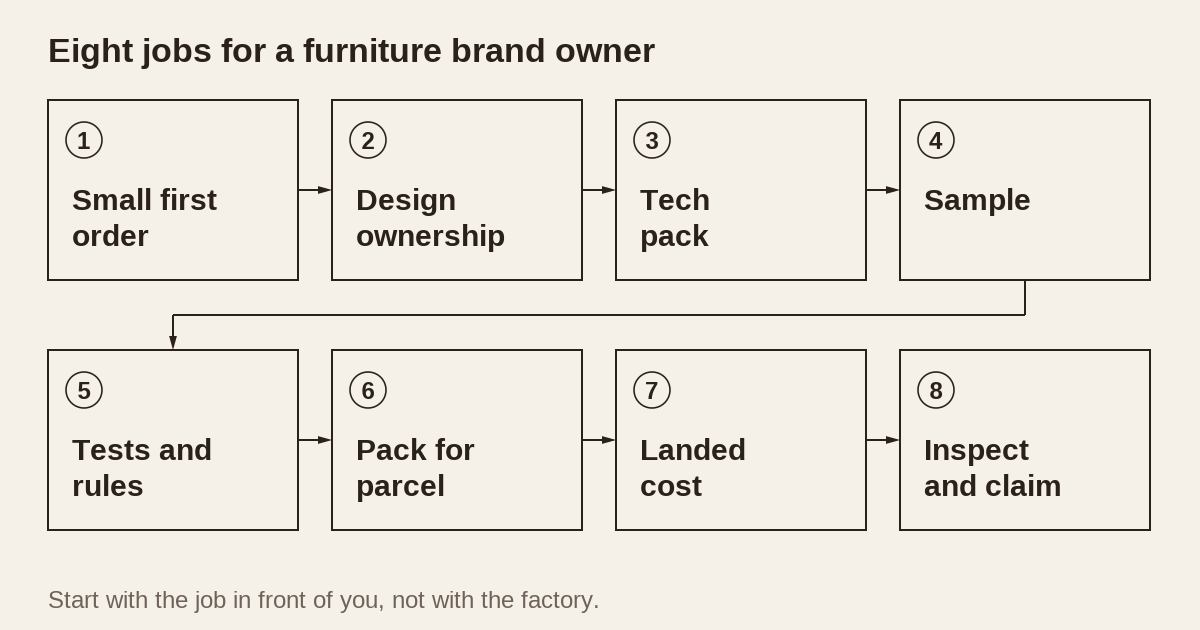
A brand owner who sells furniture online carries four jobs that a wholesale buyer can hand to someone else: designing or choosing the product, importing it in the brand’s own name, packing it for a fulfilment network or a customer’s door and handling the claims. This guide routes you by job. For each one it names the guide that covers it and the facts to send the factory. It builds no case study and promises no result. It follows the order in which most small brands meet the problems, and it sits beside our general step-by-step guide to sourcing furniture from Vietnam.
What is different when you are the brand
Three things change compared with a large retail buyer.
Your quantities are small and your range is narrow. A factory’s setup cost is the same for 50 pieces as for 5,000, so small orders carry a heavy cost per piece. The MOQ guide lists the levers that move a factory, such as fewer variants and the factory’s standard sizes, and the ones that do not.
You are often the importer. If you bring the goods in under your own name, customs and the product safety regulator look to you, not to the factory. The packing data sheet guide explains what customs facts a factory supplies and what stays with you, and cites CBP’s reasonable care guidance. The CPSC page on clothing storage units says that manufacturers and importers must issue the certificate of compliance, so a brand that imports its own dressers holds that paperwork.
Your product is handled many times. An online order travels as a parcel or a fulfilment-centre item, not only as a container pallet. Marketplace and fulfilment requirements differ by platform, category and year. Read the current rules for your category and put the carton limits and any named packing test in the order.
Eight jobs and where to start
| Job | Start with | Send the factory |
|---|---|---|
| 1. Make a small first order work | Furniture MOQ and order economics | One model, one finish, a quantity that fills part of a container, a forecast for the next two orders |
| 2. Decide who owns the design | OEM vs ODM and design ownership, NDA and tooling | The model you are in (OEM, ODM or hybrid), in writing, before the first sample |
| 3. Put the product on paper | Furniture tech pack checklist | Drawings, bill of materials, finish standard, hardware, packing and tests, as one pack |
| 4. Get a sample you can approve | Furniture sample development | The pack, the quantity and target price, a colour reference |
| 5. Know which tests and rules apply | Tests to book before selling to the US or EU and test standards for export | The standard, the edition and the clause for each model |
| 6. Pack for fulfilment and parcel | Packing data sheet, carton specs and drop tests | Carton size and weight measured on the first packed unit, barcodes you supply, the named packing test |
| 7. Price the whole journey | Compare quotes line by line, container loading CBM, payment terms and Incoterms | The same sheet for every factory, the Incoterm named, a loading plan requested |
| 8. Inspect, ship and claim | Quality inspection and loading, in-process QC, damage claims, mould in containers | The inspection standard and who inspects, in the order |
Job 1: a small first order
The shape that works, according to the MOQ guide, is one or two models, one finish each, the factory’s standard panel thickness and a quantity that fills a meaningful part of a container. Trial pricing is a separate conversation: agree the trial price as a trial and the production price separately at a defined quantity. If you are unsure of demand, order one model at a real production quantity rather than four models at trial quantities, so that you get a real price and sellable stock.
Job 2: design ownership
Before the first sample, decide whether you bring the design (OEM), buy the factory’s existing product with changes to finish, size and packaging (ODM) or adapt one of its platforms (hybrid). The hybrid is where ownership gets unclear. An ODM product avoids tooling cost because the setup is shared across its buyers, but the design is not yours. The ownership guide covers the NDA, who owns the jigs and what Vietnamese law says about registration.
Jobs 3 and 4: the pack and the sample
A quote is only as good as the pack. The tech pack checklist walks through four stages: build the pack, send it to every factory, review quotes against it and close the loop before shipment. The sample guide covers what a sample round costs, how long it takes and how to approve it. Approve the production sample only after the test report is back, as the test guide recommends.
Job 5: tests and product rules
Your market decides. For dressers and chests sold in the US, the CPSC clothing storage unit rule (16 CFR part 1261) applies to units that are free-standing, at least 27 inches tall, at least 30 pounds and with at least 3.2 cubic feet of enclosed storage, made after 1 September 2023. It requires a warning label and an anti-tip device packaged with the product. Other products meet other rules. Name the standard, the edition and the clause in the order and keep the report number on the model’s sheet. The CARB and TSCA Title VI guide covers panel-based pieces.
Job 6: packing for the last mile
Carton data causes the most avoidable trouble. Measure the first fully packed carton, weigh it and send those numbers instead of the planned ones. If your channel needs barcodes, you supply the numbers, because a factory should not invent them. If a platform or a customer names a packing test, book it before mass packing starts. The carton guide explains board grades and drop tests.
Job 7: landed cost
Put every quote on one sheet and convert it to cost per piece on the ship. Ask for a loading plan so that the freight per piece is not a guess. Name the Incoterm and the payment structure in the quote, because a FOB price and an EXW price are not comparable.
Job 8: inspection and claims
Set the inspection standard before the first inspection and decide who inspects. Loading supervision catches damage that a report will not. If the goods arrive damaged, sort the cause first: transit damage, packing failure, manufacturing defect or moisture and mould. The claim guide covers the notice clocks and the evidence to keep.
Questions to ask a factory as a small brand
- Which months are quiet, and can you quote for them?
- Which panel thickness, leg section and carton size do you already stock or machine?
- What do you subcontract (finishing, upholstery, packing)?
- Which standard did you build to on the last product like this, and where is the report?
- Who owns the jigs and templates made for my product?
- What is your packing method for parcel shipment, and which drop test have you passed?
The vetting guide explains why the subcontracting question matters, and the shortlist scoring sheet lets you rank factories on the same answers.
Need a quote for this product? Get matched with a Vietnam wood factory
Where this route does not fit
This route does not suit single pieces or a catalogue of many variants at very low quantity. The setup cost is paid once per order, and a factory has little reason to accept one-off pieces for a brand with no forecast. A product the factory already tools for, which is the ODM route, is the nearest fit.
If your product also meets the 2027 duty and import rule changes, see our 2027 rule calendar and the 2027 market data and buyer plan.
Next step
When your pack is ready, send it through the RFQ page. We reply within 24 business hours and match you with up to 3 Vietnamese wood factories that quote you directly.
Sources
This guide routes to our other posts and does not replace the product rules of your market. Confirm each requirement with your importer, customs broker or the regulator.
Frequently asked questions
Can a small online brand order furniture from Vietnam?
Yes, with the right shape of order. Factories pay setup costs once per order, so the price gap between 50 and 500 pieces is much larger than between 500 and 5,000. One model in one finish, in a quantity that fills part of a container, with a written forecast for the next two orders gets more attention than a scattered enquiry.
Who issues the safety certificate for a dresser I sell online in the US?
CPSC says manufacturers and importers must issue a certificate of compliance for clothing storage units, citing 16 CFR part 1261. For a product made in Vietnam that is normally the importer of record, so if you import in your own name the certificate is yours. The factory supplies the test results and production records.
What should I send a factory first?
One specification pack: dimensioned drawings, a material list, the finish standard, hardware, packing requirements and any test standard, plus quantity and target market. Send the identical pack to every factory so the quotes are comparable.
Do marketplace and fulfilment rules belong in the order?
Yes. Marketplace and fulfilment-centre requirements differ by platform, category and year, so read the current rules for your category and write the carton limits, labels and any named packing test into the order before mass packing starts.
Need a quote for this product?
Send the specification. We match you with up to 3 Vietnamese wood factories and reply within 24 business hours.
Get matched with a Vietnam wood factory